

The New York Times on Wednesday reported new details about an alleged Iranian plot to assassinate U.S. President Donald Trump that prompted an elaborate security deception last month, with Trump secretly moved off Air Force One, transported across an airport in a catering truck and flown out of Turkey aboard another aircraft after a NATO summit.
The Times report cited two U.S. officials familiar with the threat, who said American intelligence agencies based their assessment on multiple streams of intelligence about the alleged plot.
Trump switches planes after landing in England
(Video: Reuters)


U.S. officials learned of a specific threat involving a surface-to-air missile targeting the presidential aircraft, according to the report. A person near the NATO summit was also spotted with a shoulder-fired missile, and Iranian operatives were believed to know specifically where Trump was staying in Ankara, including the floor of the building.
The operation to conceal Trump’s location amid fears that Iran could target either the president or his aircraft was first revealed Monday night by The Washington Post.
According to that report, Trump secretly left Turkey for Britain aboard a smaller military aircraft while the plane publicly operating as Air Force One departed without him, effectively serving as a decoy. The president’s actual location was concealed for hours not only from the public and journalists but also from many White House staffers and senior administration officials.
The deception took place July 8 at the conclusion of the NATO summit in Ankara, a day after the United States resumed strikes on Iran at Trump’s direction following the collapse of negotiations aimed at ending the war.
The Post reported that security officials received a credible warning linked to Iran, prompting what was described as a deception operation.
CBS News had reported last month, citing U.S. officials, that intelligence agencies had identified a credible plot to fire a missile at the aircraft carrying Trump and that the Secret Service quickly switched to an alternate plan.
US Ambassador to Israel Mike Huckabee: 'Israel warned of a plot to target Trump'
(Video: FOX NEWS)
The Wall Street Journal subsequently reported that Trump’s departure from Turkey aboard an older Air Force One aircraft rather than the newer Boeing 747-8 received from Qatar was prompted by intelligence supplied by Israel. U.S. Ambassador to Israel Mike Huckabee confirmed that Israel had provided the intelligence.
Trump boards Air Force One — then secretly leaves
The deception began before Trump’s aircraft ever left the ground.
In full view of cameras, Trump arrived at the familiar blue-and-white Boeing 747 that has served for decades as one of the presidential Air Force One aircraft. He climbed the stairs, waved and entered the plane, giving observers no reason to believe he would travel aboard a different aircraft.
Minutes later, however, Trump and several members of his entourage secretly left through a door on the opposite side of the aircraft.
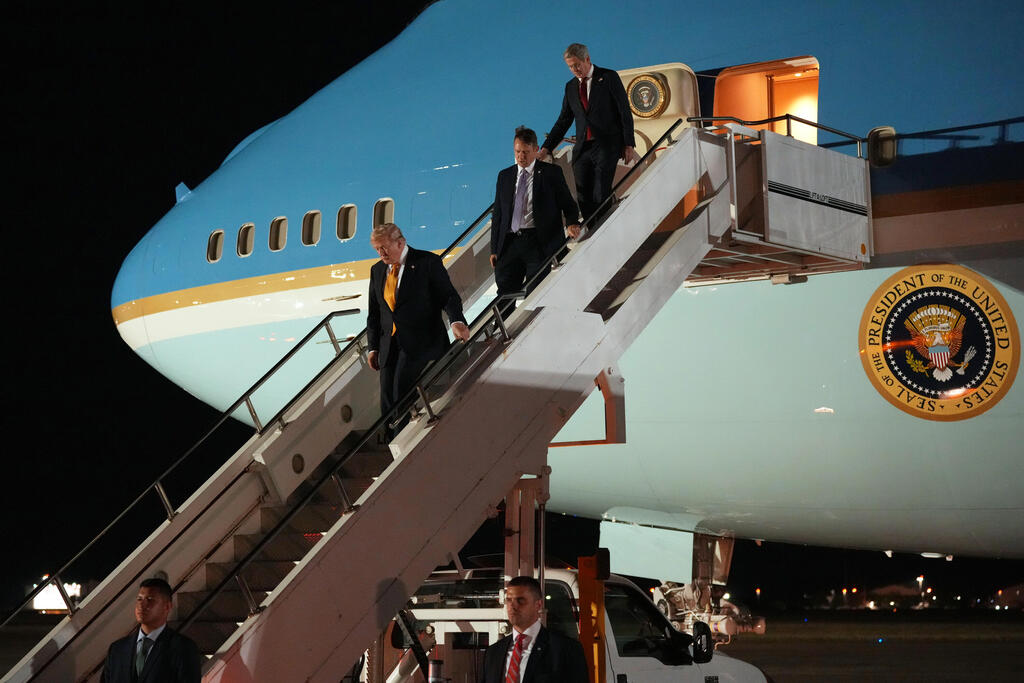
Trump steps off the older Air Force One after landing in Britain. He did not fly there aboard the aircraft
(Photo: AP Photo/Alex Brandon)
Security personnel used an airline catering truck, the type normally positioned alongside aircraft to load food and supplies, to conceal the transfer.
The truck’s cargo compartment was raised hydraulically to the level of the aircraft door. Trump and members of his team entered the compartment, which was then lowered to the ground.
The truck transported them to a nearby C-32A, the military version of a Boeing 757 used to carry senior U.S. government officials.
The Washington Post reconstructed parts of the operation using videos recorded at the airport.
One video showed the catering truck leaving Air Force One and traveling toward the smaller aircraft. At one point, it disappeared from view for about 40 seconds, in part behind the C-32A’s engines. The truck’s compartment was subsequently raised again to the height of the aircraft door.
Defense Secretary Pete Hegseth was also part of the deception.
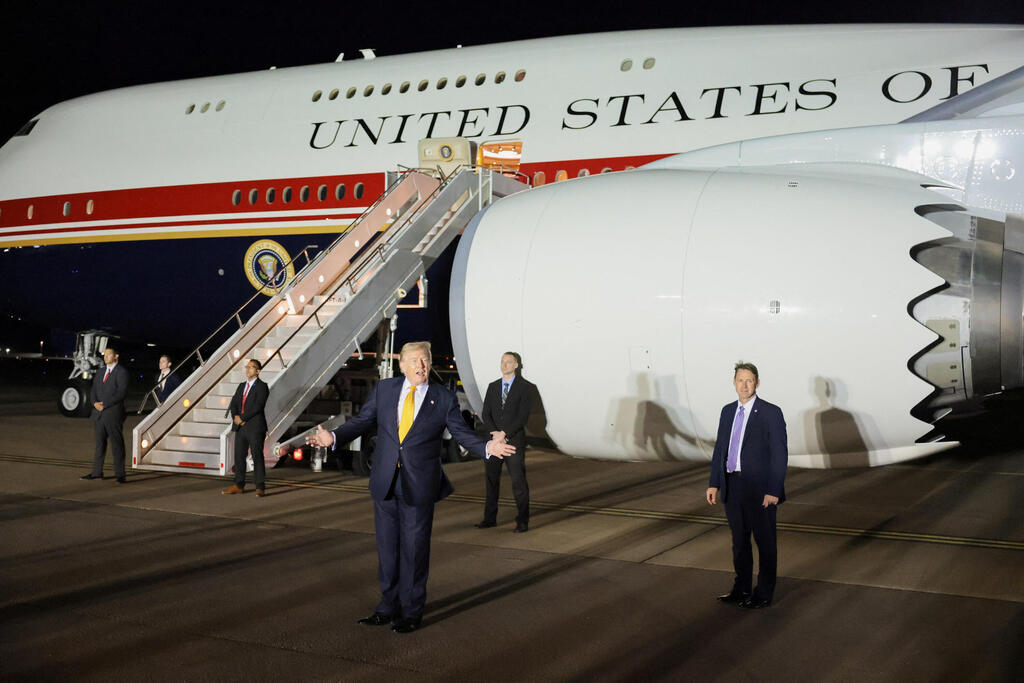
Trump switches planes after landing in England
(Photo: REUTERS/Jonathan Ernst)
Hegseth separately boarded the C-32A in public using exterior stairs, apparently making the aircraft look like an ordinary government flight. According to the Post, Hegseth then traveled aboard the aircraft with Trump to Britain.
Meanwhile, White House journalists and other administration personnel began boarding the older Air Force One aircraft without knowing the president was no longer aboard.
White House officials also instructed journalists to close their window shades before takeoff.
According to the report, some of the people who participated in the deception did not themselves know that they were helping carry out such an operation.
Trump’s aircraft disappears from tracking systems
The effort to conceal Trump’s location continued after takeoff.
“Air Force One” is not the name of a particular aircraft. It is the call sign assigned to any U.S. Air Force aircraft while the president is aboard.
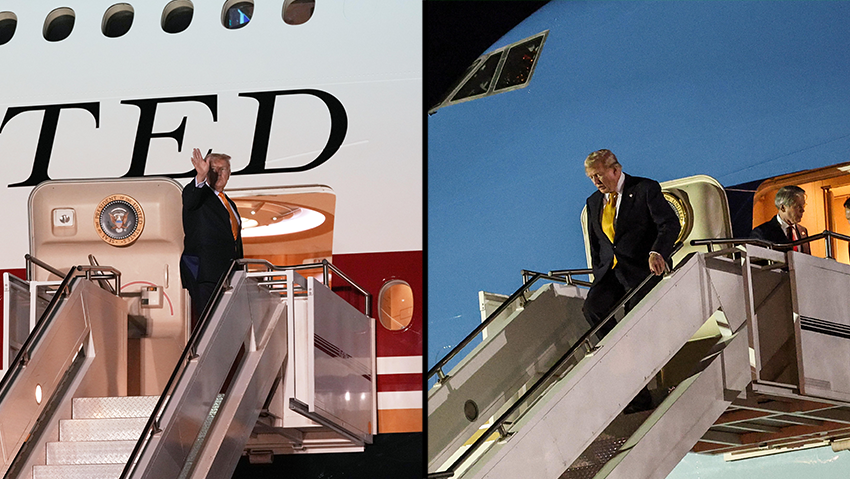
Trump boards the aircraft received from Qatar after landing in Britain, following an unusual security deception
(Photo: Win McNamee/Getty Images, AP Photo/Alex Brandon)
Despite carrying Trump, the C-32A flew to Britain under the routine call sign RCH18, or “Reach 18,” a designation typically associated with military flights transporting personnel and equipment.
Systems that would have allowed the aircraft to be easily tracked were switched off, and no public flight-tracking data showing its route was available.
The older Boeing 747 carrying journalists and White House personnel — but not Trump — appeared on flight-tracking systems under the call sign “AF1.”
Flight data showed the aircraft arriving at Royal Air Force Mildenhall in England at about 10:29 p.m.
A contemporaneous report filed by the White House press pool described the flight as uneventful and noted that nobody had visited the journalists’ cabin — an absence whose significance only became clear later.
Three aircraft were involved in the journey that evening.
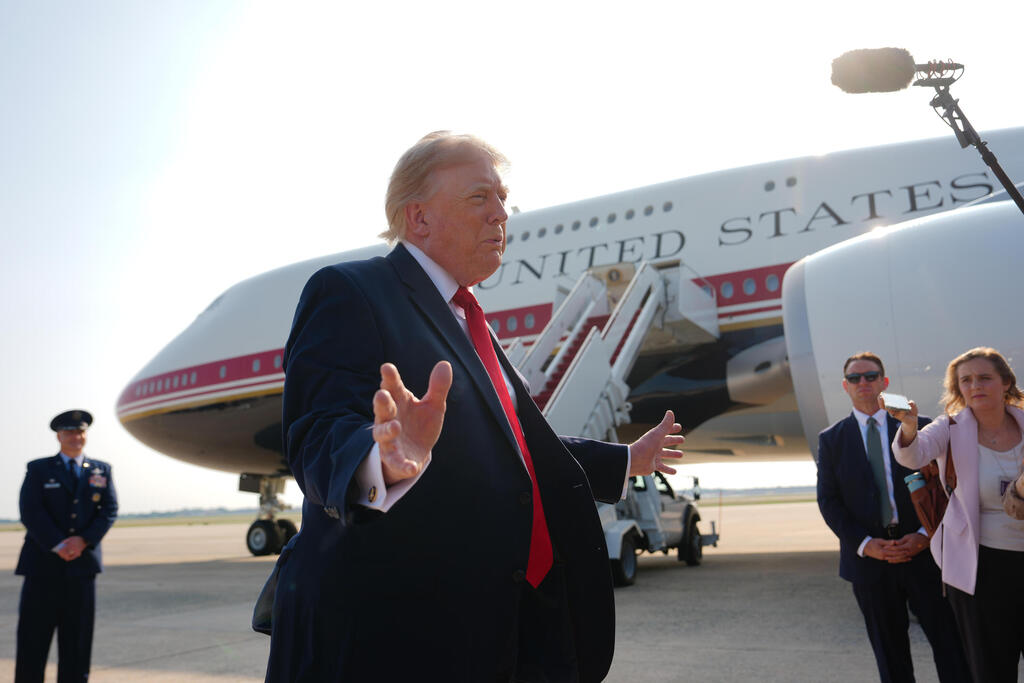
Trump makes his first flight aboard the Qatari-provided Air Force One earlier this month, before traveling on it to Turkey
(Photo: AP Photo/Julia Demaree Nikhinson)
The newer Boeing 747-8 given to the United States by Qatar departed Turkey first and landed at Mildenhall at 6:26 p.m.
The C-32A carrying Trump arrived at about 10:20 p.m., followed several minutes later by the decoy Air Force One.
It remains unclear how Trump transferred from the C-32A to the presidential aircraft after landing. But by 10:56 p.m., he appeared before cameras descending the stairs of the older Boeing 747, again creating the impression that it was the aircraft on which he had traveled from Turkey.
Five minutes later, Trump boarded the newer aircraft received from Qatar and continued to Washington with his staff and the press corps.
The White House issued a statement that night saying Trump had arrived in Britain aboard the older Air Force One, although the Post’s subsequent reporting found that he had actually made the journey aboard the C-32A.
During the flight back to the United States, Trump spoke with journalists for about 15 minutes and discussed the Iranian threat but did not disclose the deception operation that had unfolded only hours earlier.
Asked why reporters had been required to close their window shades in Turkey, Trump said it was probably because the flight was dangerous given America’s enemies. He added that he regularly faced threats and was a major target for Iran.
Concerns over the aircraft received from Qatar
The threat emerged only days after Trump began using the Boeing 747-8 that the United States received as a gift from Qatar.
Washington spent about $400 million adapting the aircraft for presidential use, but reports and photographs have indicated that it lacks some of the missile-detection and countermeasure systems installed on the two older aircraft traditionally used as Air Force One.
According to CBS News, the older presidential aircraft are equipped with laser technology designed to disrupt incoming missiles, along with other defensive countermeasures.
It has not been publicly disclosed which of those systems, if any, have been installed on the Qatari-provided aircraft.
The White House and U.S. Air Force have maintained that the newer plane is safe and suitable for presidential travel.
The White House later announced that Trump would return to using the older presidential aircraft for about a month while the newer plane underwent “additional upgrades and improvements.”
The potential threat was considered particularly serious because of Turkey’s proximity to Iran.
Turkey shares a border with Iran, and Iran possesses missiles and drones capable of traveling the roughly 1,300 kilometers, or about 800 miles, between Iran and parts of Turkey.
Britain, by contrast, is roughly 4,000 kilometers, or about 2,500 miles, from Iran. According to the Center for Strategic and International Studies, Iran does not currently possess a weapons system capable of effectively striking a target in Britain from that distance.
The older presidential aircraft, known as VC-25As, entered service more than three decades ago and were designed from the outset to transport the U.S. president.
Among other protections, they are hardened against some effects of a nuclear explosion, carry missile countermeasures, include onboard medical facilities capable of functioning as an operating room and can be refueled in flight during an emergency.
Two new aircraft intended to permanently replace them have faced repeated delays and, under the current schedule, are not expected to be delivered until 2028.
The disclosures about potential gaps in the Qatari-provided aircraft’s defenses have already caused controversy in Washington.
The Trump administration last month issued subpoenas to New York Times journalists as part of an effort to identify who had provided information about the aircraft’s capabilities.
The administration said the subpoenas were part of an investigation into a breach of national security, while the Times accused the government of attempting to intimidate journalists and their sources.
The administration later withdrew the subpoenas.