


Israel is preparing for a significant increase in aliyah from Western countries, with growing demand particularly from Britain and France, Aliyah and Integration Minister Ofir Sofer said during ynet Global’s Global Aliyah Live Summit.
Sofer said the profile of new immigrants is also changing. While previous waves included large numbers of retirees and young people arriving on their own, the ministry is now seeing more entire families move to Israel together.
Aliyah and Integration Minister Ofir Sofer during the ynet Global’s Global Aliyah Live Summit
(Video: Lior Sharon, Tal Azulay, Tal Saar)


“We see a lot of families that decided to make aliyah,” he said. “We see a lot of families get off the plane with their children.”
That shift, he said, creates a different set of challenges for the government because families are leaving established lives abroad and must rebuild everything from employment and education to housing and community networks after arriving in Israel.
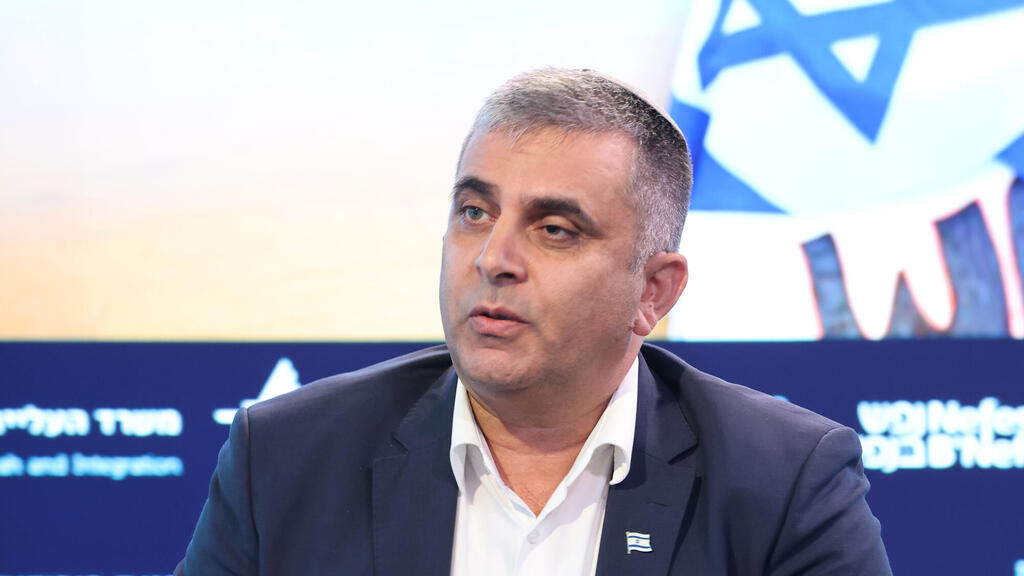
Aliyah and Integration Minister Ofir Sofer
(Photo: Yariv Katz)
Sofer said the increase is particularly noticeable in Western countries.
“We can’t ignore the numbers and the dramatic change from the UK and France, and from all Western countries,” he said. “I believe that this trend will continue and go up.”
The government, he added, is preparing for that possibility.
“I believe that we will see a major wave of aliyah, especially from the Western countries,” he said.
More than a response to antisemitism
The October 7 attack and the subsequent rise in antisemitism around the world have become part of the calculation for Jews considering aliyah. But Sofer argued that fear is not necessarily the primary force behind the increase.
“It’s clear that antisemitism is part of the aliyah decision,” he said. “But I think that the main reason that people decided to make aliyah in the last years is their solidarity, their desire to be part of the building of Israel. They want to be here in their home.”
He recalled meeting a young Jewish woman in Paris only weeks after October 7 who told him she had not grown up in a religious or strongly Zionist household and had not participated in a Jewish youth movement.
“But I saw the pictures of October 7 and decided to make aliyah,” Sofer recalled her telling him.
“This is the whole story,” he said.
The account reflects what Sofer described as a broader shift: for some Jews abroad, the war has strengthened a sense of identification with Israel rather than weakened it.
Bringing doctors — and other professionals — to Israel
One of the government’s priorities is attracting skilled professionals whose qualifications can fill gaps in the Israeli workforce.
Sofer pointed to a dedicated program aimed at encouraging doctors and other medical professionals to make aliyah. He said the model is now being expanded to education in cooperation with the Education Ministry and could eventually be applied to scientists and other professions where Israel faces shortages.
“One of the new projects that I’m proud of is the new unit whose mission is to bring medical professionals, doctors, to Israel,” he said.
The effort is part of a broader attempt to ensure that immigrants can continue working in their professions after arriving, rather than spending months or years navigating licensing and recognition requirements.
Sofer said reforms to professional licensing are among the most important changes his ministry has pursued.
“People can work in their professional fields from the first day that they are here in Israel,” he said, citing accountants, engineers, teachers and other professions.
Security concerns have not stopped aliyah
The effort to encourage immigration comes after years of war and security instability, factors that could make families abroad hesitant to relocate.
Sofer acknowledged that Israel’s security environment is challenging but argued that it has not prevented people from making aliyah.
He recalled meeting immigrants who arrived during periods of active fighting and nevertheless chose to settle near Israel’s borders.
“I remember people who got off the airplane and I asked them, ‘Where are you going?’” he said. “They told me, ‘We are going to the border.’ It was incredible.”
Sofer also said Israel’s strategic position had changed during the war, citing the campaigns against Hamas, Hezbollah and Iran. His assessment of those conflicts was presented as part of his argument that Israel remains a viable place for families to build their future despite the continuing security challenges.
Cutting bureaucracy and accompanying olim from the start
Beyond security, immigrants often face more immediate difficulties: the cost of living, housing, employment, learning Hebrew and navigating government bureaucracy.
Sofer said the ministry has worked to improve Hebrew-language programs, simplify procedures and create a system that accompanies prospective immigrants from the moment they open an aliyah file.
“Our advisers accompany them every step of the way, with community questions, with education questions and others,” he said.
The goal, he said, is not only to persuade Jews abroad to make aliyah but to improve their chances of successfully building a long-term life in Israel once they arrive.
“We understand that aliyah involves a lot of challenges,” Sofer said. “We understand that we must continue and improve the process.”
For Jews still considering whether to make the move, Sofer ended with a direct appeal.
“Israel needs you,” he said. “We appreciate your difficult decision. We appreciate the contribution of aliyah.”
He said new immigrants strengthen Israel’s resilience, solidarity and society — and stressed that the government remains committed to making the process easier.
“Your decision to make aliyah strengthens our resilience, strengthens our solidarity and strengthens our state,” he said. “You’re welcome here in Israel. Come here.”
First published: 14:51, 09.08.26