

The New York City Pride March has been taking place for 57 years and is currently considered one of the largest, and certainly the most colorful, annual events. The march, held on Sunday in the heart of Manhattan, was also one of the happiest, following a festive month in the city that included the New York Knicks winning their first NBA championship title since 1973, as well as the success of progressive representatives in last week's Democratic Party primary elections.
Many of the 75,000 marchers from the local LGBTQ+ community voted for them and took to the streets with pride flags to express their support for the local progressive wing's representatives and the man considered their leader - Mayor Zohran Mamdani.
Pro-Palestinian protesters gather in Union Square waving Palestinian flags
(Amir Bogen)


Mamdani himself marched in the Pride March and received enthusiastic applause from the crowds, alongside his Jewish ally Brad Lander, who won last week's primary as the Democratic nominee for Congress from the 10th District. Contrary to the expectations of their opponents on the right, the two politicians identified as anti-Zionist and their entourage refrained from waving Palestinian flags, focusing instead on the Pride celebrations while waving colorful miniature flags.
Generally, and perhaps surprisingly, the official march down Fifth Avenue to the Stonewall Inn (the legendary gay bar where the 1969 riots broke out in response to a police raid on the site) was not filled with political protests against Israel or in general. Although some marchers wore keffiyehs around their necks and watermelon pins out of solidarity with Palestinians, the vast majority of the marching groups and organizations refrained from waving signs with blatant political content that went beyond expressing support for the values of freedom and liberty for the LGBTQ+ community and everyone else.
However, in the nearby Union Square area, a side event took place separately from the march itself and not as part of its route, though it was inspired by Pride Day. Crowds gathered in the square to protest and demonstrate with signs against capitalism, colonialism, and imperialism, as well as the flag of the Soviet Union (featuring the hammer and sickle symbol associated with the communist movement). Unlike the official march, this gathering of far-left organizations also brought with it a protest against Israel and in favor of Palestine.
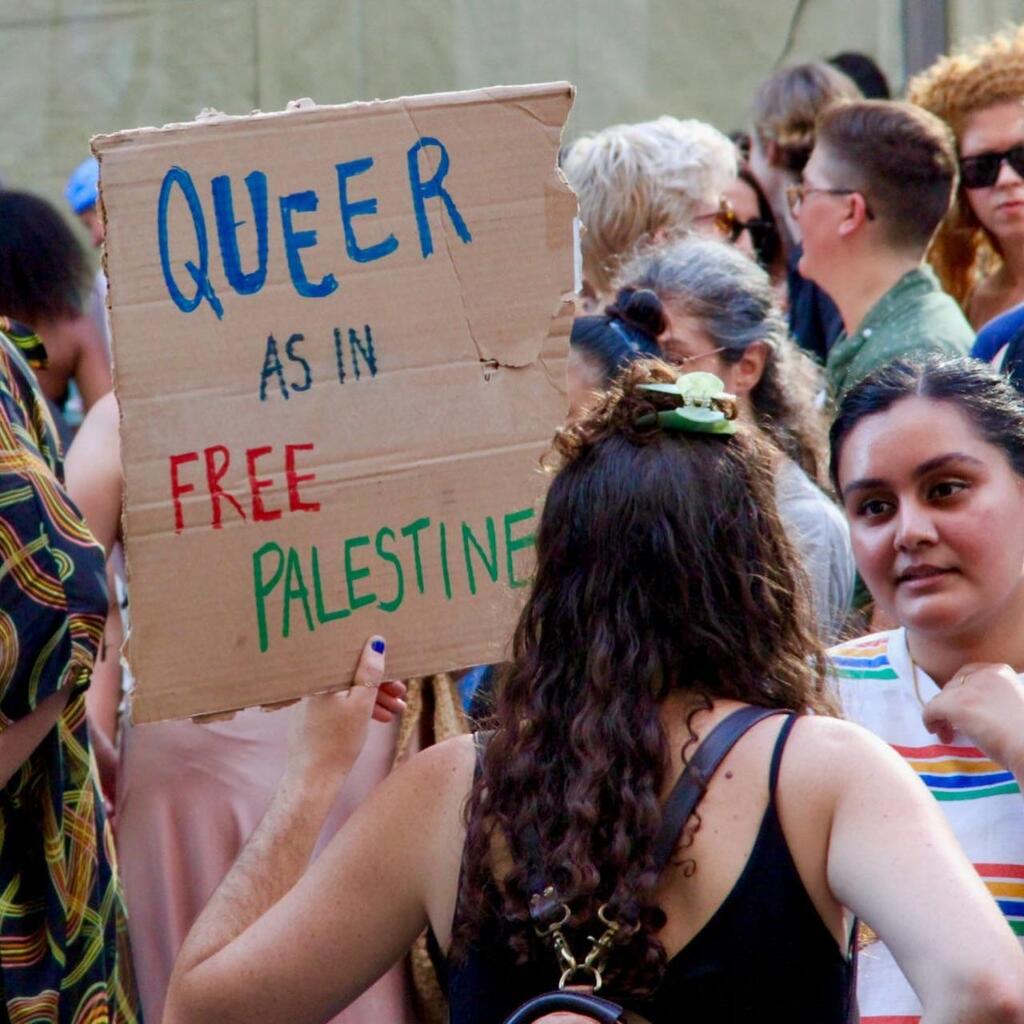
Sign at the Dyke March in New York
(Photo: Nyc Dyke March)
Alongside chants and banners against genocide and in favor of a weapons embargo against the IDF, some attendees waved Palestinian flags. For example, a member of an organization called "Trans for Palestine" was present, as well as a protester carrying a giant Palestinian flag with the Arabic Shahada blessing written on it. Nevertheless, the anti-Israel protest was not as pervasive as might have been expected given the recent progressive momentum in the city and the success of the socialist wing of the Democratic Party, which identifies as anti-Zionist. Among other things, one could even spot pride flags with a Star of David in the crowd. It seemed that, at least today, all the marchers were united in favor of pride and freedom, a desire for celebration and unapologetic hedonism, as well as in their opposition to ICE (the U.S. Immigration and Customs Enforcement agency), which attendees described as America's archenemy.