

Iran’s foreign minister said Friday that Israeli strikes have expanded to include nuclear facilities and key infrastructure, in what he described as a move that contradicts U.S. President Donald Trump’s extended deadline for diplomacy.
In a statement posted on X, Foreign Minister Abbas Araghchi said Israel had struck two of Iran’s largest steel factories, a power plant and “civilian nuclear sites,” among other infrastructure. He added that Israel claimed the attacks were carried out in coordination with the United States.
IDF strikes in western and central Iran
(Video: IDF)


The reported escalation comes despite Washington’s stated effort to allow more time for diplomatic engagement, raising questions about the gap between military developments and ongoing negotiations.
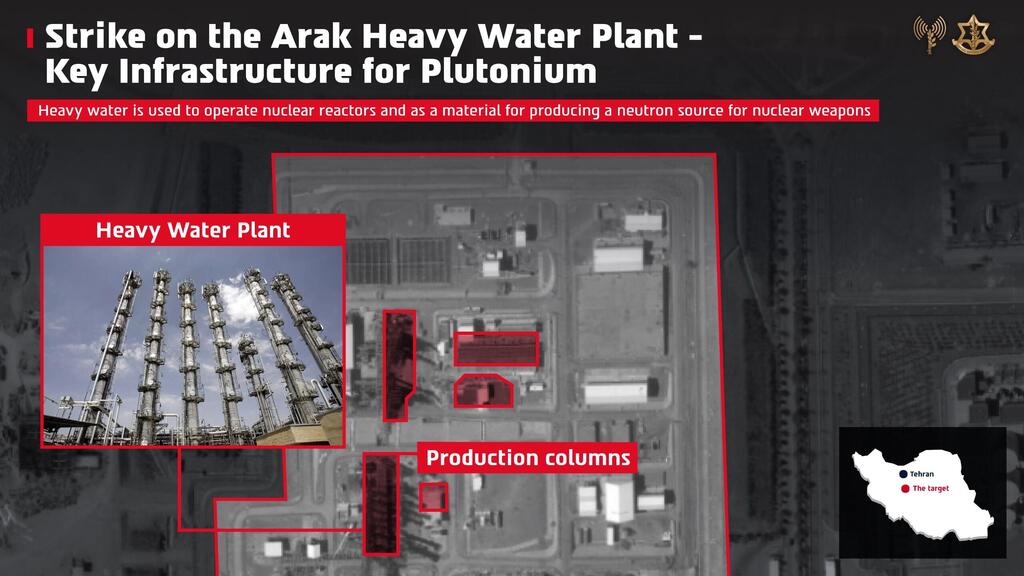
Hours earlier, the IDF confirmed that the Israeli Air Force struck the heavy water reactor at the Arak nuclear facility, known as Khondab, describing it as a key component in Iran’s ability to produce plutonium for nuclear weapons.
According to the military, the strike targeted infrastructure linked to plutonium production after identifying renewed Iranian efforts to restore the site. The attack followed a warning issued to residents in the surrounding area. Iranian media reported no casualties.
Gallery
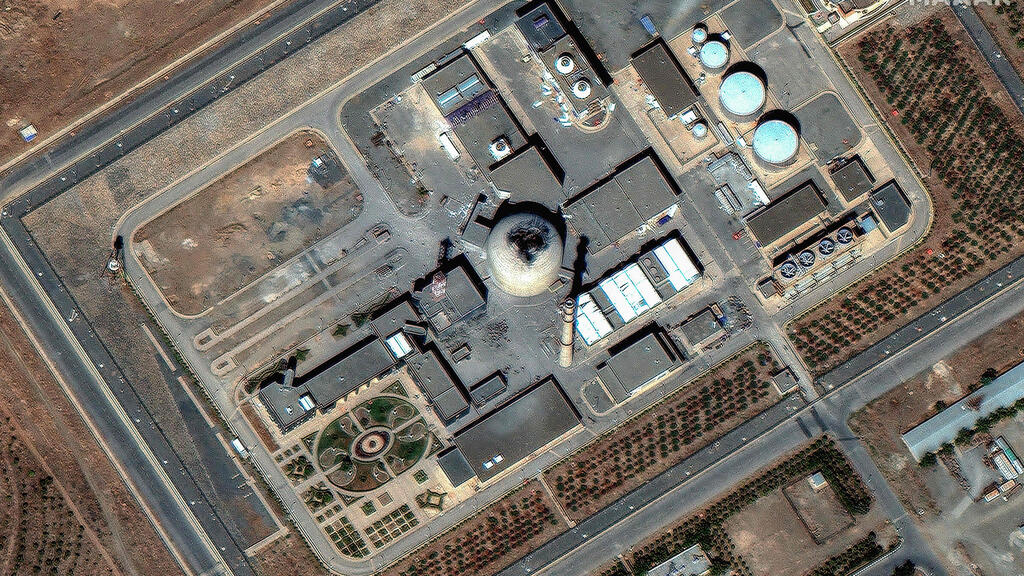
The Arak nuclear facility during an Israeli Air Force strike on June 19 in Operation Rising Lion
(Photo: SATELLITE IMAGE ©2025 MAXAR TECHNOLOGIES / AFP)
The reactor, located about 240 kilometers west of Tehran, has long been a focal point of international concern. Although Iran has maintained it is intended for civilian purposes, its heavy water design allows for relatively efficient plutonium production, a potential pathway to nuclear weapons.
Construction of the reactor began in 2004 but was halted under the 2015 nuclear agreement. Iran later resumed work on the site and had planned to bring it online in 2026.
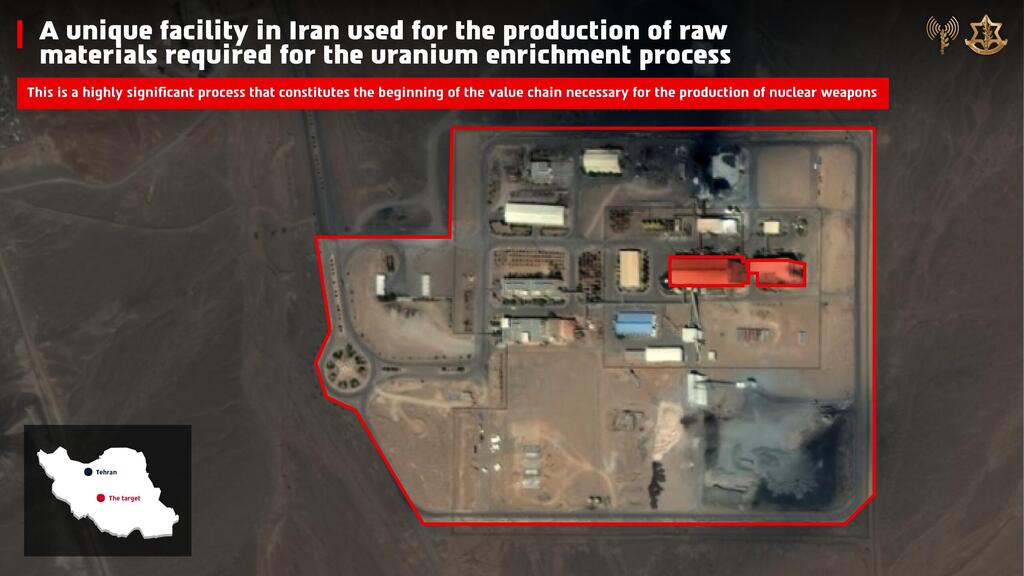
In a separate development, Iranian media reported that a uranium processing facility in the Yazd region was also struck. The site produces uranium concentrate, known as “yellowcake,” a key material in the early stages of nuclear fuel production.
According to the IDF, the facility is unique in Iran and plays a critical role in the nuclear supply chain, converting raw mined material into processed inputs used in enrichment.
Iranian reports said no radioactive material was released following the strike.
The uranium enrichment process involves several stages. First, uranium ore is converted into “yellowcake.” It is then transformed into uranium hexafluoride gas, which is fed into cascades of centrifuges. These centrifuges spin at high speeds to increase the concentration of uranium, which, at higher levels, can be used as fissile material in nuclear weapons.
The strikes on nuclear infrastructure follow earlier Israeli attacks on Iran’s industrial sector. According to Iranian and Israeli officials, the IDF targeted the Mobarakeh Steel Company in Isfahan and the Khuzestan Steel Company in Ahvaz, near the Iraqi border.
Israeli defense officials said the facilities are part of Iran’s military-industrial supply chain and are partially owned by the Islamic Revolutionary Guard Corps.
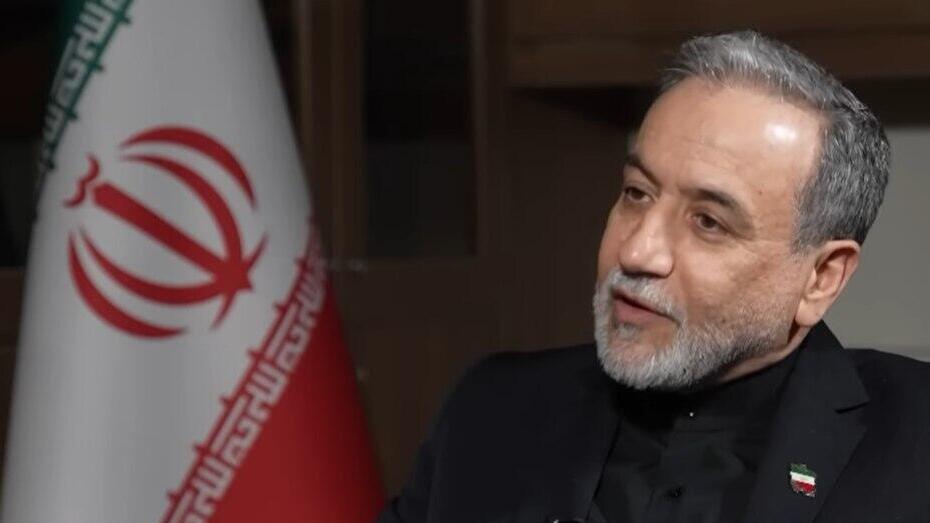
Foreign Minister Abbas Araghchi
The defense establishment has assessed that damage to the steel sector could cost Iran billions of dollars, striking at a key pillar of its economy.
Mobarakeh Steel has been under U.S. sanctions since 2018, with the Treasury Department describing it as the largest steel producer in the Middle East and North Africa. U.S. officials have said it is linked to a financial network supporting the Basij militia, which operates under the IRGC and is involved in internal repression and regional activity.
Khuzestan Steel was previously targeted in a 2022 cyberattack attributed to a group calling itself “Predatory Sparrow,” believed to be pro-Israel. Iran said at the time it had contained the attack but acknowledged that production was temporarily halted.
Defense Minister Israel Katz said earlier Friday that Israeli operations would “intensify and expand to additional targets and sectors that support the regime in building and operating weapons used against Israeli civilians.”
“We warned the Iranian terrorist regime to stop firing missiles at Israel’s civilian population,” Katz said. “Despite the warnings, the fire has continued. They will pay increasingly heavy prices for this war crime.”
The latest wave of strikes highlights a broadening Israeli campaign targeting nuclear, military and economic infrastructure, even as diplomatic efforts remain formally in play.