

At least three tankers were damaged off the Gulf coast after U.S. and Israeli strikes on Iran triggered retaliation that put commercial shipping at risk, maritime sources and officials said Sunday, as Tehran said it had halted navigation through the Strait of Hormuz.
Shipping risks surged over the past 24 hours, with more than 200 vessels, including oil and liquefied natural gas tankers, dropping anchor around the Strait of Hormuz and nearby waters, according to shipping data.
A tanker that Iran claims it struck while attempting to cross the Strait of Hormuz


Iran said it had closed navigation through the strategic waterway, which carries about 20% of global oil supply, including exports from Saudi Arabia, the United Arab Emirates, Iraq, Kuwait and Iran, as well as large volumes of liquefied natural gas from Qatar.
A Palau-flagged oil tanker under US sanctions was hit Sunday off Oman’s Musandam peninsula, injuring four people, Oman’s maritime security center said, without specifying the cause.
The Marshall Islands-flagged crude tanker MKD VYOM was struck by a projectile about 44 nautical miles northwest of Muscat while sailing with cargo, two maritime security sources said. Britain’s UK Maritime Trade Operations agency said a laden merchant vessel reported an explosion in the same area.
A separate tanker at the UAE port of Jebel Ali was nearly damaged by falling debris from an aerial interception during overnight Iranian attacks targeting Gulf states, maritime security sources said. A third oil-bunkering tanker was also damaged off the UAE coast, two shipping sources said.
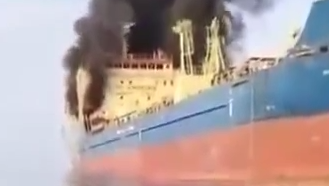
A tanker that Iran claims it struck
The US Maritime Administration advised vessels to avoid the Strait of Hormuz and the wider Gulf of Oman because of the risk of further retaliatory strikes. It said US-flagged, owned or crewed vessels should maintain a 30-nautical-mile distance from US military ships to reduce the risk of misidentification.
Security sources also warned of a potential threat from naval mines in the narrow shipping lanes. Two US officials told Reuters in July that Iranian forces had loaded naval mines onto vessels in the Gulf in June, raising concerns in Washington that Tehran was preparing to blockade the strait.
War risk insurance rates are expected to surge when underwriters review coverage Monday, maritime sources said. The Lloyd’s of London market already lists Iran, the Gulf and parts of the Gulf of Oman as high-risk areas. Dylan Mortimer of insurance broker Marsh estimated near-term marine hull insurance rate increases in the Gulf could range from 25% to 50%.
Separately, Russia’s Foreign Ministry warned Sunday that any closure of the Strait of Hormuz could cause major disruptions in global oil and gas markets. Trading sources said several tanker owners, oil majors and trading houses have suspended crude, fuel and LNG shipments through the strait following the US and Israeli strikes and Iran’s response.
The Russian Foreign Ministry also condemned what it described as the killing of Iran’s Supreme Leader Ayatollah Ali Khamenei, members of his family and senior officials, calling it a violation of international law and an attack on the principles of sovereign state relations.
“The Russian Federation resolutely and consistently condemns the practice of political assassinations and the hunting of leaders of sovereign states,” the ministry said.
With allies in Syria and Venezuela ousted in recent years, the potential fallout in Iran poses a strategic challenge for Moscow, although the Kremlin has shown limited appetite for confronting US President Donald Trump directly over Iran.