


The IDF had not planned to disclose its operation on the Ali Taher Ridge in order not to endanger the troops. But a Reuters report saying Iran had threatened to “respond forcefully” to Israeli activity in the area led the military to change its decision. According to security officials, no Iranian advisers or members of the Quds Force were present at the site during the IDF’s weeks-long operation on the ridge.
Special forces from the Yahalom unit were responsible for clearing the Ali Taher Ridge in Lebanon. The troops trapped Hezbollah terrorists inside the compound, identified openings through which they could escape and monitored them, preventing any attempt by the terrorist organization to assist its men from outside. Initially, Hezbollah tried to transfer equipment to them, but as time passed, the effort became increasingly difficult. Security officials said this created pressure within Hezbollah.
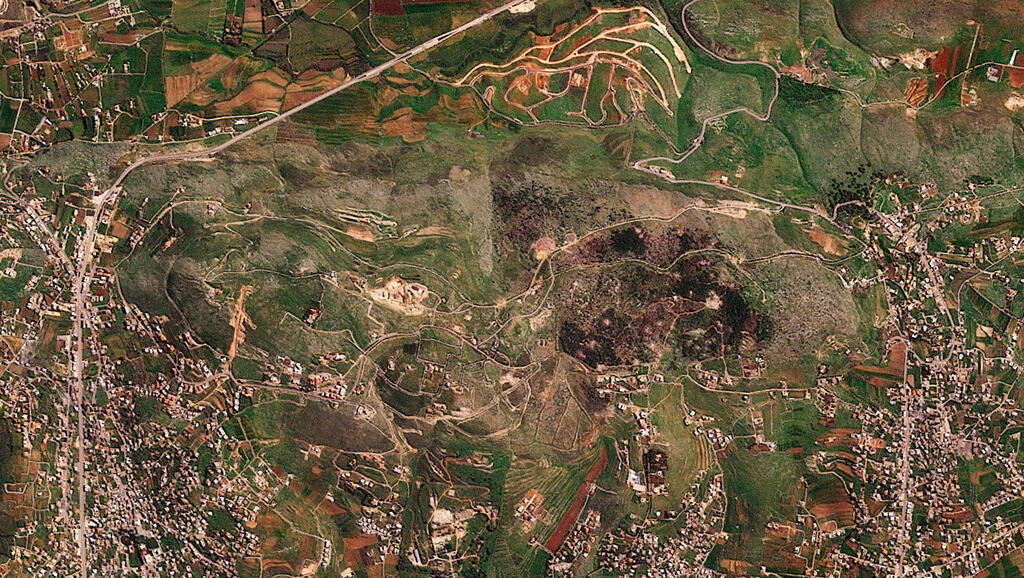
The Ali Taher Ridge in southern Lebanon, seen in satellite images from March. Damage from IDF strikes was already visible at the time
(Photo: Planet Labs PBC/Handout via REUTERS)
During the operation, the forces surrounding the openings engaged in firefights with Hezbollah terrorists attempting to escape and killed dozens of them. The IDF established operational control through offensive operations including ambushes, strikes on shafts using gunfire, grenades, drones and other firepower.
They tried to send food and water by drones
The New York Times also reported that Iran was attempting to present a different picture of what was happening on the ridge. An Iranian official and a member of the Islamic Revolutionary Guard Corps were quoted as saying that capturing the ridge would constitute “crossing a red line” and that Hezbollah had stored critical weapons in the area. Their comments were published in the same article reporting that the IDF had declared the ridge cleared of terrorists.
The Iranian source repeated the claim that Iranian advisers were present at the site along with 70 to 100 Hezbollah terrorists. The source added that the terrorist organization had tried for days to send food and water to the trapped forces by drones, but Israel killed everyone who attempted to reach the supplies.
According to the IRGC member, the compound had three escape routes, two of which were already under IDF control, while the last was on the verge of collapsing. He said Iran and Hezbollah’s priority was to evacuate and save the weapons that had been stored at the site, but that the chances of doing so appeared to be diminishing. It should be noted that despite the reports, Tehran has not officially commented on the developments on the ridge reported by the IDF on Thursday.
Defense Minister Israel Katz, who said Thursday that Iran “likes to attack on Jewish holidays,” issued a statement Friday morning saying that the capture of the Ali Taher Ridge marked the completion of the phase of establishing Israel’s hold on the security zone in southern Lebanon.
“The Ali Taher tunnels served as a command center for attacks against our forces and the Galilee region, while also serving as the last stronghold defending the Nabatieh area — which is extremely important to Hezbollah — and that is why they have strategic importance.
“Now the IDF will complete the neutralization of the tunnels and make the appropriate tactical preparations to hold the ridge and prevent the enemy from re-establishing itself in the area,” Katz said. He added that Israel would not withdraw from the security zone in Lebanon until Hezbollah was disarmed and the threat to residents of the Galilee was removed.
'The clearing is complete'
The IDF announced Thursday that it had completed clearing the underground infrastructure on the Ali Taher Ridge in Lebanon and said it was “working to neutralize it.” Forces from the 36th Division had recently operated to clear two underground routes in the area. The IDF said they had achieved operational control both above and below ground and cleared the area of terrorists. According to the IDF, some of the terrorists were killed while others fled.
“The operation to neutralize the underground infrastructure that was cleared of terrorists is continuing and, once it is complete, the IDF will make renewed defensive preparations,” the military said.
According to the IDF, the underground complex contained command centers, weapons rooms, generator rooms, living quarters, showers and a kitchen, “which enabled the terrorists to conduct fighting and remain there for extended periods. This was a strategic infrastructure project built over two decades, funded and planned by the Iranian terror regime.”
The IDF said that during Operations Northern Arrows and Lion’s Roar, Hezbollah terrorists made continuous use of the ridge. The forces advanced into the area after weakening Hezbollah throughout the war, particularly during those operations.
The military added: “IDF forces continue to operate to clear the security zone in southern Lebanon and will not allow the Hezbollah terrorist organization to advance terrorist operations against them. Any attempt by the Hezbollah terrorist organization to act against IDF forces will be met with force. The IDF remains committed to the ceasefire agreement in Lebanon.”