

For many Jews considering aliyah, Jerusalem has an obvious emotional pull. But for Pini Glinkewitz, director of the Jerusalem Municipality’s Aliyah and Absorption Authority, turning that connection into a decision to actually live in the city requires something more concrete: schools, jobs, communities and support that begins before immigrants even arrive.
“Why not Jerusalem?” Glinkewitz said during ynet Global’s Aliyah Live Summit. “Every Jew around the world always dreams of reaching Jerusalem. Every year we say, ‘Next year in Jerusalem.’”
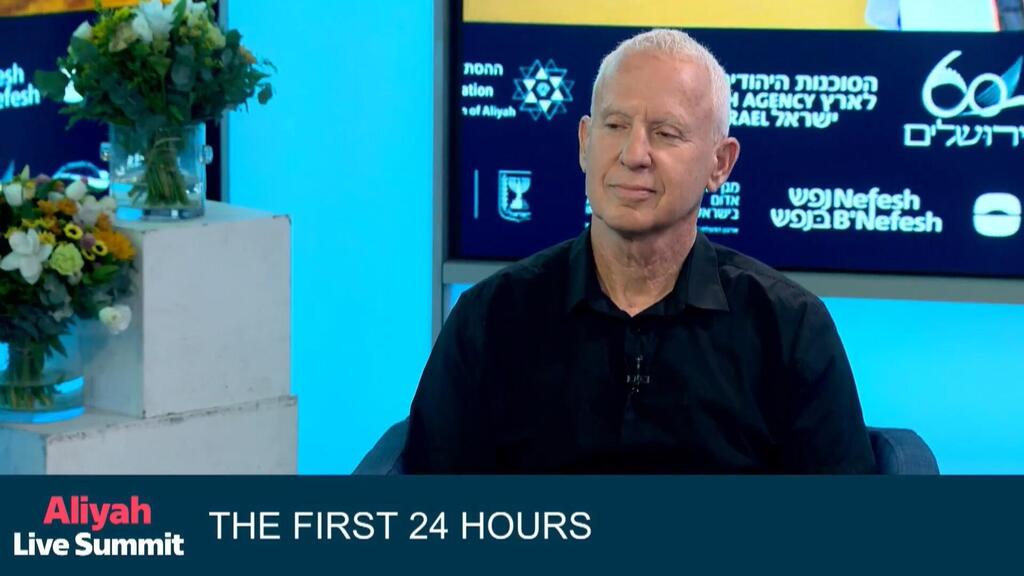
Jerusalem’s Aliyah and Absorption Authority chief Pini Glinkewitz
But the municipality, he said, is not relying on symbolism alone.
Jerusalem considers aliyah and immigrant integration a strategic priority and actively promotes the city abroad as a growing center for employment, education and community life.
“We try to market what is being done in Jerusalem, to market Jerusalem as a developing, building city with a great deal of potential,” he said.
More olim arriving from the West
Glinkewitz said immigration to Jerusalem has continued through different periods and waves, but the profile of those arriving has shifted.
In recent years, the city has seen stronger aliyah from Western countries, including the United States, Canada, Britain, Australia and France.
ynet Global’s Global Aliyah Live Summit


At the same time, he said, fewer immigrants from Russian-speaking countries are choosing Jerusalem than in some previous periods.
One of the clearest trends is the arrival of young families.
“We see this trend of young families — a lot of them,” he said, adding that many new arrivals bring children who then enter Jerusalem’s school system.
That is changing the kinds of questions prospective immigrants ask before making the move.
Education is often among the first concerns.
Jerusalem has more than 800 schools, Glinkewitz said, allowing families to choose between a wide range of educational approaches, religious affiliations and curricula.
“When a family wants to make aliyah and register a child for school, there is an enormous variety,” he said.
Employment is another major factor.
Glinkewitz said Jerusalem’s expanding business districts and technology sector are helping attract highly educated immigrants. About 60% of olim arriving in the city are academics, he said.
“We see strong populations choosing and coming to Jerusalem,” he said.
Support begins before the flight
While the Israeli government, the Aliyah and Integration Ministry, the Jewish Agency and other organizations provide national-level assistance, Glinkewitz said the municipality becomes crucial once an immigrant has chosen where to live.
“Eventually, that aliyah candidate we met in Paris or New York arrives and becomes a Jerusalem resident,” he said.
That means helping families register children for schools and kindergartens, understand which neighborhood may suit them and find communities where they can feel at home.
For many olim, he said, community is particularly important.
“They want to arrive in a community — a community that speaks to them, that absorbs them, people who come from where they came from,” Glinkewitz said.
Municipal assistance can extend to accompanying immigrants through encounters with banks, government offices and other institutions.
Jerusalem has also tried to make municipal services accessible across languages and cultures, with designated staff responsible for immigrants in areas including education and employment.
But the relationship often starts abroad.
The city takes part in aliyah fairs and meetings in cities such as New York and Paris and uses social media and other digital platforms to reach prospective immigrants before they make a final decision.
By the time they arrive, Glinkewitz said, some already know the municipal official or project coordinator who will continue accompanying them.
‘The oleh is never alone’
Once in Jerusalem, immigrants can receive assistance at the neighborhood level.
Glinkewitz said absorption coordinators operate in community centers across the city, giving olim a local point of contact for everyday problems.
“The oleh is not alone in any situation,” he said.
Sometimes the questions are major — where to live, where to work or where children should study. Other times they are highly practical.
If a child becomes sick, for example, municipal staff may not provide medical care themselves, but they can explain where a family should turn and help them navigate an unfamiliar system.
The municipality also operates neighborhood WhatsApp groups and other digital channels designed to keep immigrants connected to local services.
“You can pick up the phone, send a WhatsApp or contact the project coordinator who has been accompanying you since the fair in New York or Paris,” he said.
Integration does not end after the first year
For Glinkewitz, successful absorption cannot be measured only by whether someone arrives and completes the initial bureaucratic process.
Integration can take years, and difficulties do not always emerge immediately.
“There are quite a few crises that come up in the second year, in the seventh year — and that’s where we are,” he said.
The municipality generally accompanies olim for up to 10 years, in line with the eligibility framework used for many new immigrants, while some groups receive support for longer periods.
But Glinkewitz stressed that formal definitions tell only part of the story.
Some immigrants feel integrated within months, he said, while others may still feel disconnected decades after arriving.
“It’s a process — really a process,” he said.
‘We choose you and we want you’
Asked how he would persuade someone considering aliyah to choose Jerusalem over another Israeli city, Glinkewitz emphasized personal support.
“In Jerusalem, we absorb you personally,” he said. “We are with you throughout the entire journey. We take care of you in education, community and employment.”
His message to prospective immigrants, he said, is that the city does not view them as simply another wave of newcomers.
“We choose you and we want you,” he said. “Jerusalem is waiting for you.”
For Glinkewitz, the strongest evidence that the model works is not how many immigrants initially arrive, but how many remain.
More than 76% of olim who move to Jerusalem are still living in the city two years later, he said.
“For us,” Glinkewitz said, “that is the proof.”
First published: 15:26, 09.08.26