

A United Nations-backed hunger monitoring body said Friday that the ceasefire in Gaza has led to a notable improvement in hunger and malnutrition compared with previous assessments, but warned that the entire territory remains in a severe nutritional emergency — findings Israel strongly rejected.
In a new report, the Integrated Food Security Phase Classification, or IPC, said no area of Gaza is currently classified at the highest level of famine. However, all parts of the territory are still rated at Phase 4 out of 5, defined as a nutritional emergency, with millions of residents facing acute food insecurity.
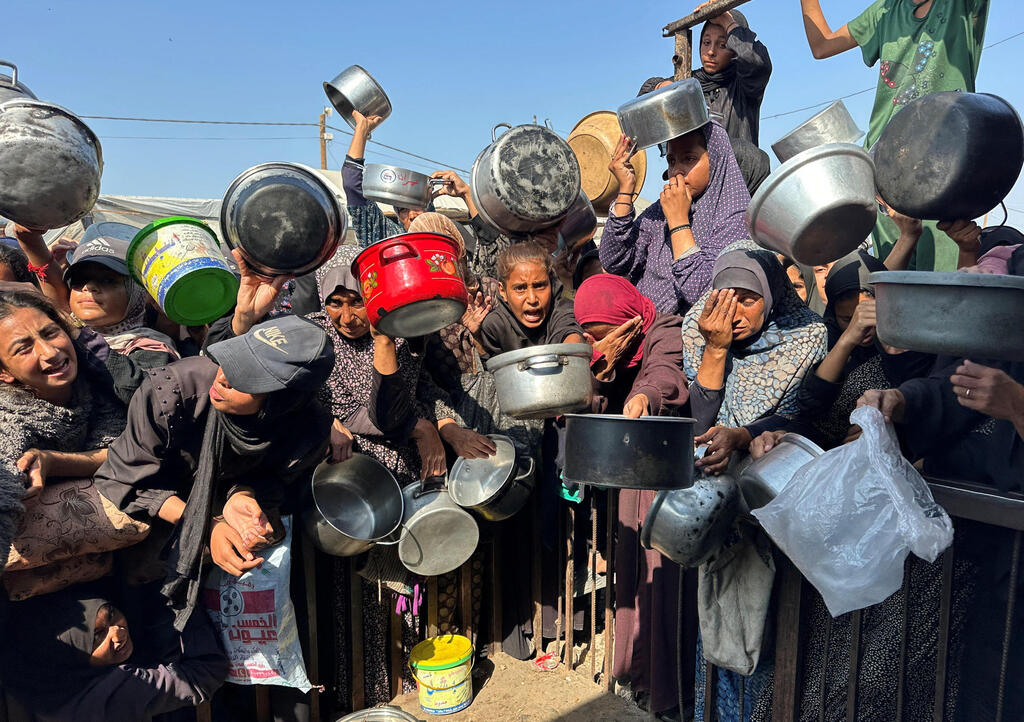
(Photo: REUTERS/Haseeb Alwazeer )
The IPC said about 1.6 million people in Gaza are experiencing high levels of acute food insecurity. Rafah was not assessed due to a lack of data and large-scale evacuation, while northern Gaza was only partially analyzed. The report cited limited access to aid, mass displacement and violations of the ceasefire as key drivers of the crisis.
The organization said the recent gains remain fragile and dependent on sustained calm. It warned that acute malnutrition is still at a critical level in Gaza City and at a serious level in Deir al-Balah and Khan Younis. Over the coming year, the IPC estimates that around 101,000 children could suffer from acute malnutrition.
The IDF agency responsible for coordinating civilian aid to Gaza, known as COGAT, rejected the report’s conclusions, saying it presents a distorted and biased picture that ignores the scale of food deliveries during the ceasefire.
“Between 600 and 800 trucks enter Gaza every day, about 70% of them carrying food,” COGAT said in a statement, adding that nearly 30,000 food trucks have entered Gaza since the ceasefire began.
COGAT also criticized the IPC’s methodology, saying the report’s authors met with Israeli officials only after the report was written and its conclusions finalized. Despite being presented with daily, verified data on aid deliveries, Israel said, the IPC relied only partially on the information provided.
The Foreign Ministry said the report itself shows there is no famine in Gaza, but accused the IPC of deliberately ignoring most aid deliveries by focusing mainly on United Nations truck data, which Israel says represents only a fraction of total assistance entering the territory.
The IPC acknowledged that the absence of famine does not mean conditions are stable, describing the situation as an ongoing emergency that could rapidly deteriorate if access worsens or fighting resumes.
Israel controls access to Gaza and says it allows large quantities of humanitarian aid to enter while fighting Hamas terrorists, whom it accuses of exploiting civilian infrastructure. Hamas denies the accusation.