

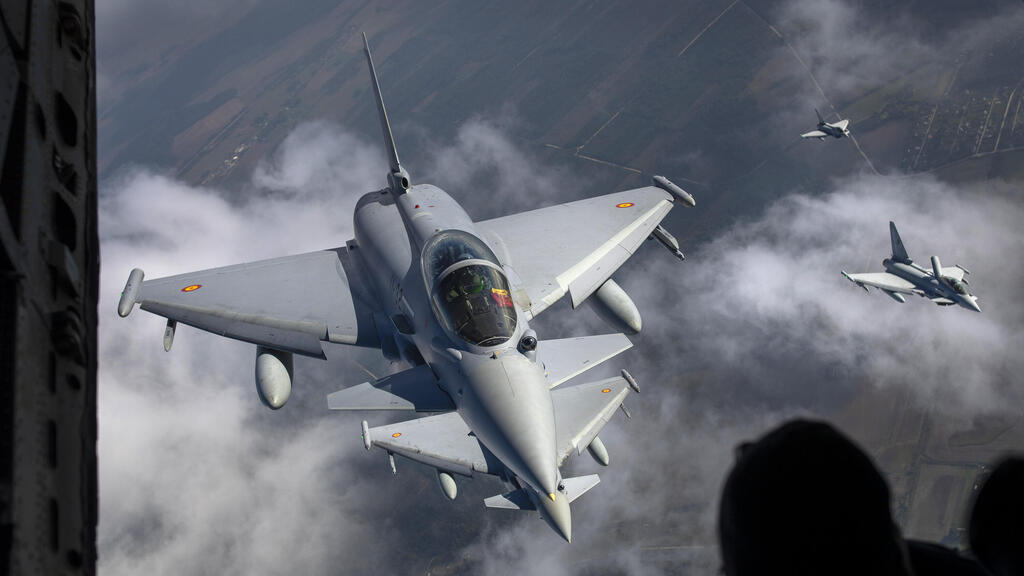
Turkey on Wednesday took a major step toward fulfilling President Recep Tayyip Erdoğan’s vision of building a powerful air force to strengthen the country’s regional influence, as it reached agreements with the United Kingdom and Germany to purchase 40 Eurofighter Typhoon jets.
The fourth-and-a-half generation fighter jets—comparable to the U.S.-made F-16s—are produced by a European consortium comprising the UK, Germany, Italy, and Spain. Turkey has been pushing for the deal since 2023 but faced resistance from the German government, largely due to Erdoğan’s aggressive foreign policy, not only toward Israel but also Greece and Cyprus.
Gallery
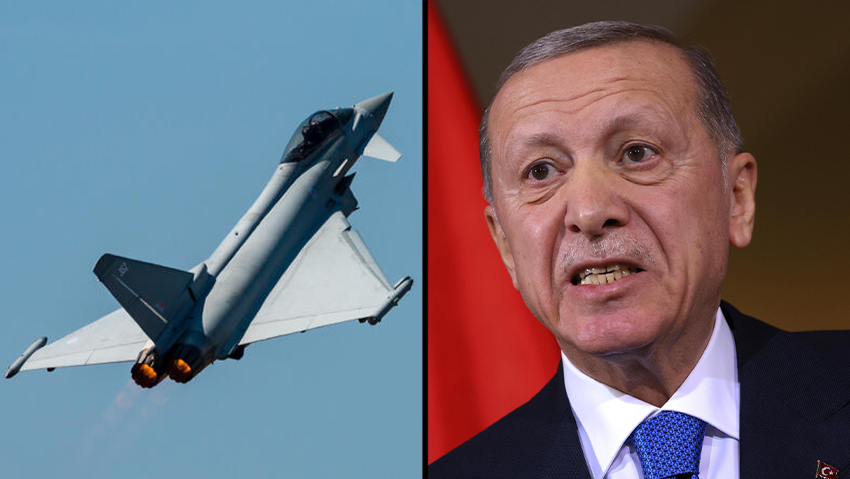
Eurofighter Typhoon jets, President Recep Tayyip Erdoğan
(Photo: Richard Whitcombe / Shutterstock, Sean Gallup/Getty Images)
In recent weeks, Ankara renewed its efforts to finalize the estimated $5.6 billion deal, partly in response to the 12-day war between Israel and Iran last month, during which Israel demonstrated the strategic importance of air superiority by striking thousands of targets nearly 2,000 kilometers away.
According to Turkish officials, Ankara has now accepted the conditions set by Germany, which paved the way for the German Federal Security Council—the body responsible for approving all German arms exports—to greenlight the sale. One key German demand was that the aircraft be used “within NATO’s general guidelines,” a diplomatic way of securing Turkey’s commitment not to deploy the jets against fellow NATO member Greece.
Greece and Turkey, both NATO members, have long been locked in disputes over maritime borders, gas drilling rights in the Eastern Mediterranean, and the divided island of Cyprus. Any military edge gained by one side risks triggering an arms race between Ankara and Athens.
(Photo: AP Photo/Mindaugas Kulbis, File)
The deal also reflects the EU’s broader interest in strengthening military cooperation with Turkey to ensure NATO's readiness amid concerns over potential future Russian aggression in Europe.
Simultaneously with the German approval, a ceremonial signing of the preliminary agreement took place on Wednesday in Istanbul between the defense ministers of Turkey and the United Kingdom. “We welcome this positive step toward joining the Eurofighter Typhoon club,” said Turkish Defense Minister Yaşar Güler, adding that the acquisition will not only bolster Turkey’s air capabilities but also benefit NATO as a whole.
Turkish officials noted that further negotiations are needed to finalize the purchase price. For the UK, the deal holds significant economic value: the jets are manufactured in Britain, and Prime Minister Keir Starmer has highlighted that the agreement would protect around 20,000 jobs. London reportedly exerted pressure to push the deal through.
Despite the economic and strategic gains for Europe, the deal has raised concerns in Israel. Opposition leader Yair Lapid issued a harsh statement criticizing the Israeli government for failing to prevent the deal. “If Israel had a functioning Foreign Ministry or a normal government, it would have already blocked the deal to sell Eurofighter Typhoons to Turkey,” Lapid said. “Turkey already has the largest and most powerful navy in the Middle East, and now it’s aiming for air parity with Israel. This is dangerous, and our dysfunctional government has done nothing about it.”
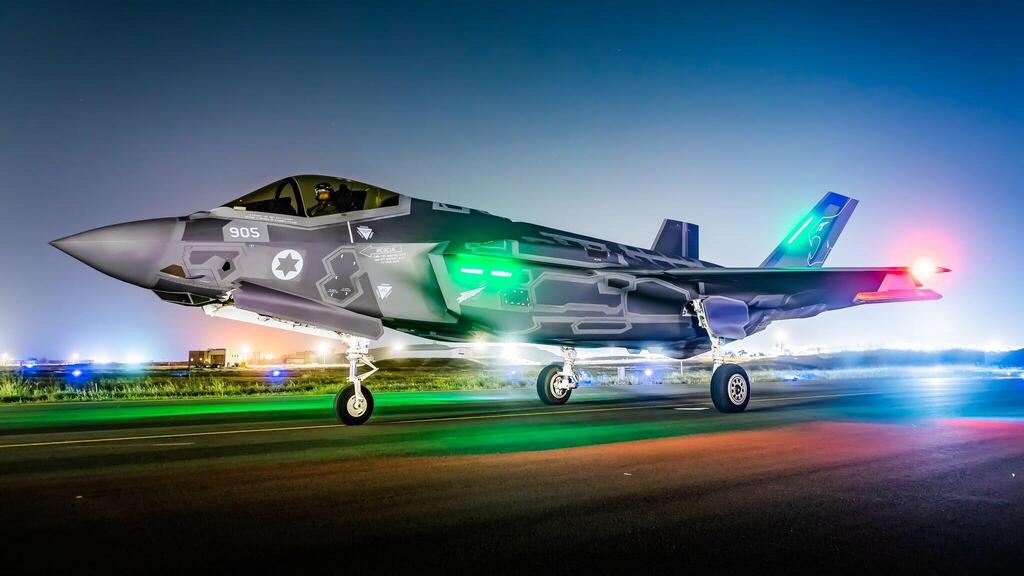
Israeli F-35 jet
(Photo: IDF)
Erdoğan, who seeks to restore Turkey’s status as a dominant regional power reminiscent of its Ottoman past, is also pursuing a multi-pronged effort to enhance its air force. Alongside the European deal, Turkey is developing its own fifth-generation fighter jet, the KAAN, and is in talks with the United States to acquire 40 F-35 stealth jets.
Turkey was removed from the F-35 program in 2019 after it purchased Russian-made S-400 air defense systems, violating NATO protocols. However, Erdoğan hopes U.S. President Donald Trump—who praised the Turkish leader repeatedly—will overturn the decision. U.S. Ambassador to Turkey and special envoy to Syria and Lebanon, Thomas Barrett, recently suggested a resolution to the F-35 dispute may come by year-end, despite prior Israeli objections to such a sale.
Get the Ynetnews app on your smartphone: Google Play: https://bit.ly/4eJ37pE | Apple App Store: https://bit.ly/3ZL7iNv
A recent Forbes report noted that Turkey’s military buildup is partially driven by a desire to avoid Iran’s fate, whose aging air force has become largely obsolete due to years of international sanctions that blocked access to new jets and spare parts. "In the wake of the 12-day war," Forbes wrote, "Turkey is actively working to ensure it is equipped for exactly this kind of modern warfare."
In parallel to these air power efforts, Erdoğan last month also vowed to enhance Turkey’s ballistic missile capabilities, both medium and long range, to build a deterrent force. He previously promised to develop a layered air defense system, which he dubbed the “Steel Dome,” modeled after Israel’s Iron Dome system: “If Israel has the Iron Dome, we will have the Steel Dome. We won’t sit idly by and ask, ‘Why don’t we have that?’”