


The Jewish People Policy Institute (JPPI) has launched a new database mapping sanctions and restrictive measures imposed on Israel by countries around the world. The database identifies 121 measures across 62 countries, including 93 currently in effect, 19 classified as historical and nine proposed or planned measures.
The Foreign Ministry said the figures presented in the report do not accurately reflect the sanctions situation. Diplomatic officials added: "Ultimately, there are no substantial sanctions against Israel. Will that continue? There's no guarantee it will last forever. It's possible that, at some point, the outcome will be different."
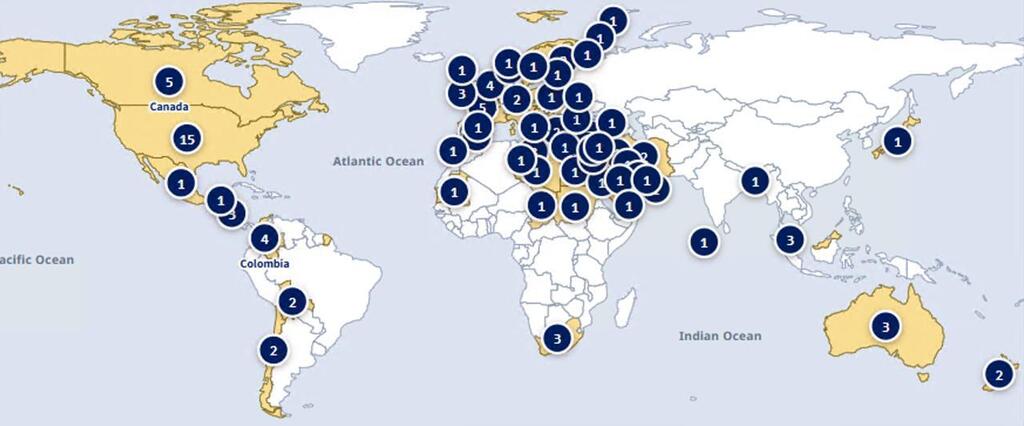
Map of sanctions against Israel
(Credit: JPPI)
The database allows users to examine measures by country, category and status, and to view their geographic distribution on a world map. The findings indicate that pressure on Israel is not confined to a single sector. Financial measures account for the largest category, with 40 measures, about one-third of the total. Defense and security and trade follow, with 24 measures each. The database also records 14 diplomatic measures and 12 legal measures.
According to JPPI Director General Dr. Shuki Friedman, the findings should be assessed not only by the number of sanctions but, more importantly, by their potential cumulative impact on Israel's economy and its ability to maintain international trade relationships, investment flows and supply chains.
"Anyone who thinks sanctions against ministers, individuals in the West Bank or products from the area will stop at the Green Line is mistaken," Friedman said. "Sanctions have a ripple effect. When they accumulate, they can affect banks, companies, investors and trading partners that have no connection whatsoever to the person or entity being sanctioned. The real danger is the transition from targeted sanctions to damage to the systems on which Israel's economy and security depend."
The database also identifies the countries where the highest number of measures have been recorded. Spain leads with 10 measures, followed by the United States with eight, all currently limited to the academic sphere, along with two "historical measures" and five proposals to prevent supplies of various types of weapons. Britain follows with seven measures, while Belgium and Turkey have five each.
However, the number of measures does not necessarily indicate their severity or potential impact. A single measure may be far more consequential than several others. The map is therefore intended primarily to illustrate the scope of the phenomenon and its geographic spread. Alongside European countries, where a substantial share of the measures is concentrated, the database includes measures from North America, Latin America, Asia, Africa and Oceania.
"The figure of 121 is only the starting point," Friedman said. "The important question is what will happen if this trend continues. A single sanction may be limited in scope. But 121 measures across 62 countries already warrant a systemic assessment. Israel needs to examine this risk as it would any other strategic threat: map it, prepare for it and act to prevent further deterioration.
"A national mechanism is needed to address the risk, one that examines the implications of these measures for the financial system, trade, investment, supply chains and the defense industry. The response cannot be limited to dealing with each sanction separately. It requires a comprehensive approach."
Diplomatic officials said the map contains distortions, noting, for example, that European Union sanctions are also counted at the individual country level. They also argued that entry bans imposed on certain individuals should not be equated with sanctions against Israel itself.
"Ultimately, there are no substantial sanctions against the State of Israel, and that was not a foregone conclusion," the officials said. "There was a realistic possibility of a different outcome, in which we would have ended 2026 facing EU sanctions against Israel. A great deal of the Foreign Ministry's energy was devoted to thwarting those measures."
They added: "There were sanctions that were prevented. The major threat was thwarted. If the EU had decided to undermine the trade agreement, every Israeli citizen would have felt the impact. The economic consequences would have been dramatic, but that was prevented. That diplomatic Iron Dome continued to hold.
"When you're inside an Iron Dome and a lot of missiles are fired at you, some get through. But the warhead carrying a ton of diplomatic and economic explosives did not penetrate. Ultimately, we succeed because we have friendly countries we can mobilize, such as Germany, Italy and the Czech Republic. It's not just Hungary. Hungary has changed, and the diplomatic Iron Dome remains intact."
The officials continued: "It's true that Smotrich and Ben-Gvir cannot enter the EU and that there are sanctions against settlers. But ultimately, people shopping at supermarkets in Ramat Gan and Tel Aviv are not feeling the impact of the biggest weapon, which is the trade agreement. The Horizon agreements and the Open Skies agreement have also been preserved."
However, they warned that the situation could change. "Will this continue? There's no guarantee it will last forever. It's possible that, if the trends continue in the same direction, the outcome will be different in the future."
According to the officials, "The Netherlands, Spain and Ireland are frustrated that they cannot achieve the outcome they want in Brussels. At the last meeting of European foreign ministers, there was frustration that it wasn't working. So, with no other choice, they are pursuing other channels, such as the Dutch sanctions.
"We are managing to preserve the core interests, and we have also reversed negative measures in countries such as Slovenia and Colombia. It's painstaking, thankless work because nobody sees what we have managed to prevent."
The officials nevertheless acknowledged that measures introduced by Spain, Ireland and Britain concerning trade with Israeli settlements "are not positive," adding that a concerning consequence is the shift toward action by individual countries.
The Foreign Ministry said in response: "The figures presented in the report do not accurately reflect the sanctions situation, whether political or economic. The Foreign Ministry is continuously engaged in this effort and is investing enormous resources in the fight against sanctions targeting Israel.
"For example, through a sustained effort lasting a year and a half, we prevented sanctions against Israel in the European Union and numerous other countries. We are also investing considerable efforts in reversing sanctions imposed by hostile governments following changes in leadership. We have done so with considerable success in Colombia, Slovenia and elsewhere.
"Countries that promote or impose sanctions against Israel undermine their own standing and influence in the region. As we have demonstrated in our dealings with various countries, most recently the Netherlands and Britain, Israel will respond firmly and forcefully to any country that takes such measures against it."