

The Knesset on Monday evening approved a law allowing the death penalty for convicted terrorists, passing the measure by a vote of 62-48, with one abstention, after a push by National Security Minister Itamar Ben-Gvir and lawmakers from his hardline Otzma Yehudit party.
Prime Minister Benjamin Netanyahu backed the bill. Ben-Gvir arrived at the Knesset plenum with champagne and sweets, while fellow Otzma Yehudit lawmaker Limor Son Har-Melech, who announced the bill’s approval, recited Shehecheyanu, the traditional Jewish blessing marking a significant occasion.
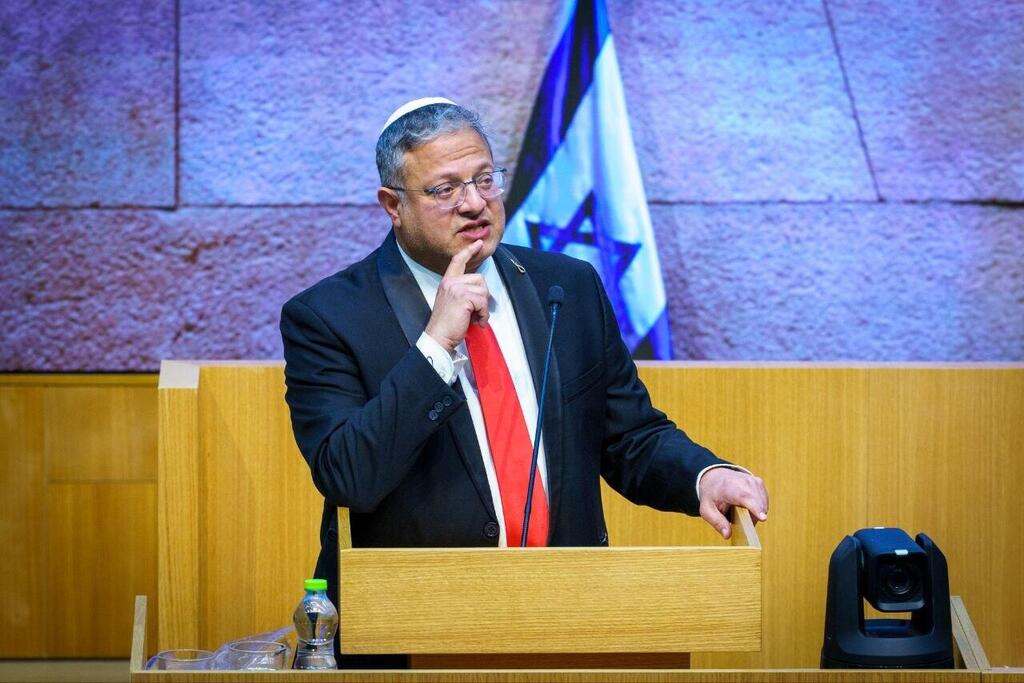
Speaking before the vote, Ben-Gvir invoked the 2011 murder of five members of the Fogel family, including a three-month-old infant stabbed to death, in the West Bank settlement of Itamar. “The time for judgment has come — the blood of our brothers and sisters cries out from the ground, and today we are doing historic justice,” Ben-Gvir said.
“Today we are creating deterrence. Today we are restoring pride to the people of Israel. Today we are restoring sanity to the State of Israel. The death penalty law for terrorists, which my colleagues and I in Otzma Yehudit led, is a historic law that changes the picture.”
Ben-Gvir said the measure would apply to those who “murdered, massacred and slaughtered” with a nationalist motive, and said such cases would no longer require the approval of the attorney general in order for the death penalty to be imposed. He said the default punishment under the law would be death, with life imprisonment becoming the exception.
Opposition leader Yair Lapid said during the debate before the vote that he opposed the bill, calling it a cynical public relations maneuver. “What is on the Knesset table is not a law,” Lapid said. “It is a distorted public relations stunt that cynically uses the justified pain and justified anger of Israel’s citizens for political gain.”

Ben-Gvir opens a bottle of champagne at the Knesset plenum after the approval of a law allowing the death penalty for convicted terrorists
(Photo: Shalev Shalom)
He argued that the law would not apply to Hamas’ Oct. 7 attackers, saying, “You were deceived. You were misled. This law does not include Gaza. It does not include the murderers of Oct. 7.”
Lapid said he opposed the specific bill because, in his words, it amounted to “surrender to Hamas.”
“This law is Hamas’ dream,” he said. “This law is what Hamas wanted when it invaded Israel on Oct. 7. We are not like Hamas. We are the exact opposite of Hamas. We did not come to the Middle East to take upon ourselves the laws of Sharia. We did not establish a Jewish state in order to adopt the moral standards of radical Islam. Hamas’ great dream is that we adopt its culture of blood and death.”
The law raised legal concerns and fears of international repercussions, but coalition leaders decided to complete the move at Ben-Gvir’s insistence after he threatened the coalition’s stability if it did not pass.
Under existing Israeli military law, the death penalty is already possible in exceptional cases if imposed unanimously by a judicial panel. In Israel’s history, it has been carried out only once, in the case of Nazi war criminal Adolf Eichmann.
Ben-Gvir had initially sought a mandatory death sentence for terrorists, with no right of appeal and no possibility of commutation. Netanyahu demanded a softer version out of concern over possible international fallout, insisting on judicial discretion in exceptional cases and the right to appeal. Ben-Gvir ultimately agreed to a compromise.

Prime Minister Benjamin Netanyahu (right) and Communications Minister Shlomo Karhi
(Photo: Shalev Shalom)
Under the current wording, the law distinguishes between the death penalty for a terrorist in the West Bank and the death penalty under Israeli law. In the West Bank system, the death penalty would be the default punishment, though not an absolute mandatory sentence as Ben-Gvir had demanded.
Under the text, judges would retain discretion to impose life imprisonment instead, but would be required to give reasons for exceptional circumstances. There would be no possibility of a pardon or sentence reduction by a regional military commander.
In addition, the defense minister would have the authority to decide whether a terrorist from the West Bank is tried in a military court or in a civilian court. Under Ben-Gvir’s wording, a unanimous judicial decision would not be required in order to impose the death penalty in the West Bank, nor would such a sentence depend on the prosecution requesting it.
Under Israeli law, the death penalty would apply only to someone who caused a person’s death “with the intent of denying the existence of the State of Israel.” The law also states that the government would not be able to release terrorists sentenced to death in future hostage deals.
According to the bill’s text, “the purpose is to establish the death penalty for terrorists who carried out murderous terror attacks, as part of the fight against terrorism.” It goes on to state that “a person who intentionally causes the death of another person with the aim of harming an Israeli citizen or resident, with the objective of denying the existence of the State of Israel, shall be punished by death or life imprisonment, and by one of those punishments alone.”
As for the time frame for carrying out a death sentence, the bill states: “A final death sentence shall be carried out within 90 days by the Israel Prison Service. If the prime minister finds that special reasons exist for delaying the sentence, he may petition the court that imposed the penalty to order a postponement for additional periods, provided that the total delay does not exceed 180 days.”
It further states that “the sentence shall be carried out by hanging. The execution shall be performed by a prison guard appointed for that purpose by the prison commissioner.”
The main objection raised by the National Security Council and other security bodies stems from concern that the law could violate international law, including provisions such as those in the Geneva Conventions requiring that condemned prisoners have the possibility of seeking clemency.
Idan Ben Yitzhak, legal adviser to the Knesset National Security Committee, said during the discussion in which the bill was approved for its second and third readings: “Throughout the process, we said we were not expressing a position on the value question of whether the death penalty should or should not be imposed. The death penalty is irreversible, and therefore caution is required both in carrying it out and in handing it down. As for the arrangement set out for the West Bank, the committee initially wanted to define the death penalty as mandatory, but by the end of the process judicial discretion to impose life imprisonment was included.”
He added: “Another difficulty in the bill is that it does not allow clemency for a person sentenced to death, which runs contrary to international conventions and could create problems. In addition, the legislation sets out several differences between the legal process for Israeli citizens and the legal process in the West Bank, and we see that as a certain difficulty. Under the bill, the defense minister will determine the policy, and in our view that does not raise a constitutional barrier.”
The foreign ministers of Germany, France, Italy and Britain expressed strong reservations about the law. In a joint statement published Sunday by the German Foreign Ministry, they said, “We are particularly worried about the de facto discriminatory character of the bill. The adoption of this bill would risk undermining Israel’s commitments with regards to democratic principles.”
At the same time, the European Union conveyed implied warnings to Israel that if the death penalty law for terrorists passes, it could be considered a violation of the EU-Israel Association Agreement, potentially opening the door to its suspension.
In an unusual statement issued over the weekend, the EU said: “The EU encourages Israel to abide by its previous principled position, with its obligations under international law, as well as its commitment to democratic principles, as reflected also in the provisions of the EU-Israel Association Agreement.”
The statement did not include an explicit threat of sanctions or suspension of the agreement, but some in Israel interpreted its final wording as a “veiled threat” that adoption of the law would constitute a breach of Israel’s commitments under the EU association agreement, potentially paving the way for damage to the agreement up to and including suspension.
A senior diplomatic official said, “If the Knesset adopts the death penalty law for terrorists, it will cause significant harm to relations between Israel and the European Union.” Similar messages, the official said, were also conveyed by Council of Europe Secretary General Alain Berset, who sought to prevent the law’s passage and expressed deep concern to Israeli officials over legislation that, in his view, harms human rights and distances Israel from shared values and normative frameworks.
The official added: “There is no threat of sanctions, but there may be hints. Nowhere does anyone say there will be a clear-cut process against Israel, but it could certainly set troubling processes in motion.”