

After two years of sirens and intercepted missiles, Israel ranks 155th out of 163 countries in the 2025 Global Peace Index (GPI), which annually assesses security, stability, and levels of violence worldwide.
The latest report paints a worrying picture: global peace is declining, conflicts are escalating, and military spending is on the rise. Yet some countries continue to live in exceptional tranquility, with Iceland holding the top spot for the 17th consecutive year.
The GPI uses a color-coded system to highlight peace levels: dark green for very high peace, light green for high, yellow for moderate, orange for low, and red for very low. Countries not included in the index are marked gray. Israel’s position in the red zone reflects extremely low peace, alongside significant security and policy challenges.

Global Peace Index
(Photo: Global Peace Index 2025)
Compiled annually by the independent Institute for Economics & Peace (IEP), which has offices in Sydney, New York, The Hague, and Mexico City, the index ranks 163 countries across 23 indicators. These measure three key dimensions: personal and societal security, involvement in internal and external conflicts, and militarization—how much resources a country devotes to military and security. The goal is to provide a global snapshot of peace trends and highlight regions at greatest risk to stability and security.
The top 20 countries this year are Iceland, Ireland, New Zealand, Austria, Switzerland, Singapore, Portugal, Denmark, Slovenia, Finland, Czechia, Japan, Malaysia, Netherlands, Canada, Belgium, Hungary, Australia, Croatia, and Germany.

At the bottom are countries facing extreme violence, political instability, and prolonged conflicts. Russia ranks last at 163, followed by Ukraine, Sudan, Yemen, Afghanistan, Syria, South Sudan, and Israel. Other low-ranked countries include Mali, Myanmar, Burkina Faso, Somalia, the Central African Republic, North Korea, Nigeria, Iraq, Turkey, Palestine (145th), Pakistan, and Niger. Regional neighbors also rank low: Syria (157), Yemen (159), Lebanon (136), Iran (142), and Egypt (107). Jordan is higher at 72, while the U.S. ranks 128, far from the leading Northwest European nations.
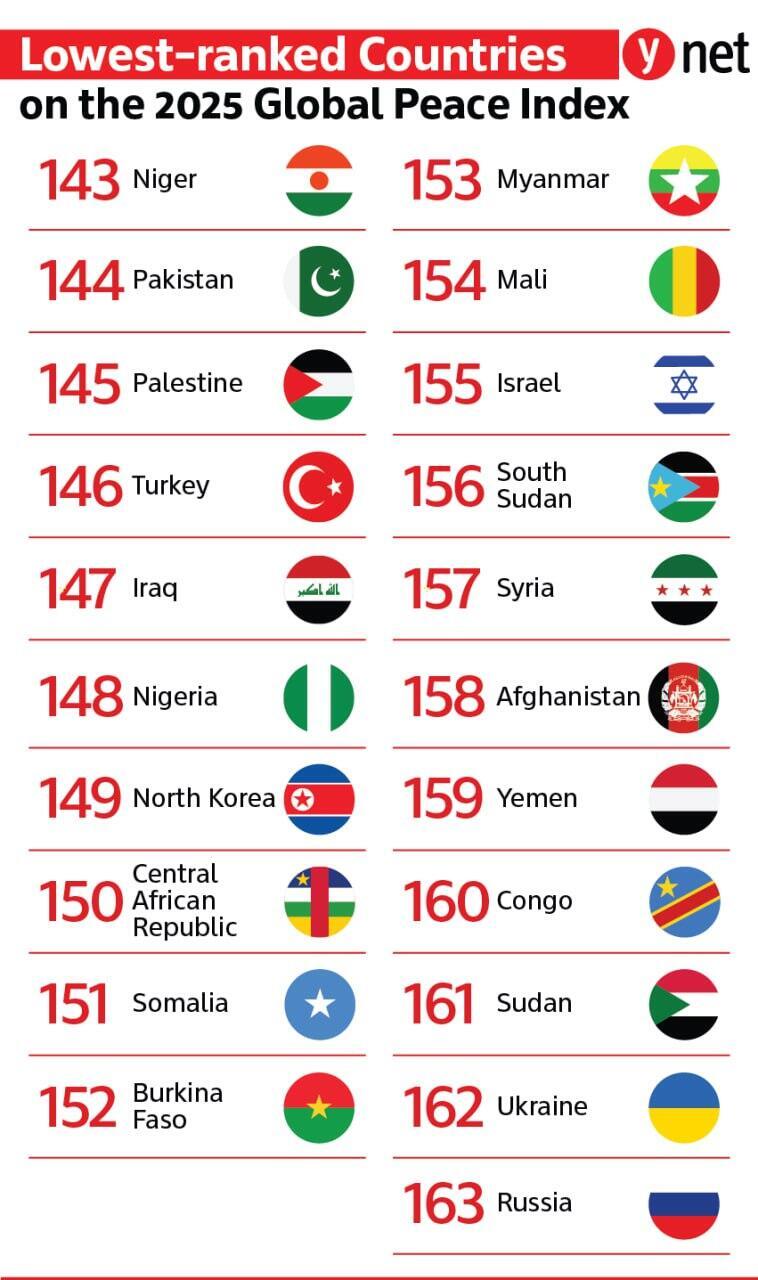
The 2025 report marks the sixth consecutive year of global decline in peace, the longest streak since the index’s 2008 inception. This year, 87 countries deteriorated compared with 74 that improved. Active conflicts rose to 59, the highest since World War II, many of which are long-running with no resolution in sight. Western Europe remains the most peaceful region, dominating the top 10, while the Middle East and North Africa are the least peaceful. South Asia experienced the steepest decline this year.

(Photo: Global Peace Index 2025)
The report also highlights growing militarization: 106 countries increased defense spending. Israel stands out with particularly high military investment, contributing to its low overall ranking. The economic cost of global violence is estimated at $19.1 trillion this year, equivalent to 13.5% of global GDP.