

Israel should not expect “tranquility” in the Middle East, according to Dr. Dan Schueftan, head of the International Graduate Program in National Security Studies at the University of Haifa.
Speaking on the ILTV Podcast, Schueftan said that “if the other side is quiet, it is because it is preparing,” and that Israel should expect to maintain a low level war on most fronts for the foreseeable future.
Despite this reality, he said Israel’s strategic position in the region is stronger than ever. According to Schueftan, whether countries such as Saudi Arabia or Lebanon formally normalize relations with Israel is far less important than practical cooperation.
“I want cooperation much more than normalization, because this is what counts,” Schueftan said. “Even though they say terrible things about Israel, they understand that they desperately need the conviction of Israel, the determination of Israel, and they're willing to do something in return.”
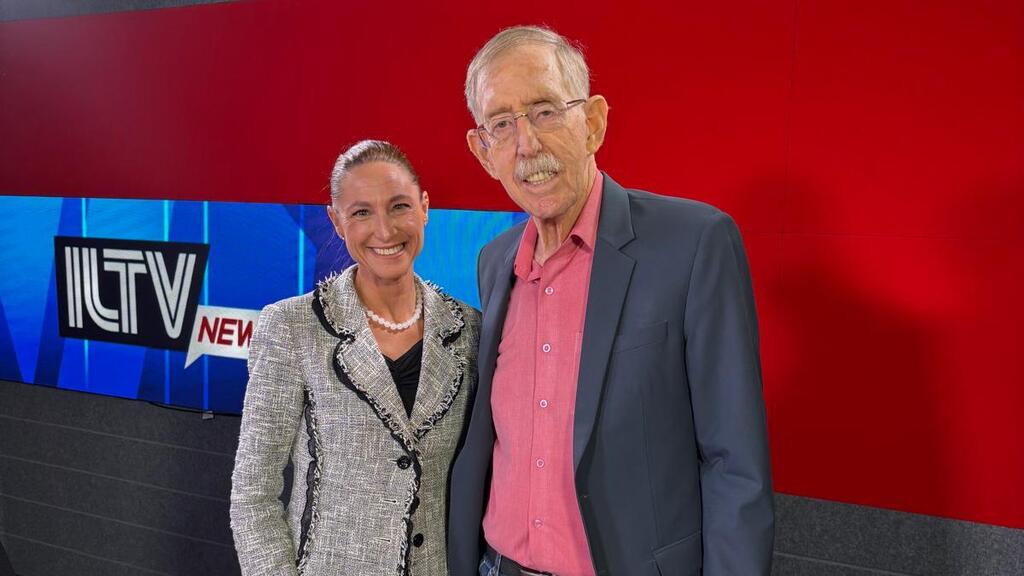
Dr. Dan Schueftan (right) with the author.
(Courtesy of Maayan Hoffman)
Schueftan argued that Israel and many Arab states share the same enemies, including Iran, Hezbollah, Hamas, and the Muslim Brotherhood. Countries such as Jordan and Egypt, he said, rely on Israel to help keep these threats in check.
“The very existence of Jordan depends on a strong Israel,” Schueftan contended. “Does King Abdullah curse Israel three times a day? Yes. As far as I'm concerned, he can do it five times a day. But he knows that without a strong Israel, Jordan doesn't exist. We saved the existence of Jordan a number of times.”
He said Egypt holds a similar view.
“The Egyptians understand that if we don't demolish the Muslim Brotherhood, they will take over in Cairo,” Schueftan said. “The people in Morocco understand it, and in the UAE and in Saudi Arabia. So does it look good? No. But I prefer things that are good, even if they don't look good. If something looks good, I'm always very suspicious.”
Schueftan said he teaches his students at the University of Haifa the importance of balancing hard power and soft power. Without hard power, he said, no one listens to your soft power. Once hard power is established, soft power becomes far more effective.
“You can tell people you have a choice between doing it the easy way or the hard way,” he said.
If world leaders understand Israel’s role in regional stability, why does the Jewish state continue to face condemnation from the West for its military actions?
According to Schueftan, the answer lies in a fundamental gap in experience.
“You have never had a civilized, open society confronted for generations with existential threats,” he said. “In order to survive in a very violent region, Israel must take action to defend itself. And for people who have never known war, who don't know what war is, it is very difficult to understand.”
He added that many radical Islamic regimes treat their own populations as brutally as they treat Israel. While Israel’s Middle Eastern neighbors often recognize this reality, Schueftan said Europeans and Americans struggle to grasp it.
“We are here to build a better society, a more robust democracy, a stronger economy, a more sophisticated science and so on,” he said. “This is what we get up in the morning for. But when you have constant terrorist attacks, you can't do it. And when you respond to it, people don't understand the need to respond, because they don't understand what the real choice is.”
Failing to respond, he warned, would only embolden radical forces and lead to even greater war across the region.
Schueftan also cautioned against excessive alarm over Israel’s relationship with the United States, noting that Washington understands Israel’s strategic value.
“We need America immeasurably more than America needs us. It's not symmetric. It's not balanced,” he said. “But there is a similar ethos between part of America and Israel.”
Is there reason for optimism? Schueftan said it depends on how optimism is defined.
“There are two kinds of optimistic people: dumb optimists and smart optimists,” he said. “The dumb optimist says things will be good. The smart optimist says things will get worse, but I'll get stronger faster.
“The gap between the good guys and the bad guys becomes bigger and bigger,” Schueftan added. “If the gap between the good guys and the bad guys grows bigger, and it does, that makes me very optimistic.”
Watch the full ILTV Podcast:
Podcast 22.12.2025
(ILTV)


Dr. Dan Schueftan is head of the International Graduate Program in National Security Studies at the University of Haifa. Schueftan is a globally renowned national security expert, consultant, author and commentator, who for decades has advised top leaders in Israel around the world. Learn more about University of Haifa International School.