

One of Prime Minister Benjamin Netanyahu's longtime ultra-Orthodox allies is considering a dramatic political shift, offering to support opposition leader Gadi Eisenkot as Israel's next prime minister in exchange for legislation exempting ultra-Orthodox men from military service. The proposal comes as Israel's election count nears completion, with neither political bloc securing the 61 seats needed to form a government.
A senior United Torah Judaism official confirmed to ynet on Thursday that the party intends to propose supporting a government led by Eisenkot, chairman of the Yashar! party, on the condition that legislation granting military draft exemptions be advanced.
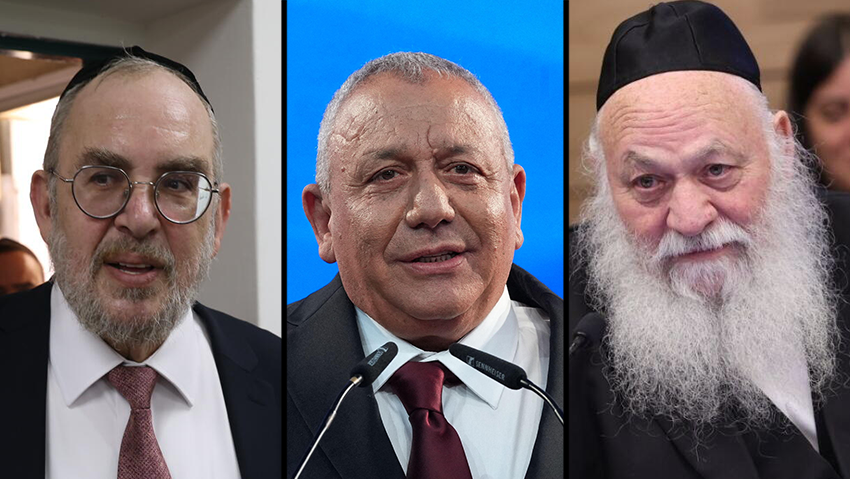
Netanyahu ally sets price for making Eisenkot PM: Draft exemption
(Photo: AP/ David Goldman, Maya LEVIN / AFP, Alex Kolomoisky)
"Gadi has the option of forming a government with Netanyahu, but then Netanyahu would be prime minister and he would be a senior minister," the official said. "We are offering him the premiership. That's better than being No. 2 or going to another election."
The proposal signals a possible break between United Torah Judaism and Netanyahu, whose right-wing and religious alliance has relied on the ultra-Orthodox party for parliamentary support. It also underscores the political leverage the party hopes to gain from an election that has left neither major bloc with a governing majority.
The obstacle, however, is substantial. During the election campaign, Eisenkot identified mandatory military or national service as one of his conditions for potential coalition partners, directly conflicting with United Torah Judaism's demand for draft exemptions.
Even with United Torah Judaism's projected seven seats, Eisenkot's current bloc would control only 55 of the Knesset's 120 seats, six short of a majority. Shas, another ultra-Orthodox party, is projected to win six seats, but no agreement involving the parties has been announced.
The proposed arrangement could also face resistance from Eisenkot's existing political partners, particularly Yisrael Beiteinu leader Avigdor Liberman, who has opposed forming a government with the ultra-Orthodox parties.
Netanyahu bloc holds 53 seats as 99% of votes counted
The political maneuvering comes as Israel's Central Elections Committee announced Thursday afternoon that 99% of votes had been counted, with no change in the balance between the main parliamentary blocs.
According to the latest figures, Netanyahu's bloc is projected to win 53 seats, Eisenkot's bloc 48 and the two Arab parties a combined 19, leaving both major political camps short of a majority.
Netanyahu's Likud remains the largest party with 27 seats, followed by Eisenkot's Yashar! with 21 and the Beyachad (Together) party with 12.
The Joint List is projected to receive 11 seats, while the Arab-led Ra'am party and the Democrats are each projected to receive eight. United Torah Judaism, Yisrael Beiteinu and Otzma Yehudit are each on seven, while Shas and the joint Religious Zionism-Zehut list are each projected to win six seats.
The Reservists and Economic Party remains below the electoral threshold and is not currently projected to enter the Knesset.
Double-envelope count completed, but results remain unofficial
Earlier Thursday, the Central Elections Committee announced that counting had been completed for the special double-envelope ballots, a voting procedure used by soldiers and others voting away from their designated polling stations.
The committee said results had been entered from 12,644 polling stations, representing 5,589,836 votes. Of those, 5,564,764 were valid and 25,072 were invalid.
The final batch of double-envelope ballots, representing 24,713 votes, had been transferred for data entry and verification. Their results will be published only after those procedures have been completed.
The committee emphasized that the figures remain provisional and that official results will be published Wednesday, November 4, following an additional election integrity review.
The preliminary outcome leaves Israel facing complex coalition negotiations, with United Torah Judaism's potential offer introducing another possible route to a government led by Eisenkot. Whether he would consider compromising on military service legislation, or secure enough parliamentary support even with the ultra-Orthodox party's backing, remains unresolved.