


Dozens of American military aerial-refueling aircraft left U.S. shores heading east across the Atlantic Ocean early on Monday in an unprecedented deployment of the U.S. Air Force.
The KC‑135 and KC‑46 planes, more than 30 in all, might participate in a scheduled NATO exercise in Europe. However, analysts and regional officials speculate the mission could extend to the Middle East, possibly supporting operations related to the ongoing hostilities between Israel and Iran.
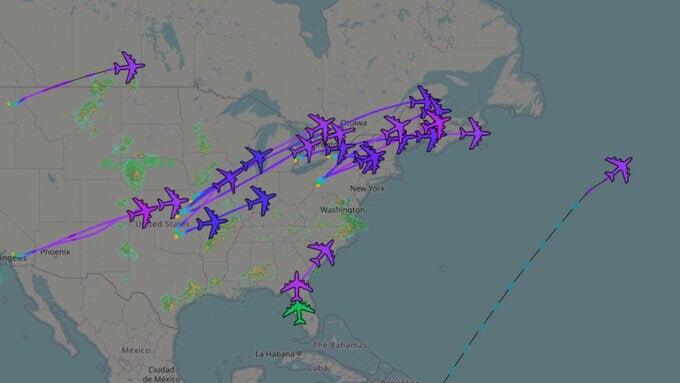
Officials in Washington have denied any direct support for Israeli airstrikes against Iran. The U.S. State Department instructed American diplomats to reassure host governments that Washington “was not involved” in Israel’s “unilateral” operation targeting Iranian assets and that it had not provided refueling assistance to the IDF, according to CBS.
The department also emphasized that Washington’s support for Israel is limited to defensive measures, warning that any attacks on U.S. civilians, military installations or infrastructure—particularly following threats from Iraq—would prompt a response.
Get the Ynetnews app on your smartphone: Google Play: https://bit.ly/4eJ37pE | Apple App Store: https://bit.ly/3ZL7iNv
Despite these reassurances, the mass deployment of tankers has fueled speculation about deeper U.S. involvement. Iranian Foreign Minister Abbas Araghchi accused the United States of complicity in Israel's bombing campaign, warning that Washington will “pay” for its actions.
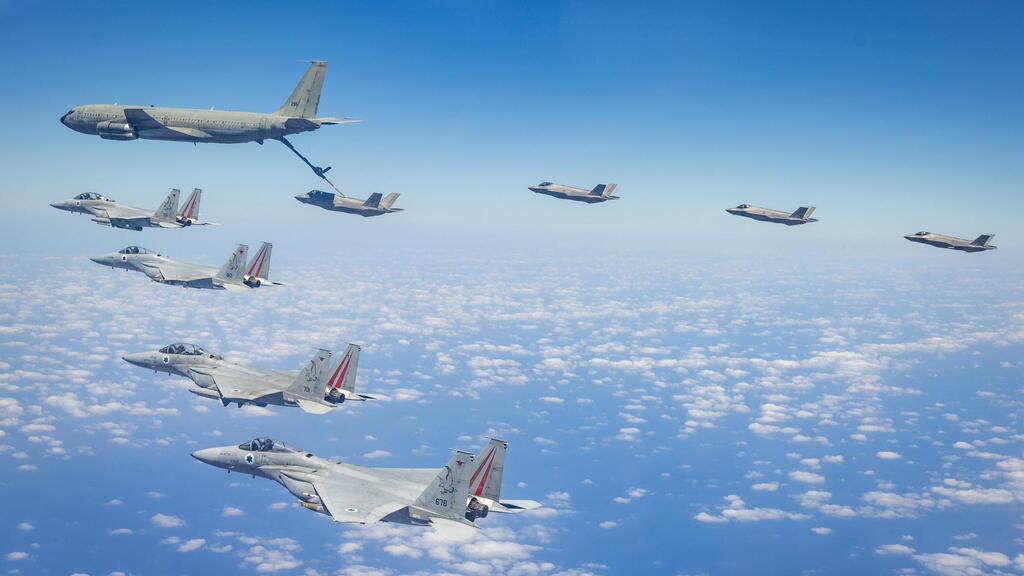
Joint US-Israeli air drill
(Photo: IDF)
Another possibility is that the refueling fleet is being positioned to service American Air Force and Navy aircraft should the United States opt for a more active military role in the conflict.
Strategic experts note that while Israeli F‑15 fighter jets possess the range to reach Iranian territory without refueling, the more numerous F‑16s—and other Western aircraft—require midair tanker support to strike deep targets in Iran. This limitation contrasts with Russian and Chinese bomber platforms, which can operate at longer ranges independently.