

The 2025 Nobel Prize in Economic Sciences has been awarded to Israeli-American economist Joel Mokyr, 79, of Northwestern University, alongside Philippe Aghion, 69, a professor at the College de France and INSEAD in Paris, and Peter Howitt, 79, of Brown University. The trio was recognized for their "groundbreaking work explaining how innovation drives long-term economic growth." The selection committee said their joint research “bridges history, theory, and policy, illuminating how ideas and technological progress shape prosperity across centuries.”
Mokyr was awarded half the prize with the other half being shared between Aghion and Howitt.

Mokyr was born in Leiden, the Netherlands, to a Dutch-Jewish family that survived the Holocaust. When he was one year old, his father — a civil servant — died of cancer. His mother then immigrated to Israel, raising him in Haifa. He began his academic career at the Hebrew University of Jerusalem, earning a bachelor’s degree in economics and history in 1968. He later completed his master’s and doctoral studies in economics at Yale University, with a dissertation focused on industrial growth and stagnation in the Low Countries between 1800 and 1850.
After a brief period as a lecturer at Yale, Mokyr joined Northwestern in 1974, where he remains on the faculty. Over the course of his career, he has supervised or co-supervised more than 50 doctoral students. Since 2001, he has also been a research fellow at the Eitan Berglas School of Economics at Tel Aviv University.
Mokyr receives half of this year’s prize for using "historical sources as one means to uncover the causes of sustained growth becoming the new normal. He demonstrated that if innovations are to succeed one another in a self-generating process, we not only need to know that something works, but we also need to have scientific explanations for why. The latter was often lacking prior to the industrial revolution, which made it difficult to build upon new discoveries and inventions. He also emphasized the importance of society being open to new ideas and allowing change," the committee said in a statement.
The remaining half of the prize is shared by Philippe Aghion and Peter Howitt for studying "the mechanisms behind sustained growth. In an article from 1992, they constructed a mathematical model for what is called creative destruction: when a new and better product enters the market, the companies selling the older products lose out. The innovation represents something new and is thus creative. However, it is also destructive, as the company whose technology becomes passé is outcompeted.,” the committee said.
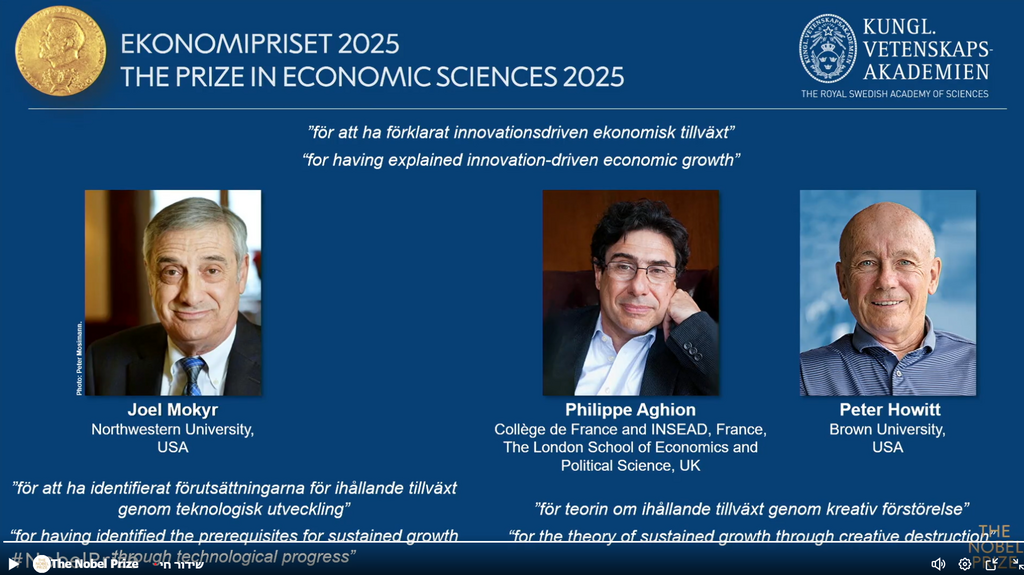
Nobel Prize in Economics announcement
(Photo: Screenshot from the Nobel Prize X account)
"Together, the laureates have provided a comprehensive framework explaining why innovation is the true engine of progress and how societies can foster it responsibly. Their insights influence today’s debates on inequality, industrial policy, and sustainable development, making the 2025 prize a celebration of ideas that continue to reshape our world.”
10 Million Swedish Kronor prize
The laureates will share a prize of 10 million Swedish kronor (roughly $900,000). Unlike the original Nobel Prizes, the economics prize — officially the Sveriges Riksbank Prize in Economic Sciences in Memory of Alfred Nobel — was not established by Alfred Nobel himself. It was created in 1968 by Sweden’s central bank, Sveriges Riksbank, and first awarded in 1969.
Last year’s prize (2024) went to Daron Acemoglu, Simon Johnson, and James A. Robinson for their work on how economic and political institutions shape prosperity.