


Ahead of Monday night’s UN Security Council vote on a U.S.-backed resolution promising a “path to a Palestinian state,” Israeli officials say Washington has no intention of softening the text despite Israeli pressure. The resolution will be brought for approval at 10 p.m. Israel time and could strain Prime Minister Benjamin Netanyahu’s coalition.
Formally changing the language would require the U.S. to withdraw its draft, revise it and resubmit it. “I don’t see the Americans doing that unless Netanyahu speaks directly with Trump and convinces him,” a senior official said. “The U.S. worked very hard to assemble a majority, and they have it. From their perspective, the changes Israel wants could collapse that majority. It is unlikely the Americans will agree to dilute it.”
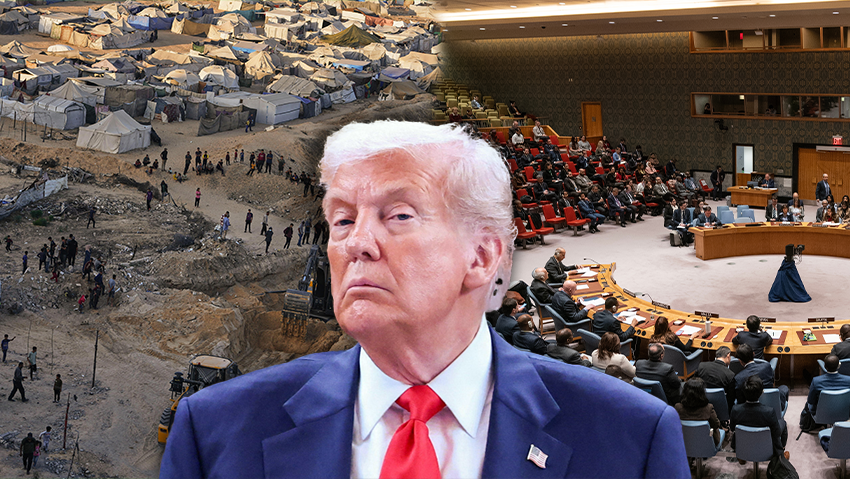
The draft is built on former President Donald Trump’s 20-point plan, which explicitly mentions a path to a Palestinian state — a reference Israeli officials strongly oppose. They also object to the mention of the Saudi-French proposal and language suggesting the Palestinian Authority could return to govern Gaza securely once its reform plan is carried out.
Beyond the Security Council resolution, the Americans also inserted statehood language into a joint statement issued with Qatar, Turkey, Saudi Arabia, Pakistan, the UAE, Jordan and Egypt. Israeli officials believe this reflects Arab pressure. “You don’t want a Security Council resolution talking about a Palestinian state,” a senior diplomatic official said. “Even with conditions, it’s better for us if it isn’t mentioned at all.”
Israel believes Russia and China will not veto the U.S. proposal, though they may abstain to avoid being blamed for blocking it.
Arab states refuse to send troops to Gaza
One key reason Washington is pushing the resolution is that, without it, states will not be able to contribute troops to an international stabilization force in Gaza. But so far, the U.S. has secured commitments only from Indonesia and Azerbaijan. Egypt, Jordan, Gulf states and Saudi Arabia have all refused, fearing their soldiers could end up in direct confrontation with Hamas.
“They fear that a clash involving Emirati or Jordanian troops would spark domestic unrest,” a senior official said.
Despite claims Israel has lost veto power over which countries would join a stabilization force, an Israeli official said Israel maintains “very significant input” and is coordinating fully with the U.S. He added that clear guidelines are already embedded in Trump’s 20-point framework.
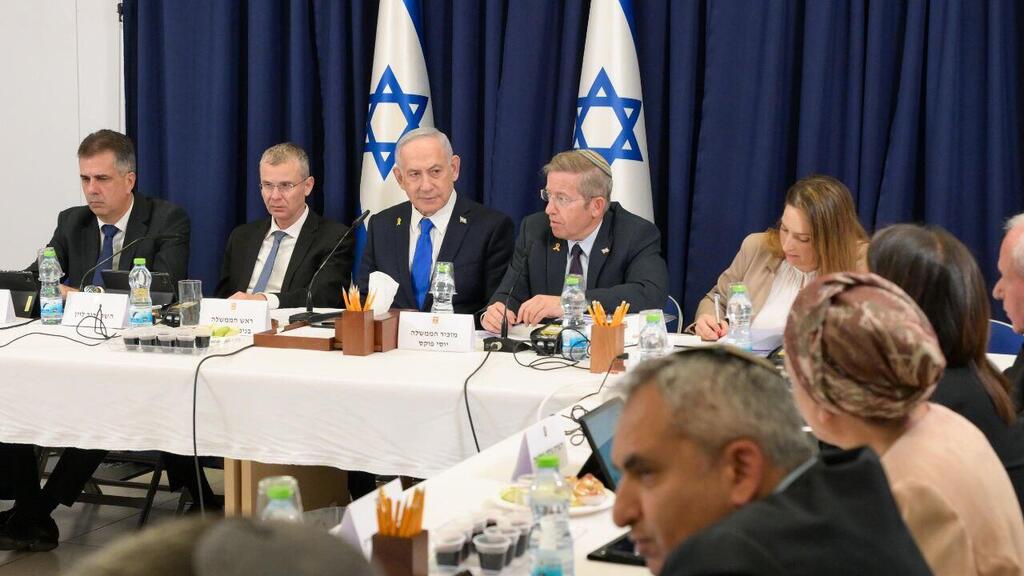
Prime Minister Benjamin Netanyahu during a government meeting
(Photo: Maayan Toaf, GPO)
Netanyahu: Our opposition to a Palestinian state hasn’t changed
At the start of Sunday’s cabinet meeting, Netanyahu said, “Our opposition to a Palestinian state on any territory has not changed. Gaza will be demilitarized and Hamas will be disarmed, by the easy way or the hard way.” He also rebuked ministers for public political posturing, saying that in an election year, “we are witnessing a primary-season offensive,” including on national security issues that are coordinated with the prime minister.
Netanyahu insisted that Israel will not tolerate any “non-demilitarized” Hamas-run enclave in Gaza. “In Trump’s 20-point plan, and in any other plan, that territory will be demilitarized and Hamas disarmed,” he said.
Amid criticism from right-wing ministers, Netanyahu convened the security cabinet in an unscheduled meeting during the government session. He told them the phrase “path to a Palestinian state” is accompanied by “a long series of conditions the Palestinians are unlikely to meet,” which is why the Palestinian leadership opposes the proposal.
Israeli officials said the conditions are so stringent that the chances of Palestinian compliance are “virtually zero.” “They would have to become Sweden,” one official said. “They already have a declaration of a state in principle. Now these conditions would create, at most, a long corridor full of requirements before anything could even begin.”