

France pressed ahead Friday with a civil conference in Paris aimed at advancing the two-state solution, even as Israel and the United States stayed away and the diplomatic agenda ahead of next week’s G7 summit appeared likely to be dominated by Iran.
The second civil conference for the two-state solution opened at the Arab World Institute in Paris, bringing together 150 Israelis and Palestinians from 80 organizations. Participants were invited to submit concrete proposals ahead of the G7 summit, which is set to take place next week in Vichy.
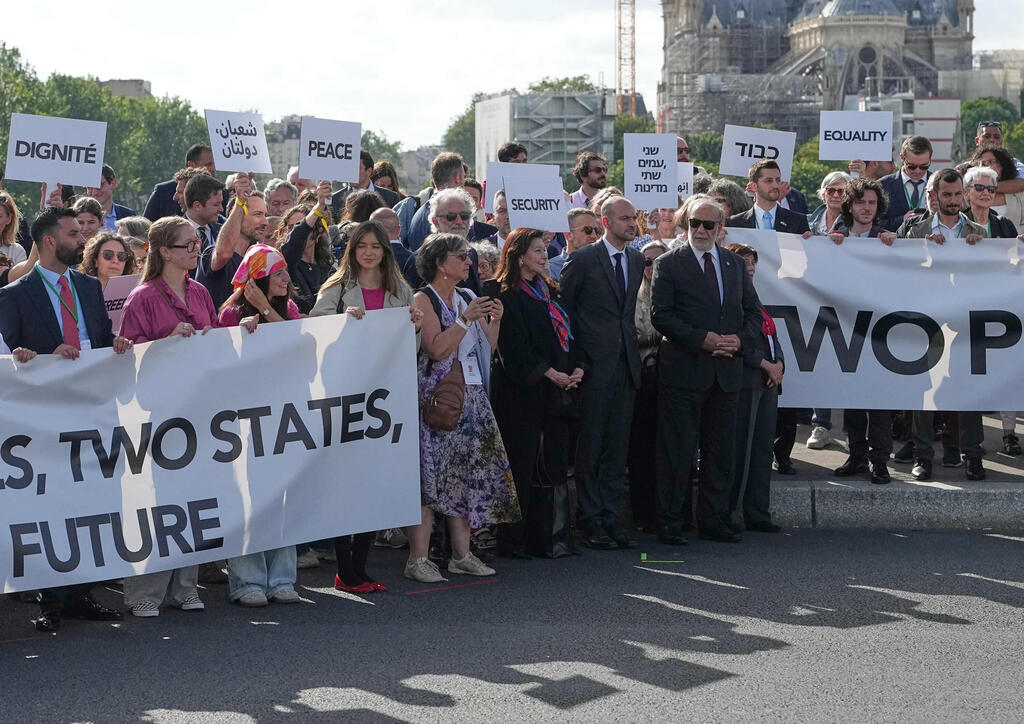
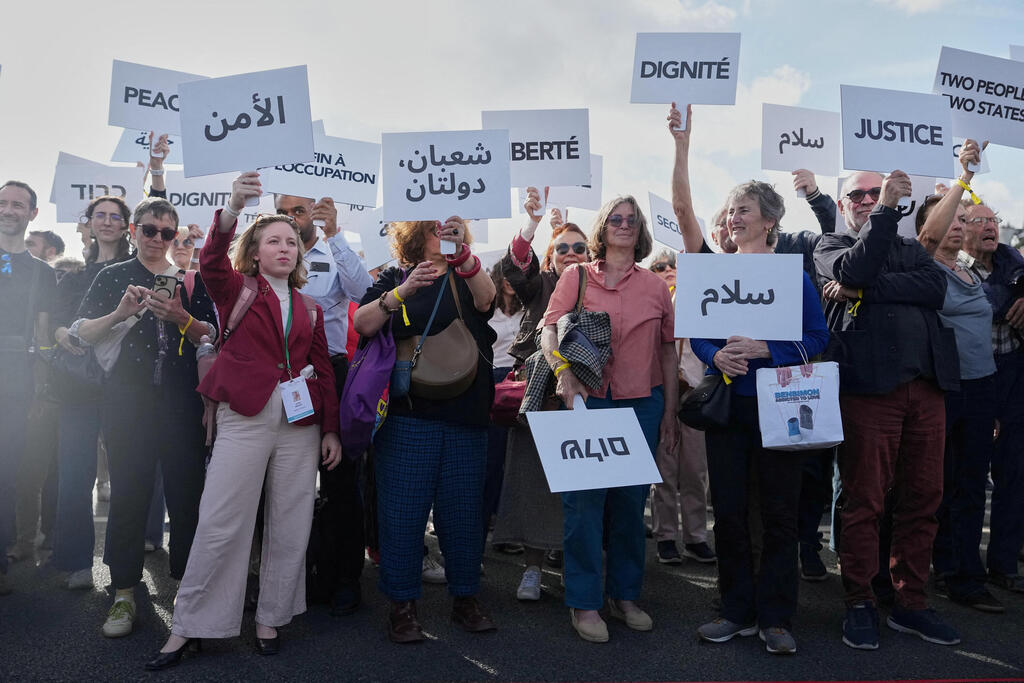
(Photo: Thibault Camus/Pool via REUTERS)
The previous “Paris Call” conference helped lay the groundwork for the proposal advanced by France and Saudi Arabia at the United Nations last September, when France formally recognized a Palestinian state.
This time, however, the political path for any recommendations appears far more difficult. Israel chose not to take part in the conference, the United States was not represented, and discussions at the G7 are expected to focus largely on Iran, economic fallout and tensions between Europe and Washington.
Still, the French Foreign Ministry is seeking to remain relevant, at least at the civil-society level.
As EU foreign policy chief Kaja Kallas put it, “Peace is also built from the bottom up.” Kallas announced that 20 million euros had been raised this year to support the peace process. French Foreign Minister Jean-Noël Barrot used his address to describe the obstacles facing any renewed diplomatic track.
He cited “the unbearable humanitarian disaster in Gaza, the wound of October 7 that is still engraved in every family in Israel, the missiles that continue to strike Israel, the unbearable situation in the West Bank and East Jerusalem where radical settlers are active, calls for annexation, the transfer of populations without their consent and harm to the status quo at the holy sites.”
“We could see this reality as a reason to give up, but you are here,” Barrot said. “Your testimonies are in themselves a reason for hope and action. This is a decisive year. Your two peoples face elections. Elections are not an end in themselves, but a starting point so that the Palestinian Authority can assume responsibility, including in Gaza, and so that extremists on all sides can be isolated.”
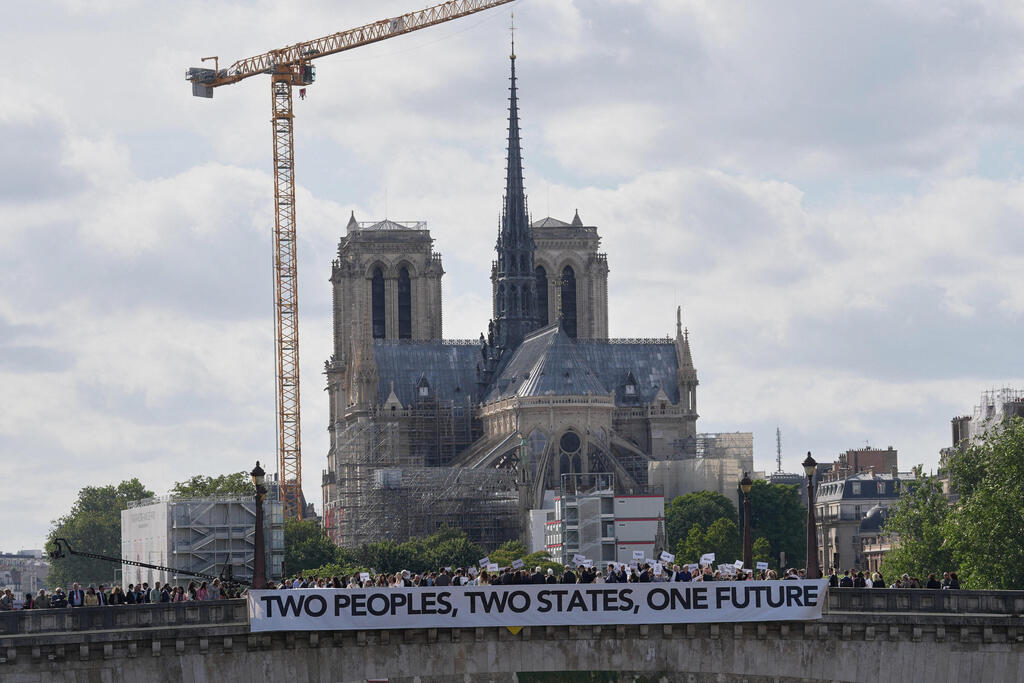
(Photo: Thibault Camus/Pool via REUTERS)
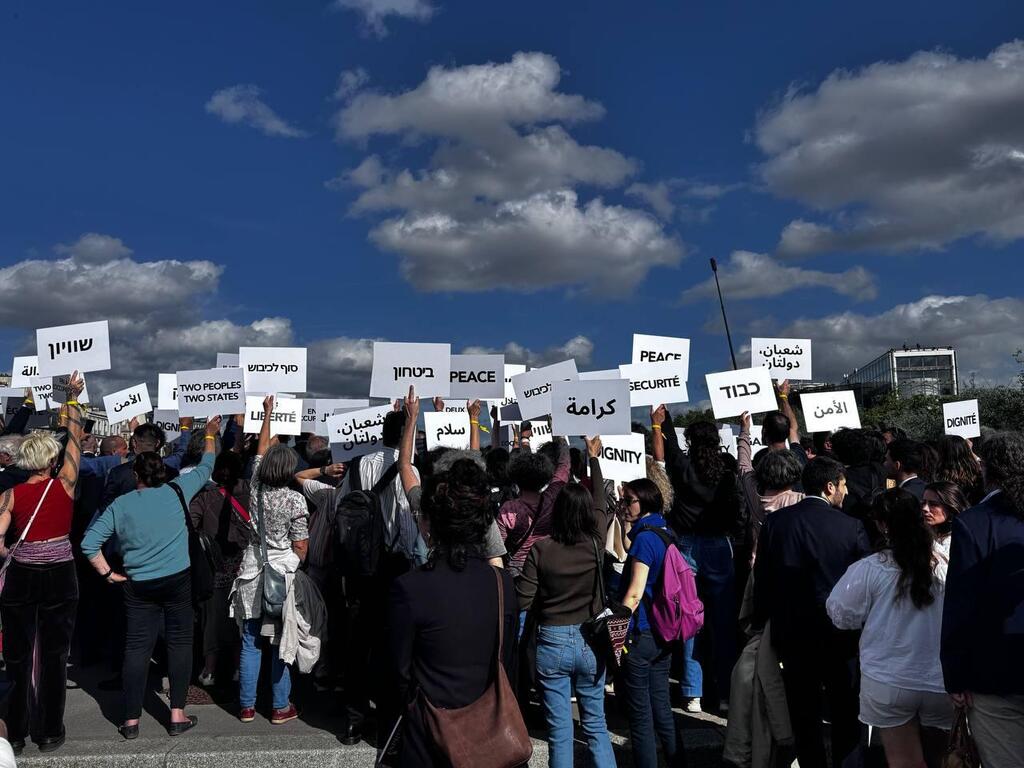
(Photo: Tamar Sebok)
Fifteen foreign ministers and deputy foreign ministers attended the conference, including representatives from Qatar, the United Arab Emirates, Britain, Spain, Mexico, Ireland, Belgium, Brazil, Canada, Norway and Turkey.
Diplomatic frustration was voiced clearly by Xavier Bettel, Luxembourg’s deputy prime minister and foreign minister, who said he had heard from Israelis that “Germany has a historical debt to Israel.”
“I do not think that criticism of the Israeli government conflicts with that debt,” Bettel said. “The UN may not be perfect, but all I see now is suffering, hunger and settler violence.”
At the end of the conference, participants called on G7 leaders to enforce a permanent ceasefire in Gaza and protect civilians; bring all existing initiatives into a single implementation track for the two-state solution in a regional framework; stop annexation in order to preserve a viable political horizon; and rebuild Gaza for the sake of its residents.
They also urged leaders to advance mutual security through a responsible security framework; support the renewal of legitimate Palestinian governance through elections and institutional reform; prevent the collapse of the Palestinian Authority; reconnect Gaza to the West Bank; treat regional integration as a catalyst for ending the occupation and advancing the two-state solution; and join the International Fund for Israeli-Palestinian Peace.