


The Israel Defense Forces (IDF) began the next phase of its ground maneuver in Gaza City on Friday under the operation known as Gideon's Chariots II, starting with heavy airstrikes on high-rises that Hamas had used for surveillance. Troops are expected in the coming days to advance into neighborhoods that have not seen Israeli boots on the ground in over a year.
Israeli political leaders are considering renaming the campaign to present it as a new, unprecedented stage in the war. Prime Minister Benjamin Netanyahu may announce a more “attractive” name later this week. According to IDF Chief of Staff Lt. Gen. Eyal Zamir, the campaign could last up to a year, largely due to the extensive Hamas tunnel system under Gaza City and the presence of Israeli hostages believed to be held there.

The operation effectively began over the weekend with preemptive airstrikes that destroyed hundreds of surveillance cameras, sniper nests and anti-tank missile positions located in the upper floors of buildings in neighborhoods such as Sheikh Ajlin, Sabra and Rimal in central and western Gaza City. Despite nearly two years of war, Hamas still maintains and deploys advanced surveillance technologies, Israeli officials told Yedioth Ahronoth and Ynet.
Defense officials hope that bringing down these buildings in broad daylight, using special precision munitions, will encourage some of the estimated 1 million displaced Palestinians sheltering nearby in tent encampments to flee further south. On Wednesday, the IDF announced the completion of a new “displaced persons city” near Khan Younis, with water, food, shelter and medical facilities.
The timeline is complicated by pressure from U.S. President Donald Trump, who is urging Netanyahu to move quickly. While the IDF has shortened preparations for the phased ground entry into Gaza City, commanders believe the takeover of the city itself may take only a week or two — perhaps even just a few days — to reach deep areas such as Shifa, the Indonesian and Turkish hospitals, all the way to the coast.
Displaced Gazans travel on the coastal road south of Gaza City


The far greater challenge will be locating and destroying Hamas’ strategic underground infrastructure: kilometers of fortified tunnels, some of which the IDF believes may hold hostages. Military intelligence also assesses that Hamas will attempt to transfer additional captives into Gaza City.
The IDF expects Hamas to maintain the same strategy adopted by leader Yahya Sinwar in November 2023, after Hezbollah declined to join the war and Israel concentrated its full military weight on Gaza: using the mass displacement of civilians as cover to relocate terrorist fighters. Nearly 10,000 armed Hamas operatives are expected to escape southward with civilians during the current offensive.
Israeli commanders debated filtering these convoys to intercept terrorists but decided against it, citing both operational difficulties and humanitarian concerns. “We tried this only in small areas, like during encirclements of hospitals or refugee camps,” officers explained. “But when you’re moving hundreds of thousands of people, it’s impossible. Hamas exploits this every time. If we slow the process, they will send suicide bombers or gunmen into the crowd. The chaos and casualties would be far worse.”
The goal of Chariots of Gideon II, the IDF acknowledges, is not to defeat Hamas outright or kill every fighter, but to severely damage its infrastructure in Gaza City — above and below ground — much like the destruction carried out in northern Rafah and parts of Khan Younis during Gideon's Chariots I.
Attacks on high rise buildings in Gaza City
“Once we strip Hamas of more tunnels and buildings above them, its fighters will be more exposed, its commanders will struggle to survive, and this will affect the hostage issue as well,” according to an IDF spokesperson. “Already today, if Hamas wants to move hostages from central Gaza northward, it must bring them above ground — because we cut off its main cross-Gaza tunnels under the Netzarim corridor.”
Guiding principle: Soldier safety is more important than speed
Despite political pressure for swift action, Chief of Staff Zamir has instructed commanders to prioritize soldier safety over speed, particularly in areas where hostages may be held. He told political leaders there is no guarantee that captives in Gaza City will survive the offensive. “We cannot predict how Hamas will treat them in the coming months,” he warned.
Strategically, Zamir recommended pursuing a partial hostage deal now — both as a moral duty and as a way to meet the war’s stated goal of securing their release. He also pressed the government to decide on post-war governance in Gaza, warning against drifting into an unplanned military administration, which would require thousands of Israeli troops.
Although some politicians describe the operation as the “conquest of Gaza City,” officials stress it will more closely resemble a long-term encirclement and operational takeover, with the city divided into sectors and held for months. A similar model may be applied next year in Chariots of Gideon III against Hamas battalions in Deir al-Balah and Nuseirat, where hostages are also believed to be held.
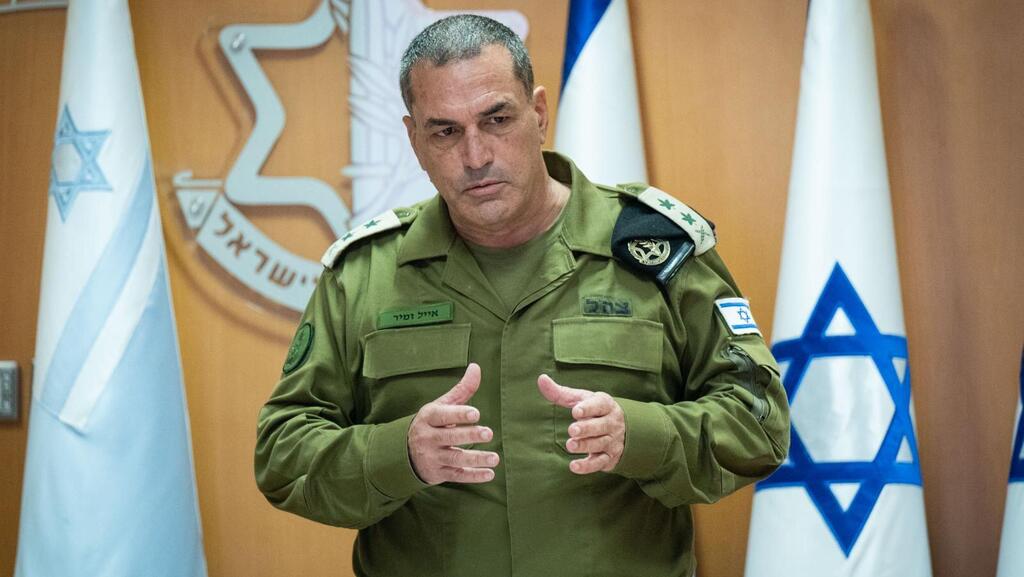
IDF Chief of Staff Eyal Zamir gives a situational update
(Photo: IDF Spokesperson's Unit)
Meanwhile, Israeli reservists will soon take over the “partition corridors” carved out during Chariots of Gideon I, including the Magen Oz and Morag routes. Regular army units from the 36th Division will redeploy into Gaza City. Reservist battalions, with fewer troops and resources, are considered more vulnerable. IDF officials fear Hamas may focus on attacking these static positions rather than directly confronting the main Gaza City assault.
The uncertainty has been compounded by political indecision. Netanyahu’s shifting short-term directives, commanders say, have left the military unsure where to concentrate its resources — whether to fortify existing corridors with permanent bases or leave troops exposed in temporary, vulnerable positions. Recent Hamas attacks, including the ambush of a Kfir Brigade unit and mortar fire on Golani troops near Nasser Hospital, highlighted the dangers.
Southern Command remains on high alert not only for ambushes on partition routes inside Gaza but also for possible cross-border raids into Israeli communities, despite the buffer zone established on the Gazan side of the border.