


The greatest threat: polarization and baseless hatred within the nation. Even after more than two and a half years of war, during which Israel has faced nearly all of its security threats on various fronts, most Israelis define internal polarization and baseless hatred within the nation as the country’s greatest threat. A new study on the issue found that 59% of the public believes internal polarization is the greatest threat.
The study also found that 39% believe the security campaign has deepened polarization, while 34% think the war has actually increased unity. According to the study, 30% of Israelis are considering leaving the country.
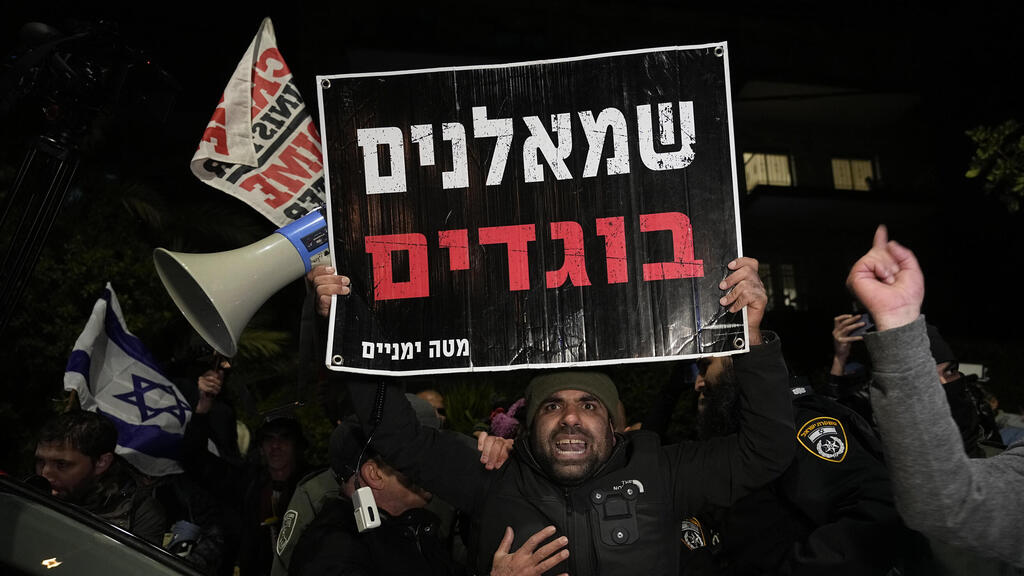
An unauthorized right-wing demonstrator is arrested by police while holding a sign reading 'Leftists are traitors'
(Photo: AP)
The study, conducted by the Agam Institute and the Dan Department of Communication at Tel Aviv University, presents alarming findings and warnings: The index measuring national and social polarization between population groups in Israel stands at 8.3 out of 10, which the institute defines as a “very advanced stage” of national risk. The institute’s report raises a red flag: “Israel is not merely a divided society; it is approaching a zone in which political and social polarization could turn into civil conflict.”
The study, which will be presented for the first time at the Tel Aviv University conference in partnership with the Kadar Foundation, is based on an examination of four dimensions.
The first is the depth and intensity of the rupture and divide, examining what the central rift is and characterizing the dispute. The study found that between 66% and 71% of the public believes the gap between the different camps over their vision for the identity of the state is significant to a large extent. This marks a 15% increase since August 2023, the height of the dispute over the judicial overhaul.
The nature of the rupture and divide in the country has also changed since that period. In the eyes of most of the public, the most significant rift is no longer the Israeli-Palestinian conflict or questions of diplomatic right and left. According to the index, the central divide in Israel is between secular and religious Israelis, between nationhood and democracy, and between the tension over majority rule and the need for checks and balances.
 Asa Shapira Photo: Tel Aviv University
The second dimension is the state of alienation and delegitimization. The central question examined is the extent to which each side sees the other as a legitimate citizen. The study found that more than 70% of coalition voters and opposition voters believe the conduct of the opposing camp harms Israel’s security. Only 10% of the public completely rejects that claim. As part of the examination of delegitimization, respondents were asked whether they would be willing to be friends with someone who votes for the opposing camp. Some 71% agreed — a decline of 10% compared with August 2023.
The third dimension examines trust in the central institutions and principles of Israeli democracy. On the question of democratic principles, a substantial gap emerged between coalition and opposition voters. About 57% of coalition voters believe that “the majority rules” is the most important principle in democracy, while only about 12% of opposition voters think so. By contrast, most opposition voters pointed to the principles of equal rights and balance between the branches of government as the most important principles, compared with about 20% of coalition voters who thought so.
Despite the gap, another question showed a shared position: 69% of the public is willing to give up some of the principles of the political camp to which they belong for the sake of national unity. The researchers stress with concern that 31% of the public — not a majority, but a significant share — said they are willing to accept division within the nation in exchange for preserving the principles of their camp.
 Dr. Nimrod Nir Photo: Agam Institute
The fourth dimension examined was the most severe of all: legitimization of politically motivated violence. The researchers examined whether polarization within the nation is already translating into physical confrontation, and this issue raised a serious warning sign. Some 6% of the public supports violence when it comes to achieving an important goal, and 11% of the public said they would support any action — including violence — if it involved saving Israeli democracy. Although these figures are relatively low, they still represent hundreds of thousands of citizens — a grave warning sign ahead of the elections.
The study’s authors, Dr. Nimrod Nir of the Agam Institute and Asa Shapira, head of the marketing track at Tel Aviv University’s School of Communication, emphasize that the 2026 National Polarization Index is “an emergency report, not a report of despair,” and that it serves as an important warning sign for the state.