

Thousands of people who travel each day between southern Spain and the British territory of Gibraltar can now cross without passing through a physical border.
The change took effect at midnight Tuesday after a border fence was removed, allowing freedom of movement under a historic treaty between the European Union and the United Kingdom following years of post-Brexit negotiations.
Gallery
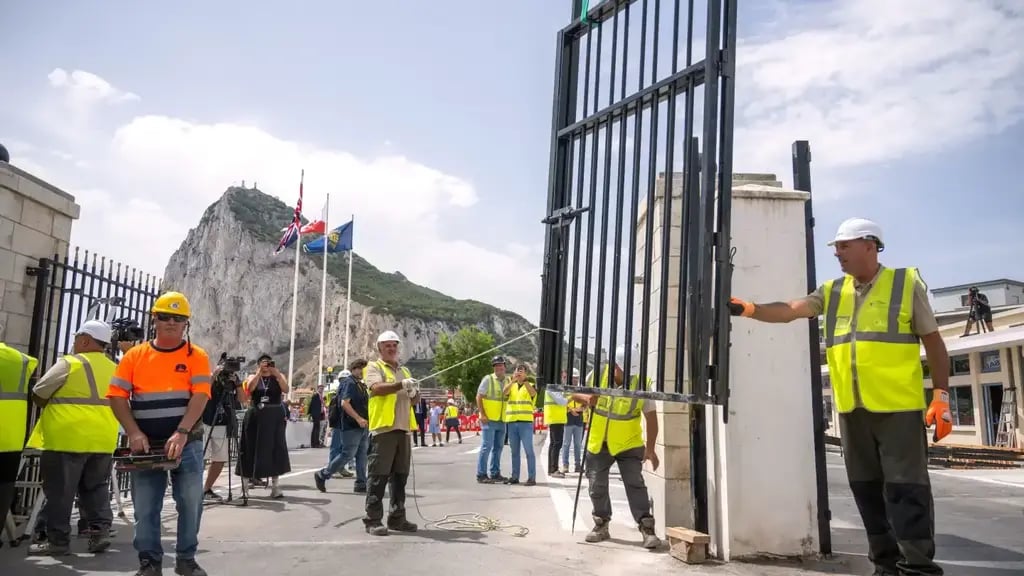
Workers remove the fence at the border crossing between Gibraltar and Spain
(Photo: Marcos Moreno/AP)
The disputed British overseas territory, home to about 38,000 people, sits at the southern tip of the Iberian Peninsula, just miles from Morocco, where the Atlantic Ocean meets the Mediterranean Sea.
Soon after midnight, crowds moved freely in both directions between Gibraltar and the Spanish city of La Línea de la Concepción. Many wore Spanish soccer jerseys following Spain’s victory over France in Tuesday’s World Cup semifinal, adding to the celebratory atmosphere.
“What you feel here is the brotherhood between the two peoples,” Gibraltar Chief Minister Fabian Picardo told Spanish broadcaster RTVE.
A deal years in the making
When Britain left the EU in 2020, Gibraltar’s relationship with the bloc remained unresolved.
Negotiations aimed at ensuring the continued movement of people and goods across the border made slow progress. In 2025, the EU and the U.K. announced an agreement on the outstanding issues. The two sides and Gibraltar’s government signed a treaty Tuesday easing border crossings.
U.K. Foreign Office Minister Stephen Doughty said the agreement secured Gibraltar’s long-term economic future and interests.
Maroš Šefčovič, the EU’s trade representative, also praised the deal.
“It has taken four years of patient, complex negotiation, but the outcome speaks for itself,” Šefčovič said. “It is a very special feeling to see a fence come down.”
Without an agreement, Gibraltar could have faced a hard land border with full passport checks, posing economic risks for a territory that relies heavily on about 15,000 Spaniards — nearly half its workforce — who cross the frontier each day for work.
Mendez Segura, 51, crossed from Spain into Gibraltar for work Wednesday, still adjusting to the new freedom of movement.
“I’ve been crossing over and working in Gibraltar all my life with my identity card,” the home care worker said. “I know you’ll be able to cross without it, but it’s just what I’m used to.”
Leisure and family travel on both sides of the border also would have been affected without a deal.
“People who are visiting family in Spain, or whose Spanish family is visiting them in Gibraltar. Children who are going to football matches and extracurricular activities, either in Spain or in Gibraltar. They will be able to do that without having to worry about frontier queues,” Picardo told The Associated Press.
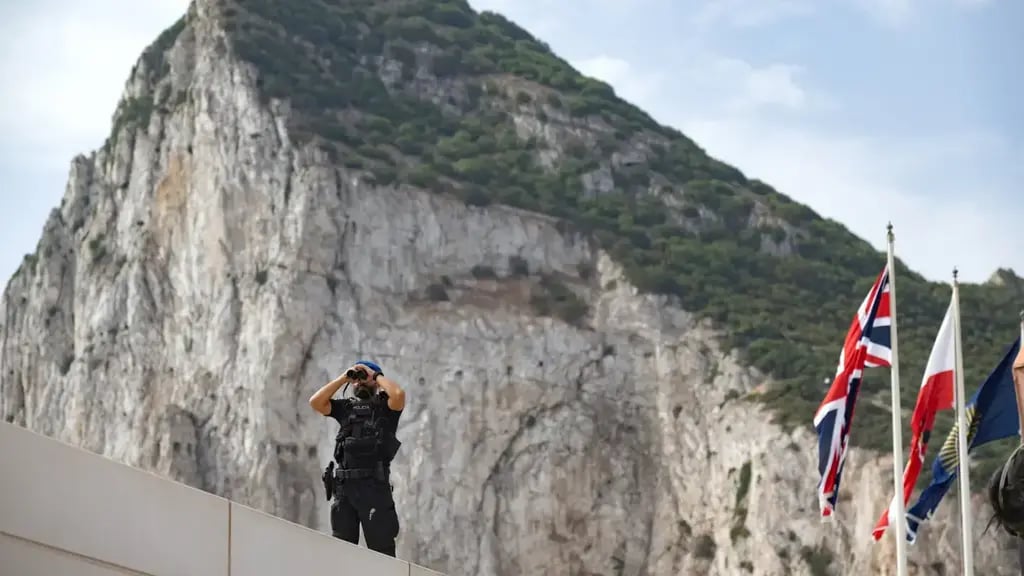
A Spanish police officer
(Photo: Marcos Moreno/AP)
The agreement effectively brings Gibraltar into the EU’s Schengen free-travel area. At Gibraltar’s airport and port, entry and exit checks will be conducted by both British and Spanish border officials.
The arrangement resembles the system at Eurostar train stations in London and Paris, where British and French officials conduct passport checks.
Gibraltar was ceded to Britain in 1713, but Spain has maintained its claim to sovereignty over the territory. Relations between the two countries over Gibraltar have fluctuated for centuries. The treaty removing the border fence does not resolve the dispute over the territory’s status.
In Britain’s 2016 Brexit referendum, 96% of voters in Gibraltar — popularly known in English as the Rock — supported remaining in the EU.
Travelers arriving in Gibraltar from countries outside the Schengen Area, including the U.K., will be subject to the EU’s Entry-Exit System. The system, introduced across Europe in April, replaces passport stamps with biometric information collected through photographs and digital fingerprints.
Facial recognition cameras at the Rock
With the border fence removed, Gibraltar officials have installed live facial recognition cameras at entry points and across the territory.
Picardo said Gibraltar would have many more closed-circuit television cameras and had increased its police presence and resources for customs and coast guard agencies.
“The fortress has become a digital fortress now,” Picardo said.