


U.S. President Donald Trump threatened Wednesday to resume bombing Iran at a “much higher level and intensity” if Tehran does not accept what he described as an emerging agreement to end the war, hours after he said he would temporarily suspend a U.S. operation aimed at breaking Iran’s blockade of the Strait of Hormuz.
“Assuming Iran agrees to give what has been agreed to, which is, perhaps, a big assumption, the already legendary Epic Fury will be at an end, and the highly effective Blockade will allow the Hormuz Strait to be OPEN TO ALL, including Iran,” Trump wrote on Truth Social. “If they don’t agree, the bombing starts, and it will be, sadly, at a much higher level and intensity than it was before.”
Gallery
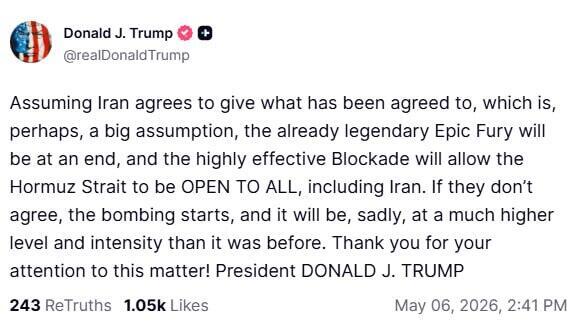
Trump: 'Assuming Iran agrees to give what has been agreed to, the already legendary Epic Fury will be at an end'
(Photo: Screengrab)
Trump’s statement came amid reports of significant progress in U.S.-Iranian contacts toward an initial memorandum of understanding to end the war, a step that would allow broader negotiations on a final agreement. But in recent hours, Iranian officials have also mocked Trump and portrayed him as having backed down in the face of Iranian threats after he did not renew the war following Iranian attacks Tuesday and Wednesday on ships in the Persian Gulf and on the United Arab Emirates and Oman — attacks he avoided describing as violations of the ceasefire.
Despite reports of progress, Iranian officials told the Qatari newspaper The New Arab shortly after Trump’s post that the United States was still making “excessive demands” in the negotiations.
“The negotiations are focused on ending the war, not on the nuclear issue,” the officials said. “Progress has been made in the talks with Washington through Pakistan, but it has not yet reached the level that would lead to an agreement. What has been published by the American media regarding the details of the negotiations does not reflect the reality of what is happening.”
The initial report of progress toward a memorandum of understanding was published by Axios, which said the White House believes it is nearing a one-page agreement with Iran to end the war and set a framework for more detailed nuclear negotiations. According to the report, the United States expects to receive Iran’s response within 48 hours on several points raised in the talks.
The reported deal would include an Iranian commitment to freeze enrichment for nuclear weapons for at least 12 years, U.S. agreement to lift sanctions and release billions of dollars in frozen Iranian funds, and an understanding by both sides to remove restrictions on passage through the Strait of Hormuz.
A Pakistani official familiar with the contacts later told Reuters that the Axios report was accurate. “We will close this very soon. We are getting close,” the official said.
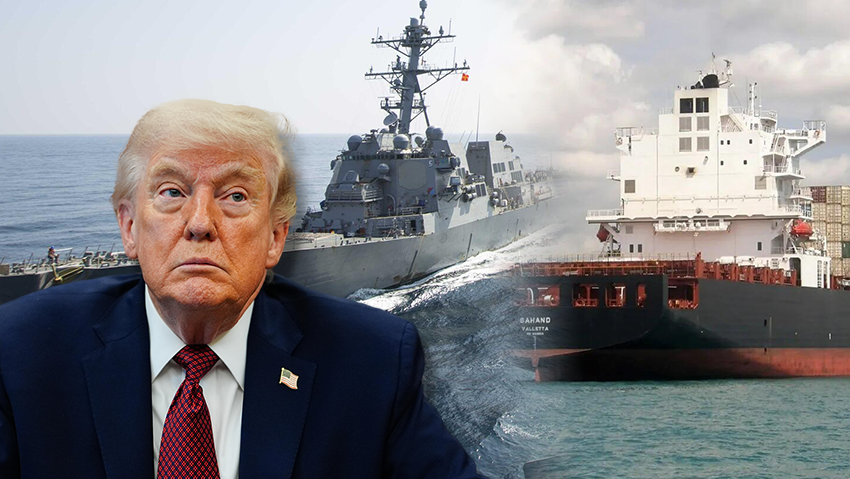
(Photo: Hans Rosenkranz, Marinetraffic.com, US Navy, AP Photo/Julia Demaree Nikhinson)
Saudi-owned Al Arabiya also quoted Pakistani officials as saying a draft agreement already exists and that most of its provisions have been approved by both sides. The draft, they said, sets a timetable for upcoming rounds of negotiations and includes reopening the Strait of Hormuz to international shipping.
“The two sides are closer to signing an initial agreement to end the war,” the Pakistani sources said.
According to those sources, negotiations after the initial agreement could continue for months. They said Iran had affirmed that it does not seek nuclear weapons and that the United States welcomed that statement.
Trump himself sounded more cautious in a brief telephone interview with the New York Post published Wednesday afternoon, saying it was “too soon” to discuss direct peace talks between the United States and Iran.
Iranian officials, responding to Trump’s renewed threat, also quickly issued their own warnings. Ebrahim Rezaei, spokesman for the Iranian parliament’s National Security and Foreign Policy Committee, denied the Axios report.
“What was reported in Axios is an American wish list,” Rezaei said. “Iran is on high alert, and if they do not surrender and make the necessary concessions, we will respond severely in a way that will make them regret it.”
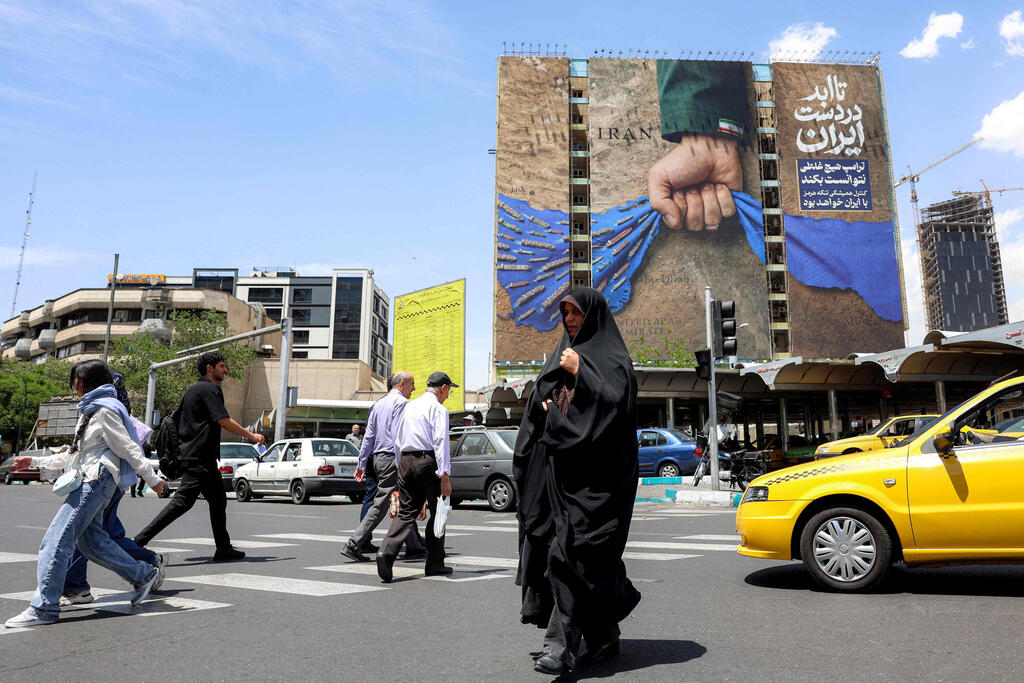
Tehran, Iran
(Photo: AFP)
Overnight, Trump had sounded more optimistic. In a post announcing what he described as significant progress in the talks, he said he had decided to pause “for a short period of time” Project Freedom, which was intended to resume the movement of ships and tankers through the Strait of Hormuz and protect them from the threat of attacks by the Islamic Revolutionary Guard Corps.
Trump stressed that the naval blockade of Iranian ports would continue until an agreement is reached. The operation, now suspended, did not lead to any substantial breach of the Iranian blockade in the strait. The United States has so far announced only the passage of two merchant ships on the first day of the operation.
Iran, for now, is not signaling any intention of compromising on its sovereignty claim over Hormuz, the strategic shipping lane it has blocked since the start of the war and now views as a strategic weapon. Under international law, the strait is a free shipping route that neighboring states cannot claim ownership over. The United States strongly opposes Iran’s demand that tankers and ships pay for passage through the strait.
According to the Axios report, management of traffic through the strait is also expected to be addressed in negotiations that would begin after the signing of an initial memorandum of understanding.
The Revolutionary Guard navy issued its first official response Wednesday to the suspension of the U.S. operation.
“We thank the captains and owners of vessels stationed in the Persian Gulf and the Gulf of Oman for their cooperation in passing through the Strait of Hormuz in accordance with Iranian regulations and for the participation of the vessels in regional maritime security,” it said. “With the end of the threats from the aggressors and in light of new procedures, safe passage will be possible.”
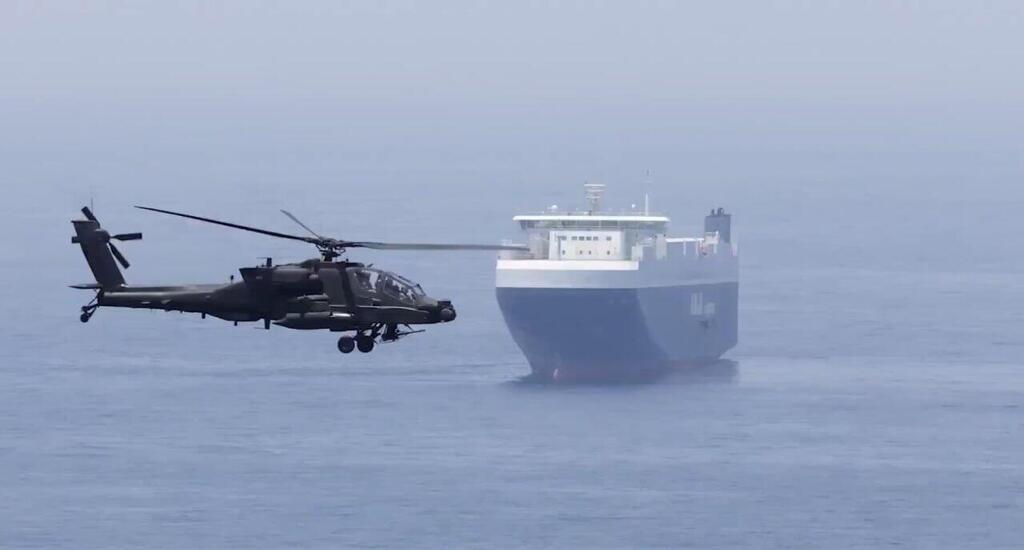
The Strait of Hormuz
(Photo: from X)
Meanwhile, an Iranian state TV reporter broadcasting from the coast near Hormuz boasted that “all eyes are on the place where I am standing” and said the world had been forced to comply with the Islamic Republic’s regime in the Strait of Hormuz “clause by clause.” He emphasized that ships cannot pass without approval from the Revolutionary Guard navy.
Israel is watching the latest developments with concern, amid fears that a weak agreement would not eliminate the strategic threat posed by Iran. Trump, for example, has not signaled that he will insist on an agreement that significantly restricts Iran’s ballistic missile program.
Some Israeli officials believe Trump ultimately will have to use military force, or that Israel will do so. But one Israeli official made clear that the decision rests with Washington.
“Your ability to influence is limited, and in the end, you have to accept the decision of the president of the United States,” the official said.
Gulf states have also expressed concern that an agreement with Iran at this stage could encourage its aggressive conduct toward its neighbors.