

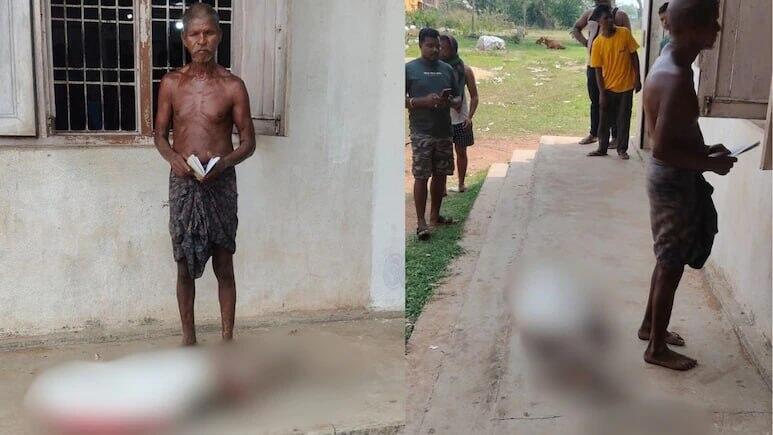
A viral video circulating on social media in India has sparked outrage after a man was seen carrying his dead sister’s remains to a local bank branch to prove she had died and argue that her savings should be released to him.
The man, 52-year-old Jeetu Munda from the eastern Indian state of Odisha, said he had been repeatedly turned away after trying to access the money his sister left behind. His claims, set against the wider difficulty many poor families in rural India face in obtaining official documents such as death certificates, prompted an investigation and public anger at the bank’s handling of the case.

The incident took place earlier this week, when Munda was filmed carrying his sister’s remains, wrapped in a sack, to the bank and placing them at the entrance. He said he acted out of frustration after repeated attempts to claim the money failed because he could not provide official proof of her death.
His sister, Kalara, died about two months ago at age 56. A few months before her death, she had sold her goats and cattle and deposited the 19,300 rupees, about $203, she received from the sale in the bank.
Munda told the BBC that since her death he had gone to the bank several times to collect the money but was not given access to it. He said he then went to her grave and removed her remains.
“When the bank manager refused to listen and kept asking for proof, I became frustrated,” he said. “I brought the skeleton to show that she had died.”
The video and Munda’s account triggered widespread criticism in India, with many accusing the bank and local authorities of failing to help him. The BBC reported that the case drew attention to the bureaucratic hurdles families often face when trying to access the bank accounts of relatives who have died, especially when the deceased did not leave clear instructions about who should receive the money.
Others pointed to the difficulties rural residents face when dealing with the banking system. According to The Guardian, obtaining an official death certificate in such areas can take months, and the process often becomes a bureaucratic ordeal for grieving families. Many in India saw the video as a heartbreaking example of how unforgiving the system can be, especially toward poor communities living on the margins.
Following the public outcry, Odisha Finance Minister Suresh Pujari said the matter was under investigation and that action would be taken against the branch manager over the alleged handling of the case. The bank, however, strongly denied the allegations.
Indian Overseas Bank, which operates Odisha Grameen Bank, where the incident occurred, said reports that staff had asked Munda to bring his late sister to the branch were false. It said Munda had been informed of the required procedures but had not completed them.
The bank also claimed that when Munda first came to the branch, he was drunk and caused a disturbance. It said he initially told staff that his sister was paralyzed and could not come to the bank, and only said she was dead after employees offered to visit her themselves.
The branch manager also rejected other claims made by Munda, saying other legal heirs had come forward to claim the money, which is why the bank requested the necessary documentation.
The bank said it never asked Munda to bring the remains, only the required documents. It added that the process has since been completed, the death certificate has been issued and the money has been handed over to the legal heirs in the woman’s family.