


Representatives of Hadash, Ta’al and Balad met Sunday evening and announced afterward that they were willing to reach an agreement with Ra’am on a technical joint run by the Arab parties in the upcoming elections. Hours later, Ra’am said it was prepared to join a “technical list” — but one that preserves each party’s political and public independence.
The parties have very different ideological views. Ra'am left the Arab joint list in 2021 to join the 18-month government coalition of Naftali Bennett and Yair Lapid.
The three parties stressed that they agree on the main political issues on the agenda and that, despite their differences with Ra’am, they are willing to reach understandings with the party led by Mansour Abbas on a technical joint run in the elections. Ra’am itself expressed optimism about a joint run and said it would discuss the matter after the meeting of the three potential partners.
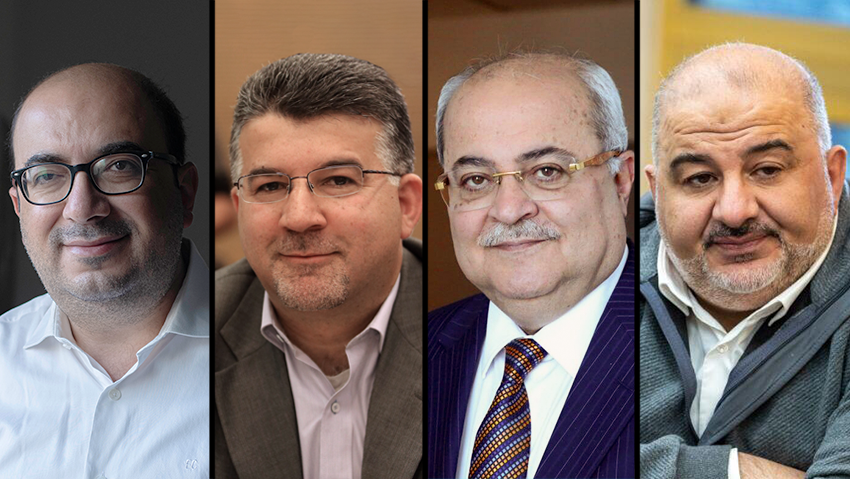
Fro right, Mansour Abbas, Ahmed Tibi, Yousef Jabarin and Sami Abu Shehadeh
(Photos: Shalev Shalom, Ryan Preuss, Alex Kolomoisky, Yuval Chen)
In a joint statement issued by Hadash, Ta’al and Balad, the parties said: “We hope to announce to our people, on the eve of Eid al-Adha, the reestablishment of the ArabJoint List, in a way that will restore hope to our public and strengthen its unity and ability to confront the growing challenges and dangers.”
Ra’am said it welcomed the three-party agreement, calling it “a significant step toward preventing the loss of Arab votes.” The party clarified that it was ready to sign an agreement for a joint technical list, but stressed that each party must preserve its political and public independence. Any binding clause between the parties, it said, “empties the technical model of its content.”
Ra’am added that the framework is intended to strengthen Arab representation in the Knesset and does not require shared political positions or mutual recommendations after the election. The party said the proposal allows each party freedom of action, including the possibility of future coalition cooperation. It also said understandings on the division of roles are “not binding” and are meant to prevent a repeat of past mistakes.
The move comes amid concern among Arab parties over the continued decline in voter turnout in the Arab public and the possibility that some parties will fail to cross the electoral threshold if they run separately. Figures in Arab politics estimate that renewed unity could bring voters back to the polls and significantly strengthen Arab representation in the next Knesset.