

Is the United States backing away from Israel’s demands in the negotiations? That at least is the impression from remarks by Iranian Foreign Minister Abbas Araghchi, comments by President Donald Trump in recent days and a CBS report on the intentions of US Middle East envoy Steve Witkoff.
Araghchi said Friday in an interview with MSNBC that the United States did not demand that Iran agree to "zero uranium enrichment" during the talks in Geneva, nor did it require Tehran to suspend enrichment. According to him, the discussions focused on steps that could prove to Washington that Iran’s nuclear program is intended “solely for peaceful purposes, and will remain so forever.”
Gallery

Steve Witkoff and Abbas Araghchi
(Photo: REUTERS/Evelyn Hockstein/Pool, Amer HILABI AFP, CameraObscura82 shutterstock, Smolkov Vladislav shutterstock)
He argued there is “no military solution” to Iran’s nuclear program and that diplomacy is the only path forward. “Iran is ready for both negotiations and war,” he said, adding that a draft of the new framework the United States is awaiting from Tehran will be ready “within two to three days.” After receiving the necessary approval, he said, he would forward it to Washington, potentially paving the way for another round of talks.
Araghchi also said International Atomic Energy Agency Director-General Rafael Grossi is playing a “constructive role” in the negotiations.
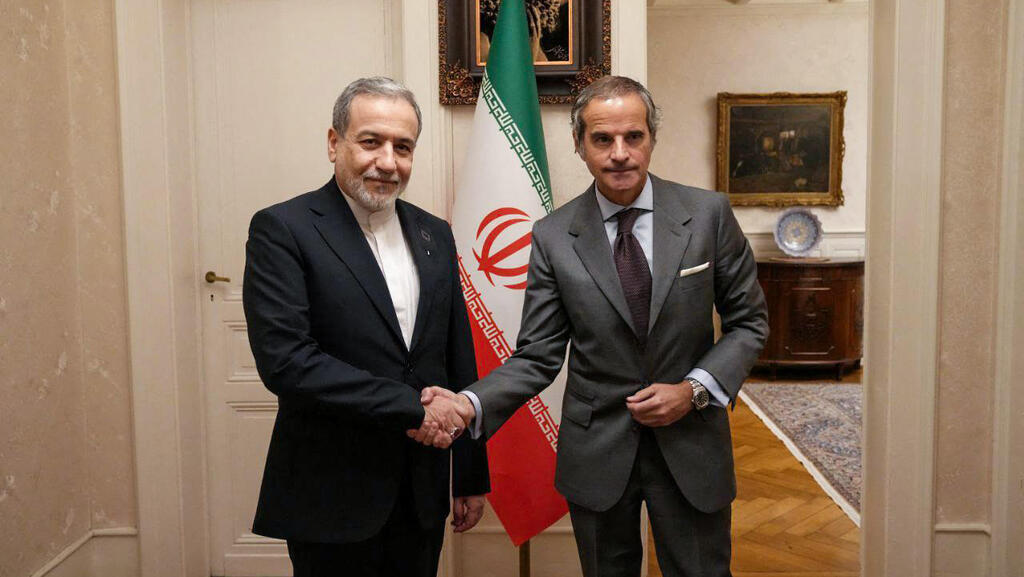
IAEA chief meets with Araghchi
(Photo: IRANIAN MINISTRY OF FOREIGN AFFAIRS / AFP)
Trump: We may reach a deal, we’ll find out in the next 10 days


Earlier, CBS reported that “unique proposals” were raised in the indirect talks between the United States and Iran regarding its nuclear program, its enrichment capabilities and its stockpile of enriched uranium, as well as ways to reach an agreement that would be “economically beneficial” to both countries. In that context, Iranian Oil Minister Mohsen Paknejad responded “everything is possible” when asked whether cooperation between Iran and the United States in the oil and gas sector could be feasible.
Two regional sources said diplomats advised Witkoff to separate the nuclear program from other issues in the negotiations, such as the regime’s support for militias in the Middle East, including the Houthis and Hezbollah, and Iran’s ballistic missile stockpile.
The two sources said Witkoff appeared to have adopted the idea of addressing those issues in a “separate diplomatic track,” together with regional actors. In addition, US officials and regional diplomats told CNN that Trump’s son-in-law and former Middle East envoy Jared Kushner still hopes a “nuclear agreement” with Iran can be reached.
Israel, however, has demanded that the negotiations not focus solely on resolving the nuclear issue, but also address Iran’s ballistic missiles and its regional proxies. Trump himself in recent days has appeared careful to mention only the nuclear program, without referring to the missile issue that he previously said was part of the talks. Just yesterday, while ignoring other issues under discussion, he said that Iran must not obtain a nuclear weapon and that there can be no peace in the Middle East if it does.
He later reiterated his warning that serious consequences would follow if Iran does not compromise in the negotiations, adding that Tehran must reach an agreement.
Meanwhile, according to CNN, the US military could be prepared to strike Iran as soon as this weekend, although US officials and diplomats do not believe such action will occur “imminently.” Other reports suggest Trump may soon order strikes, possibly “limited” ones, as part of an effort to pressure Iran into reaching an agreement.
Previous reports said the president could order an attack aimed at destroying Iran’s missiles, nuclear facilities and possibly even the regime itself, in a confrontation that would last at least several weeks and could entangle the United States in a new war in the Middle East.
As Trump keeps his cards close to the vest, the warship USS Mahan, part of the USS Gerald R. Ford Carrier Strike Group, transmitted signals Friday in the Strait of Gibraltar, indicating it is entering the Mediterranean Sea. It will join the substantial US forces already assembled in the Middle East, the largest buildup since the 2003 Iraq war, at significant cost.