

U.S. officials told The Washington Post that the Trump administration is prepared to launch a prolonged military campaign against Iran but is waiting for the aircraft carrier USS Gerald R. Ford and its accompanying warships to arrive in the region. The vessels approached the Strait of Gibraltar on Thursday, making it possible to begin an attack on Iran within days — though it could also happen sooner.
At the same time, U.S. officials and regional diplomats told CNN that the U.S. military could be ready to strike Iran as early as this weekend, though they do not believe it will happen “imminently.” They noted that Trump’s son-in-law and Middle East envoy, Jared Kushner, still hopes a nuclear agreement with Iran can be reached. Israel, however, is demanding a framework that also addresses Iran’s ballistic missile program.
Trump: Maybe we’ll reach a deal, we’ll know within 10 days


The Washington Post reported that it remains unclear whether Trump has approved military action. It added that while the United States and Israel have a clear military advantage over Iran, that does not mean Tehran is incapable of striking back. Daniel Shapiro, a former U.S. ambassador to Israel who served in a senior Pentagon role during the Biden administration, said a war with Iran carries “serious risks,” including ballistic missiles capable of killing American troops in the region and Tehran’s proxies across the Middle East that could ignite a far broader and deadlier regional war. He also warned of the potential for significant disruption to global oil markets and maritime trade.
“They would certainly suffer terrible damage from combined U.S. and Israeli strikes,” Shapiro said. “But that doesn’t mean it would end quickly or cleanly. Iran has the ability to impose certain costs on the other side as well.”
Officials familiar with the details said some American troops are expected to leave their bases in the Middle East for Europe or the United States as part of final preparations for a possible attack. Others will remain to defend facilities against potential retaliation.
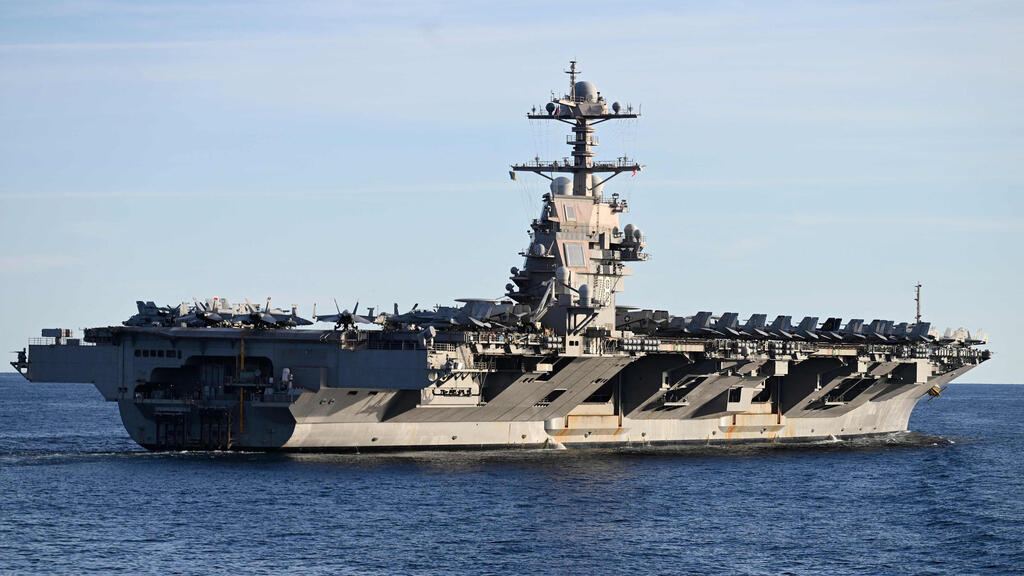
the aircraft carrier USS Gerald R. Ford
(Photo: Jonathan KLEIN / AFP)
The Washington Post noted that although the United States is awaiting a new Iranian proposal in the negotiations, “it is not clear whether Trump is prepared to wait that long.”
Regional diplomats initially believed the Trump administration’s military pressure was intended to push Tehran to offer more significant concessions. They now believe Iran is unlikely to shift from its “core positions,” including its right to enrich uranium. “The Iranians planned to drown them in technical details and defer the substance,” one diplomat said. “A traditional approach would rely on dialogue, but Trump doesn’t have the patience for that.”
According to the diplomat, signs that the Trump administration is preparing for a prolonged confrontation have become “deeply concerning.” He said some actors may have preferred limited strikes to increase pressure on Iran, but a sustained conflict would be bloody and could draw additional countries into the war, whether intentionally or by miscalculation.
‘Trump isn’t saying why’
The timing of any attack remains unclear, and Trump has issued conflicting statements about the deadline he set for Iran. A State Department official clarified that although Secretary of State Marco Rubio plans to arrive in Israel on Feb. 28, that does not mean initial U.S. strikes could not occur beforehand.
A prolonged confrontation would mark a significant shift in Trump’s policy. In the past, he sharply criticized previous U.S. administrations for entangling the country in long-term military interventions in the Middle East that led to the deaths of thousands of American troops and drained Pentagon resources. “Military operations look quick and easy — until they’re not,” said Jason Dempsey, a retired military officer. “What we did in Venezuela was unique and one-off, and even that I’m not sure will end well.”
Trump has a wide range of options, from striking nuclear and missile sites to attempting to assassinate regime leaders and topple the government. The New York Times gave prominent coverage to the issue, questioning why the United States is amassing massive forces in the Middle East — the largest since the Iraq War — without anyone explaining to the American public why, what objective is being pursued, how an attack would help achieve it and what has changed since last June, when Trump declared Iran’s nuclear program eliminated.
CNN similarly questioned why Trump has not publicly outlined what he hopes to achieve in a new war or sought to rally support from the American public or members of Congress.
U.S. military forces have not yet received a list of potential targets for strikes in Iran, CNN reported, a sign that Trump “has not yet pulled the trigger” or ordered any specific military action. White House officials say he continues to prefer a diplomatic solution, as he has stated publicly. However, they acknowledge that the chances of reaching an agreement that would satisfy the president appear to be diminishing.