

Dmitry Medvedev, Russia’s former president and current deputy chairman of its Security Council, wrote last week that it remains unclear how the ceasefire between Washington and Tehran will develop, but “one thing is certain: Iran has already tested its ‘nuclear weapon.’ It is called the Strait of Hormuz, and its potential is limitless.” Medvedev is considered one of President Vladimir Putin’s closest allies.
The New York Times on Sunday reviewed the conflict surrounding the Strait of Hormuz, through which about one-fifth of the world’s oil supply passes under normal conditions. The newspaper also reported that Iran continues to recover its missile stockpiles that were struck by the United States and Israel. Once the process is complete, some U.S. officials estimate Iran could restore up to about 70% of its prewar missile inventory. Other officials dispute that assessment, saying it is inaccurate. Still, there is broad agreement on one point: the Islamic Republic will retain enough military capability to close the strategic waterway in the future.
The Indian captain shouts: 'You are firing now!'


The Times reported that although the United States and Israel went to war with Iran in part to prevent the ayatollah regime from obtaining nuclear weapons, Iran already has a sufficient deterrent — its geography. Iran’s decision to close the strait drove a sharp rise in global fuel prices, as well as in fertilizer and other goods, disrupting war planning in Washington and Jerusalem. It also prompted what the report described as efforts to develop “military options to wrest control of the strait from Iran.”
“Everyone now knows that if there is a future confrontation, closing the strait will be the first move in the Iranian playbook,” Danny Citrinowicz, a former head of the Iran branch in Israeli military intelligence and now a fellow at the Atlantic Council, told the Times. “You can’t defeat geography.” He added that Iran viewed the June war as an Israeli campaign serving its own strategic goals. “Now it is a war for regime change.”
According to the Times, even naval mines and the risk they pose are enough to deter commercial shipping and oil tankers from passing through the strait. However, Iran retains more precise capabilities, including attack drones and short-range missiles. U.S. military and intelligence officials estimate that even after the war, Iran still possesses about 40% of its attack drone arsenal and more than 60% of its missile launchers — “more than enough to hold traffic in the Strait of Hormuz hostage in the future.”
Trump: Iran can't blackmail us
(Video: TheWhiteHouse)
U.S. President Donald Trump last week imposed a naval blockade on all ships departing from or heading to Iranian ports after Tehran refused to reopen the strait as part of a temporary ceasefire agreement — an agreement Iran said was violated because it initially did not include Lebanon. Two days ago, after Trump compelled Israel to agree to a ceasefire with Hezbollah, Iranian Foreign Minister Abbas Araghchi announced that traffic through the strategic strait would be fully restored. Oil prices plunged following the announcement and Trump thanked Iran.
However, on Saturday morning — in a move that may indicate internal divisions within the regime — Iran’s Revolutionary Guard abruptly announced that the strait would be closed again, apparently in response to Trump’s statement that the naval blockade would remain in place until a broader agreement is reached.
Several ships managed to pass through the strait before the announcement, but after the Revolutionary Guard’s statement, two vessels were reportedly attacked there, including a supertanker carrying oil from Iraq. The tanker reported it had come under fire from two Revolutionary Guard speedboats. The second vessel reported “unidentified ordnance” that damaged several tankers on board. No casualties were reported in either incident, but the affected ships, along with others preparing to transit the strait, were forced to turn back. Both vessels were sailing under the Indian flag, and India later summoned Iran’s ambassador in New Delhi for a reprimand, expressing “deep concern” over the attacks.
Meanwhile, The Wall Street Journal reported that the U.S. military is preparing to seize, possibly within days, oil tankers and commercial vessels linked to Iran. The seizures are expected to take place in international waters, including areas far from the Strait of Hormuz and the Persian Gulf, where the U.S. Navy is already enforcing a blockade. The move is intended to increase economic pressure on the ayatollah regime in an effort to push it toward compromise in negotiations with the United States and to reopen the strait.
The Times reported that the blockade is having a significant impact on Iran. Maritime trade accounts for about 90% of the country’s economic output — roughly $340 million per day — and that flow has largely been disrupted in recent days.
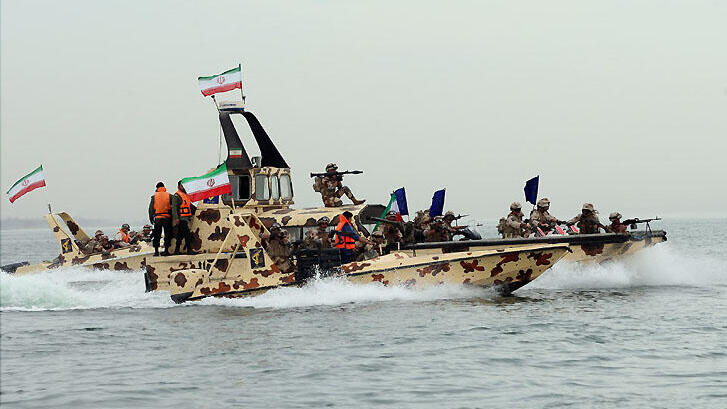
Iran's Revolutionalry Guards 'mosquito fleet'
(Photo: Wikipedia)
For now, it remains unclear how talks between the United States and Iran will evolve. Mohammad Bagher Ghalibaf, Iran’s parliament speaker who led its negotiating delegation to Islamabad last week, told the Iranian Tasnim news agency that “there has been progress in the negotiations with the United States, but significant gaps remain.” He said, “We have reached conclusions on some issues, but not on others, and various proposals have been raised. We are still far from a final discussion. We insist on several issues that are nonnegotiable for us. The talks in Islamabad have not removed our distrust of the United States, but I think mutual understanding between the two sides has become more realistic.”
On Saturday, after Tehran again announced the closure of the Strait of Hormuz, Trump told reporters in the Oval Office that “talks with Iran are going well,” but added that “they can't blackmail us.”
“The West tends to act as if Iran is a country with a clear chain of command — you negotiate with the Foreign Ministry, they pass it up the ranks, decisions are made, and that’s it,” Mohamed Amersi, an Iran expert and a member of the Wilson Center’s global advisory council, told The Wall Street Journal. “When the moment of truth comes, the guys with the guns, drones and speedboats tend to win the arguments.”