

When does daylight saving time begin in Israel in 2026?
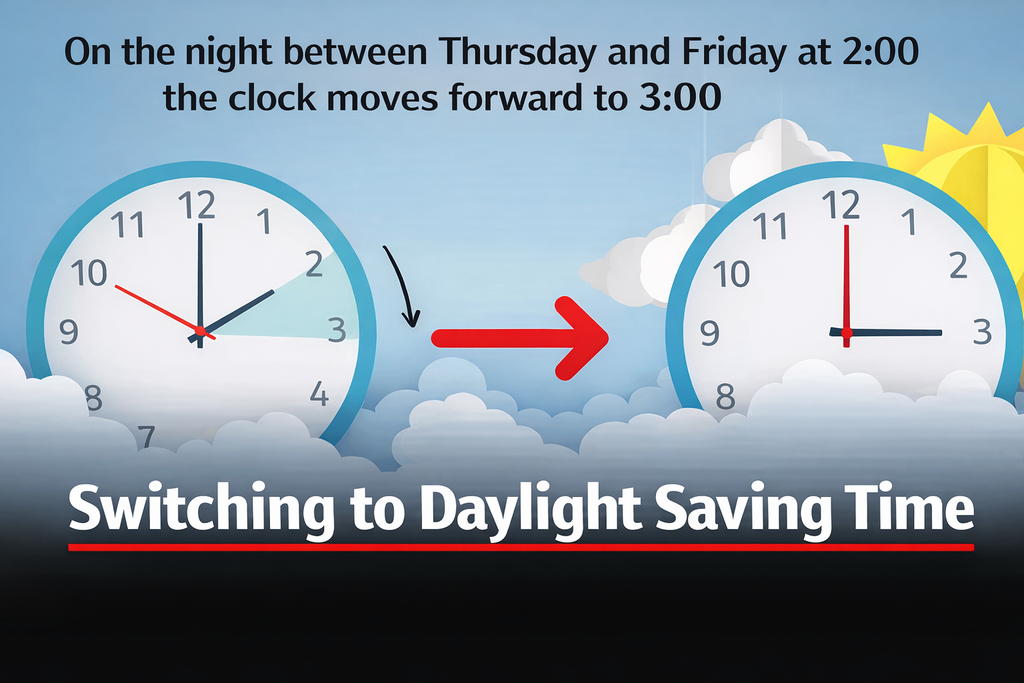
Daylight saving time will begin on the night between March 26 and March 27, 2026 (Thursday to Friday). At 2:00 a.m., clocks will move one hour forward, meaning we will lose one hour of sleep. Daylight saving time will remain in effect until the switch back to winter time on October 25, 2026.
How can I make sure my alarm works correctly?
In most smartphones, the time updates automatically, so no manual change is required. If you are unsure whether your phone updates the time automatically, go to your device’s settings and check the Date and Time settings. If needed, switch from automatic adjustment to manual and set the local time zone to Jerusalem.
What happens to our sleep?
Because the clock moves forward by one hour, we effectively sleep one hour less on the first night of daylight saving time.
Why do we change the clocks at all?
The shift between winter and summer time in Israel is determined by the Time Determination Law, last updated in 2013. According to the law, clocks move forward by one hour each year from the Friday before the last Sunday in March until the last Sunday in October. The change also marks the transition into warmer seasons with longer daylight hours.
When will it get dark?
On the last day of winter time, sunrise will be at 5:34 a.m. and sunset at 5:58 p.m.
On the first morning of daylight saving time, sunrise will be at 6:33 a.m. and sunset at 6:59 p.m.
How does winter time affect us?
During winter, when daylight is limited and nights are longer, the body produces higher levels of melatonin, often called the “darkness hormone,” which regulates the sleep cycle and can make people feel more tired or sleepy.
Another hormone, serotonin, which affects mood and emotions, is also linked to exposure to sunlight. Reduced sunlight during winter may lower serotonin levels and contribute to low mood or seasonal depression.

Sunrise on the Sea of Galilee
(Photo: Tami Nehemia for the Kinneret Cities Association)
How does the clock change affect daily life?
Switching between winter and summer time helps align human activity with daylight hours. In summer, people gain an extra hour of evening light, while in winter most people wake up closer to sunrise, making better use of daylight hours for daily activity and economic productivity.
Why not keep daylight saving time all year?
Because of its advantages, some people support keeping daylight saving time year-round. Opponents of winter time argue that it reduces family time in the evening, increases the risk of road accidents due to driving in darkness, distorts alignment with time zones in Europe and other regions, and costs the economy hundreds of millions of shekels.
What happens in other countries?
Several countries have stopped switching their clocks between summer and winter time, including most nations in Asia, Africa and South America. In the United States, there are also efforts to eliminate seasonal clock changes.
In 2019, the European Parliament voted to abolish the seasonal time change, allowing each EU country to decide whether to remain permanently on standard time or daylight saving time. The issue has also been debated in Israel several times, but the Knesset ultimately decided to maintain the current system.
When will daylight saving time end?
Daylight saving time will end on the night between Saturday and Sunday, October 25, 2026, when clocks will move back one hour.
First published: 22:29, 03.08.26