

Air raid sirens sounded Wednesday morning in Riyadh and the nearby city of Al-Kharj, a day after Yemen's Houthi rebels struck the headquarters of Saudi oil giant Aramco in Dhahran, eastern Saudi Arabia. The Saudi Energy Ministry confirmed that an administrative building at the company's headquarters was hit, causing what it described as a limited fire. There were no casualties, while international media reported that it remained unclear whether the building had been struck directly by a missile or damaged by interception debris or shrapnel.
The attack followed Saudi airstrikes on oil facilities in Houthi-controlled areas of Yemen. Before the strikes, Saudi authorities issued an evacuation warning for facilities belonging to the Yemeni Oil Company, particularly the al-Sabaha station in the capital, Sanaa. The Houthis subsequently issued their own warnings to Aramco employees, identifying the company's headquarters in Dhahran, King Khalid International Airport in Riyadh and Aramco's Riyadh refinery as potential targets. Like the Saudis, the Houthis included precise locations of the threatened facilities in their announcements.
Gallery
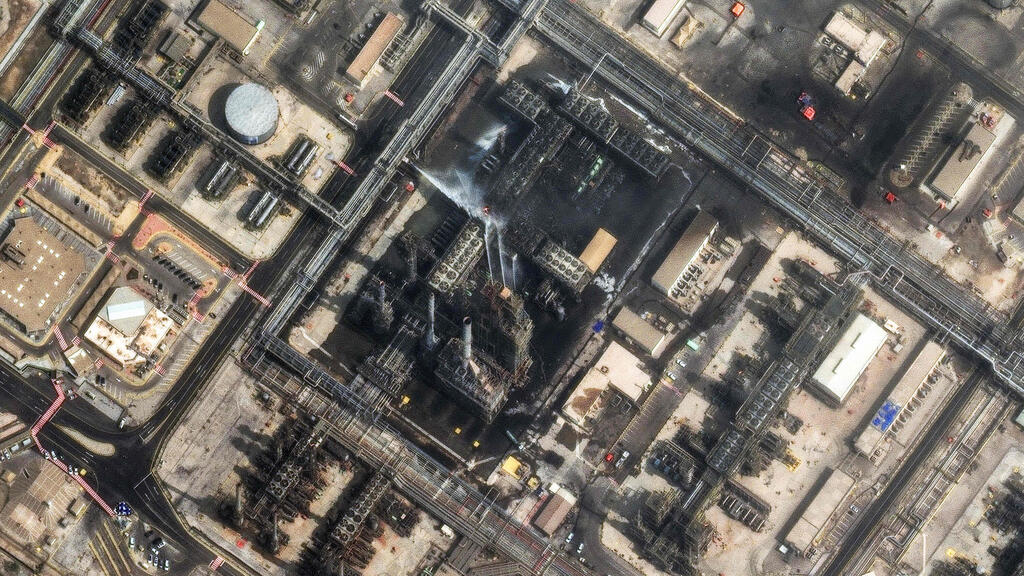
Saudi Aramco's Ras Tanura oil refinery targeted by Iranian drones
(Photo: AFP PHOTO / SATELLITE IMAGE ©2026 Vantor)
The exchange came after a devastating Houthi attack on Riyadh's international airport on Saturday, which killed at least 13 people and wounded 309. A regional official familiar with the details told the Associated Press that the missile struck an area containing passenger terminals 3 and 4, which serve domestic flights.
According to the Saudi aviation authority, the dead included foreign nationals from the United States, Egypt, Jordan, Syria, the Palestinian territories, Sudan and Bangladesh, as well as Saudi citizens. Reports said the airport was evacuated and numerous ambulances were dispatched to the scene. US Secretary of State Marco Rubio subsequently confirmed that an American citizen had been killed and strongly condemned the attack, calling for an immediate end to strikes that endangered innocent civilians. Saudi authorities deployed heavy security around the airport and warned against distributing footage of the Houthi attacks.
Saturday's strike came just two days after another deadly Houthi assault on the same airport, Riyadh's main international aviation hub. During the earlier attack, at least one passenger aircraft, reportedly empty at the time, was damaged, and three Saudi citizens, including a pilot, were killed. Three additional people were killed in previous attacks on airports in Riyadh and Abha last week.
Standing in line, then an explosion: moment a Houthi missile struck Riyadh airpot
(רויטרס )


The strikes mark a significant escalation in the long-running conflict between Saudi Arabia and the Houthis. Fighting has continued inside Yemen between the Iran-backed rebels and forces loyal to the internationally recognized Yemeni government, which receives Saudi military support, including extensive airstrikes. The growing ability of the Houthis to disrupt Saudi aviation represents an especially serious challenge for Riyadh, exposing vulnerabilities in its defenses and undermining confidence in the kingdom's ability to protect vital infrastructure.
Repeated missile attacks have also severely disrupted international aviation, effectively restricting access to Saudi airspace and putting additional pressure on airlines already struggling with the effects of regional wars and soaring fuel prices. The damage to airports, combined with the threat to energy infrastructure, has heightened concerns about how long the kingdom can sustain such disruptions.
The Chinese connection
Meanwhile, a report published Wednesday by The Wall Street Journal revealed that the Houthis had obtained a range of components from Chinese suppliers to develop their own version of Iran's Kheibar Shekan ballistic missile. The findings, based on research by Conflict Armament Research, suggest that the rebels are working to manufacture more advanced weapons domestically rather than relying exclusively on complete missile systems smuggled from abroad.
The Iranian missile, which has reportedly been used against US military targets during the war with Iran, is designed to maneuver toward its target and potentially evade air defense systems. According to US assessments cited in the report, certain versions feature a warhead that separates during the final phase of flight and uses a small propulsion system to adjust its trajectory. The technology could make interception considerably more difficult.
ביקור נשיא סין שי ג'ינפינג ב וייטנאם האנוי 14 באפריל
(צילום: Athit Perawongmetha/Pool Photo via AP)
The Conflict Armament Research report described two shipments intercepted by Yemeni authorities in 2025, with missile-related equipment concealed among other goods. The seized material reportedly included metal components for missile bodies and engines, stabilizing fins, solid-fuel rocket motor components and heat-resistant materials designed to protect parts of the missile during launch.
According to UN reports cited by The Wall Street Journal, Chinese companies have become the largest source of goods destined for the Houthis. Beijing, however, maintains that it complies with restrictions on arms sales to the rebel group. The findings raise concerns about the Houthis' growing manufacturing capabilities and their ability to acquire increasingly sophisticated missile technology despite international restrictions.
The latest escalation is also raising fears of wider economic consequences for Saudi Arabia. The kingdom's real GDP is projected to contract by 3.6% this year, reflecting several factors, including declining oil activity. The attacks have added pressure ahead of major international gatherings scheduled for Riyadh this month, including the kingdom's flagship investment conference and the World Petroleum Council's energy congress. Several senior executives have reportedly canceled plans to attend.
The impact is extending beyond the suspension of operations at Riyadh's airport. Employees in the capital's financial district were instructed to work from home Wednesday amid continuing security concerns, illustrating how the Houthi campaign is increasingly disrupting the kingdom's economic and commercial life.