

The dramatic shift unfolding in Judea and Samaria, led by Finance Minister Bezalel Smotrich, is reflected sharply in the budget. ynet and Yedioth Ahronoth reveal for the first time the extensive funding Smotrich is directing beyond the Green Line: billions of shekels from the state budget aimed at reshaping the settlements. The funds are earmarked for transferring IDF bases, building infrastructure for dozens of new communities, opening access roads, and strengthening defense systems.
One of the most significant steps is the transfer of military bases across the Green Line, particularly to northern Samaria. Under the Oslo Accords, Israel removed several bases in order to reduce its control over the area. The current effort reverses that approach, seeking instead to reinforce Israeli presence in northern Samaria by relocating bases to the area of Sa-Nur, a community evacuated under the Disengagement Law. As previously reported by ynet and Yedioth Ahronoth, settlers intend to return to Sa-Nur before the upcoming elections and implement the government’s decision, ensuring a permanent Jewish presence there.
Gallery

Bezalel Smotrich
(Photo: GONZALO FUENTES / POOL / AFP, Shalev Shalom, Menahem Kahana / AFP, Reuters)
The divisional headquarters for the Menashe Brigade, currently based at Camp Ein Shemer, is set to move to Sa-Nur. Alongside it, two battalion bases will also be relocated to the same area. It marks another major step in reinforcing Israel’s presence in the territory previously vacated.
The largest component of the plan is a roughly 2.7 billion shekel investment spread across the next five years, focused on strengthening a wide range of infrastructure beyond the Green Line. The plan addresses all elements that bolster Israeli governance there — effectively, a form of de facto annexation.
Of that sum, 1.1 billion shekels will go toward strengthening and establishing communities. Some 660 million shekels will be directed to the 17 new communities recently approved by the government, including Maalot Halhul, Sa-Nur and Mount Ebal. Another 338 million shekels will go to 36 communities and outposts undergoing regulation. These funds cover basic infrastructure such as water, sewage and electricity, along with public buildings like ritual baths, synagogues and community centers.
In the new communities, “absorption clusters” will also be built — about 20 caravans per site that will allow families to move in and create an initial core population. The state will transfer roughly 300 million shekels to all the new communities: 160 million as an “establishment grant” and 140 million for “organization and activity.” Another line item allocates “grants to established communities,” distributing 434 million shekels among existing communities based on population, to rehabilitate infrastructure. An additional 300 million shekels will be distributed to regional and local councils in Judea and Samaria.
Some 225 million shekels will be allocated for establishing a land registry unit. This is one of Smotrich’s most consequential moves beyond the Green Line and will affect roughly half a million residents and the state. Until now, property purchases in the area were recorded with the Civil Administration (the Jordanian-era registry) rather than in Israel’s land registry. After a mapping process, all land records will be transferred to a dedicated registry for Judea and Samaria. The unit will have 41 staff positions and aims to formalize about 60,000 dunams by 2030.
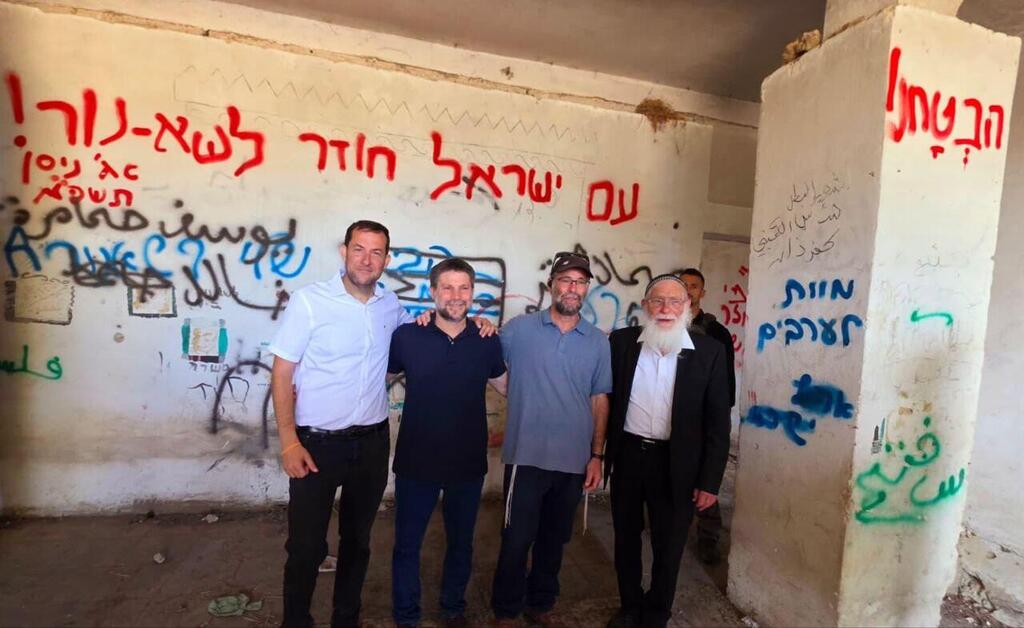
Smotrich in Sa-Nur, last August; the plan: to move bases to a settlement that was evacuated during the disengagement
Another 140 million shekels will go toward opening new access roads, mainly to meet IDF needs. Funding for security components is also increasing: the government will allocate 150 million shekels over the next three years to upgrade armored buses in Judea and Samaria (50 million per year), roughly quadrupling previous investments of about 36 million. In addition, Defense Minister Israel Katz is expected to transfer millions more from the defense budget to reinforce security in new communities, including smart fences, equipment posts, cameras and other systems.
These budget allocations reshape Israel’s approach beyond the Green Line, creating a reality that future governments will find difficult to reverse. Behind the scenes is the Yesha Council, which has regained significant political influence over the past year. Its officials, including CEO Omer Rahamim, were seen at the Finance Ministry in the days leading up to the budget vote and on the night of its approval.
Professional work on Judea and Samaria affairs relies heavily on coordination between the Yesha Council and Smotrich’s office, which also engaged with Defense Minister Katz’s office, the defense establishment, and the IDF. This budget is the realization of plans the Yesha Council has long sought to implement and that Smotrich is now bringing to fruition.