


With 77 days remaining until Israel’s election, the political blocs are still taking shape and the final party lineup remains far from settled. One factor, however, is becoming increasingly important: small parties hovering around the electoral threshold could ultimately determine who forms the next government.
A new analysis published Tuesday by the Taub Center for Social Policy Studies in Israel warns that the number of votes required to enter the Knesset is expected to rise sharply, largely because Israel’s eligible voting population has grown substantially since the 2022 election.
Gallery

Israel’s growing electorate could push Knesset entry threshold close to 200,000 votes
(Photo: Amit Shabi, Rafi Kotz, Alex Kolomoisky, Shutterstock, Marc Israel Sellem, Motti Kimchi)
If the scenarios outlined by the center materialize, and no major mergers take place among smaller parties, several could struggle to clear the electoral threshold, potentially leaving hundreds of thousands of votes unrepresented.
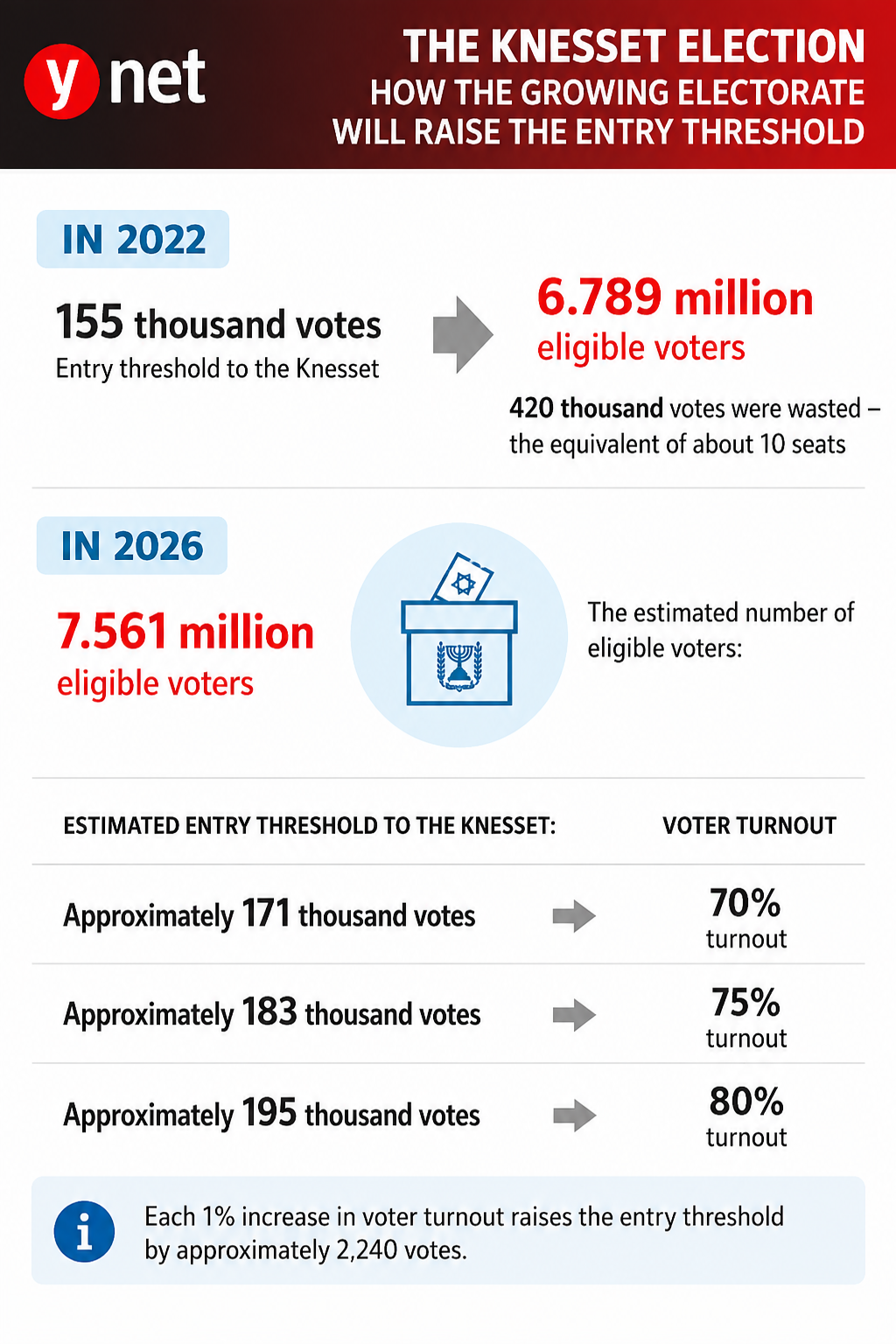
In the 2022 election, a party needed roughly 155,000 valid votes to cross the threshold. Nearly 420,000 votes, or 8.8% of all ballots cast, ultimately went to parties that failed to enter the Knesset, an amount equivalent to roughly 10 parliamentary seats.
This time, the bar is expected to be considerably higher.
The number of Israelis eligible to vote has risen from 6.789 million in November 2022 to an estimated 7.561 million by the end of October 2026. The increase stems both from large age cohorts reaching voting age and from significant waves of new Israeli citizens receiving citizenship.
How many votes will a party need in the 2026 election? The answer depends on both the size of the electorate and turnout.
According to the Taub Center’s scenarios, if turnout reaches 70%, similar to the previous election, a party would need around 171,000 valid votes to clear the threshold.
At 75% turnout, the required number would rise to roughly 183,000.
And if turnout reaches 80%, slightly above levels recorded in Israel from the 1970s through the 1990s, a party would need approximately 195,000 votes to enter the Knesset.
Even a threshold of 160,000 votes would pose a significant obstacle for smaller parties. That could affect parties or lists associated with Chili Tropper and Yoaz Hendel, Benny Gantz, Gilad Erdan and Yuli Edelstein, and potentially Ofer Winter, leaving several at risk of falling short.
Political officials believe Tropper, who has previously said he would not allow votes to be wasted, would seek a merger if polls close to the deadline for submitting candidate lists showed his party failing to clear the threshold safely.
Regarding Erdan and Edelstein, political assessments suggest that even if their parties fail to enter the Knesset, the votes lost could be divided relatively evenly between Prime Minister Benjamin Netanyahu’s bloc and the opposing bloc.
Prof. Alex Weinreb, who authored the Taub Center paper, said every increase in turnout would push the numerical threshold higher. According to his calculations, each one-percentage-point increase in voter turnout raises the number of votes required to enter the Knesset by approximately 2,240.
The implication, he said, is that leaders of parties unable to secure support from at least 200,000 voters may be directly endangering their political bloc.
Large numbers of voters ending up without parliamentary representation, he added, could also damage public confidence in democracy and state institutions.
“Polls give an indication of the level of support for each party relative to the electoral threshold, but it is important not to confuse the percentage threshold with the actual number of votes needed to cross it. The latter determines who enters the Knesset,” Weinreb said.
“It is important that in the coming weeks, leaders of small parties and their advisers keep this in mind when they look at the numbers. They need to remember that even the most reliable polls have a margin of error around every estimate, and that margin also grows when percentages are converted into absolute numbers.
“Given the rapid growth in Israel’s voting-age population and expectations of particularly high turnout in the coming election, my message to those people is simple: If your party does not have 200,000 votes, do the right thing and leave the race. Find another way to contribute to the country.”
The Taub Center for Social Policy Studies in Israel is an independent, nonpartisan research institute focusing on economic and social policy. It provides policymakers and the public with research and data on issues including education, health care, welfare, the labor market and economic policy.