

A new study by JPPI (the Jewish People Policy Institute), based on advanced artificial-intelligence analysis, points to a systematic pattern of exceptional treatment by UN Secretary-General António Guterres toward the State of Israel, both in the volume of his statements and in their tone, even though his role requires fairness and neutrality toward all countries.
The study, conducted by analysts at JPPI’s Diane and Guilford Glazer Information Center, examined more than 1,100 official statements made by the Portuguese UN Secretary-General since he assumed office in January 2017 through April 2026. These included statements delivered to journalists or published on the UN website. The analysis compared references to Israel with references to a selected group of other countries accused of human-rights violations, including Iran, China, Russia, North Korea, and Qatar.
The analysis included both a quantitative measurement of the scope of the references and a sentiment analysis of the tone of the statements, using advanced AI-based tools.
Volume of statements: Israel leads by a wide margin
The data shows that Israel is the country mentioned most frequently in statements by the UN Secretary-General, by a significant margin over the other countries examined. The volume of references to Israel is higher even than that of major countries such as Russia, and nearly three times higher than the number of references to Iran.
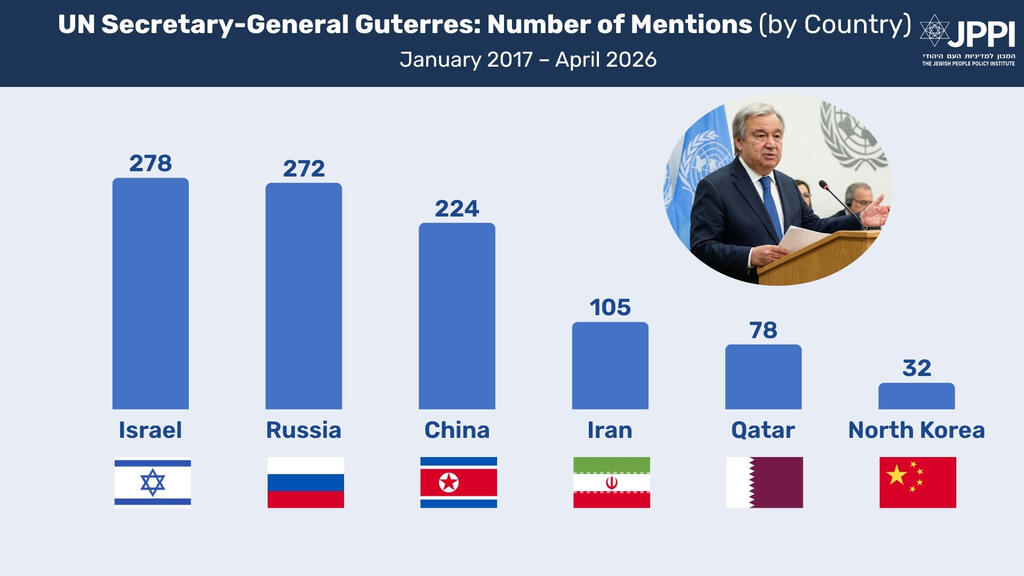
Number of mentions by Guterres
(Photo: JPPI)
The Tone toward Israel: the most negative
The sentiment analysis yielded similarly stark findings: more than half of the statements about Israel were negative, the highest share among all countries examined. By contrast, statements about countries such as Iran were mostly neutral, with positive references outnumbering negative ones.
Negative statements about China were de minimis, despite criticism by Human Rights Watch, Amnesty International, and other human rights organizations of his relative silence on China’s alleged persecution of its Uyghur minority.
Qatar received particularly favorable treatment.
Even when criticism was directed at Russia, its scope was narrower than the criticism directed at Israel.
The study also identifies a clear trend of an intensifying negative tone toward Israel over the course of the UN Secretary-General’s tenure, especially in recent years.
Guterres has, on several occasions, expressed support for Israel’s right to exist and to security; he condemned the October 7 attack, met with families of hostages, and called for their release. Yet a qualitative analysis of the full body of his statements reinforces the numerical findings and points to a consistent pattern: even when the UN Secretary-General condemns terrorism against Israel, the emphasis quickly shifts to criticism of Israeli policy.
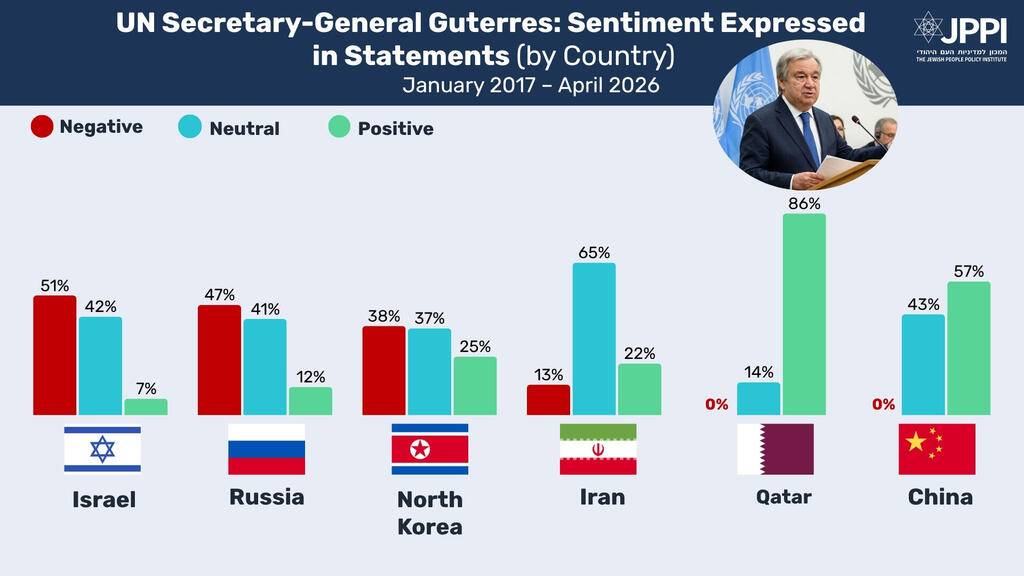
Sentiments expressed by Guterres
(Photo: JPPI)
Similarly, even when Israel’s right to security is acknowledged, that recognition is not expressed with the same force as the criticism directed at Israel.
For example, in a statement on October 13, 2023, just days after the Hamas attack, in which 1200 Israelis were murdered and another 250 abducted, the UN Secretary-General opened with the assertion: “The situation in Gaza has reached a dangerous new low.”
Although the Secretary-General did condemn the Hamas onslaught, he devoted relatively brief attention to it, while the bulk of his remarks focused on sharp criticism of Israel, including the evacuation of civilians in Gaza and claims that Gaza’s health system had been harmed:
“Moving more than one million people across a densely populated warzone to a place with no food, water, or accommodation, when the entire territory is under siege, is extremely dangerous — and in some cases, simply not possible.”
In a January 2024 statement, he described Israel’s Gaza operations as the “most intensely destructive campaign” since he became Secretary-General: “The relentless Israeli bombardment… is the most intensely destructive campaign waged since I became Secretary-General.”
In another statement, from August 2025, he directly accused Israel of harming civilians, medical teams, and journalists, describing its actions as “horrors,” while making only minimal reference to the hostages and the terrorism that led to the war:
“One attack was followed by another — killing civilians, including medical personnel and journalists who were carrying out their essential work. All with the world watching. I know so many of the reporters here — along with us — have lost dear colleagues. These attacks are part of an endless catalogue of horrors.”
As noted, the study presents a consistent pattern of bias in the UN Secretary-General’s statements regarding Israel, both in volume and in tone. Israel receives an exceptional level of attention and an especially high level of criticism, while other countries, including some accused of systematic human-rights violations, receive more moderate, neutral, and at times even sympathetic treatment.
The findings raise questions about the objectivity of the person holding one of the most influential positions in the international arena.
The data was collected and analyzed by JPPI researchers: Shlomi Bereznik, Eli Kannai, and Yaakov Katz.
“The findings of this study are not based on feelings or political perceptions, but on a systematic analysis of hundreds of official statements. The picture that emerges is one of a clear gap between the way the UN Secretary-General treats Israel and the way he treats other countries", said JPPI President Prof. Yedidia Stern.
“The role of the UN Secretary-General requires balance, caution, and consistency of standards, as someone who acts on behalf of, and for, the entire international community. When the State of Israel — a country ranked fairly high in global democracy indices published by expert international organizations — is exposed to such extreme criticism at such an exceptional scale, while totalitarian states with a documented record of systematic violations of their own citizens’ human rights receive more moderate treatment, a fundamental question arises regarding Guterres’s performance.
“Our study does not seek to reject criticism of Israel, but rather to point out the double standard applied by a central figure in the international community toward the nation-state of the Jewish people. We recommend that Israel’s Ministry of Foreign Affairs distribute these findings among the representatives of UN member states.”