

Donald Trump’s name will not appear on the ballot when Americans vote on November 3, but the midterm elections are increasingly shaping up as a referendum on his presidency.
Less than two years after returning to the White House with a victory that dramatically expanded the Republican coalition, Trump now faces sharp erosion among independent voters, Hispanics and more moderate Republicans, even as his core MAGA base remains overwhelmingly loyal.
Gallery

Trump
(Photo: AP Photo/Jacquelyn Martin, רויטרס, ATTA KENARE / AFP, AP P, REUTERS/Stringerhoto/Mohsen Ganji, PNGTree)
The stakes are enormous. Republicans currently hold narrow control of the House and a Senate majority. Losing either chamber would make it significantly harder for Trump to advance legislation, confirm nominees and avoid congressional investigations during the final two years of his term.
The central problem for Republicans is that Trump’s 2024 coalition extended well beyond traditional MAGA voters.
He made major gains among Hispanics, younger voters and working-class Americans, while also attracting people who did not consider themselves reliable Republicans. Pew analysis found that 48% of Hispanic voters backed Trump in 2024, up from 36% in 2020, with especially strong gains among Hispanic men and voters without college degrees. Now, parts of that coalition are moving away.
The reasons vary. For many Hispanic voters, the economy is central. Among independents, frustration reflects a combination of the cost of living, the war in Iran and broader dissatisfaction with the president. Inside the Republican Party, the divide between loyal MAGA supporters and more moderate Republicans is becoming increasingly visible.
For congressional candidates, however, the reason matters less than the result: some of the voters who helped Trump win in 2024 are no longer in the same place politically.
The nearly six-month war with Iran has added another major burden for Trump. He returned to office promising to tackle the cost of living and avoid prolonged wars. Instead, the conflict has disrupted oil trade through the Strait of Hormuz and contributed to higher fuel prices, turning a foreign-policy crisis into an immediate economic issue for American households.
A Reuters/Ipsos poll published this week put Trump’s approval rating at 33%, the lowest of his current term, while 64% said they disapproved of his performance. Eight in 10 Americans believe U.S. involvement in Iran will continue for a long time, including 71% of Republicans. Only one in five Americans said the war had been worth the cost.
An Economist/YouGov poll painted a similarly difficult picture. Fifty-seven percent said going to war was the wrong decision, while only 25% said it was the right one. Sixty-five percent want Washington to reach an agreement ending the conflict as quickly as possible, including 48% of Republicans. Among independent voters, 61% believe the war will last at least another year. For many voters, the debate over Iran ultimately comes down to what they pay at the gas station.
Why the midterms matter
Midterm elections are held halfway through a president’s four-year term. The presidency is not on the ballot, but all 435 seats in the House of Representatives are. Republicans currently hold a narrow House majority, meaning even a relatively small shift in competitive districts could hand control to Democrats.
If Democrats capture the House, they could block or delay White House legislation, control congressional committees, launch investigations and summon administration officials for testimony.
The Senate operates differently. Senators serve six-year terms, with roughly one-third of seats contested every two years. In November, 33 regularly scheduled seats will be up for election, along with additional special elections.
Republicans currently hold 53 Senate seats, while Democrats have 45. Two independents, Bernie Sanders and Angus King, caucus with Democrats, effectively giving the Democratic bloc 47 votes. That means Democrats would need four more seats to reach 51 and control the Senate outright. Losing the Senate would also make it harder for Trump to secure confirmation of senior administration officials and judges.
MAGA remains loyal. The problem is everyone else
Trump’s core support remains exceptionally strong. In an Economist/YouGov poll conducted August 14-17, 95% of Republicans who identified as MAGA supporters approved of his performance, while only 4% disapproved.
But among Republicans who do not identify with MAGA, approval dropped to 59%, with 40% disapproving. That divide is increasingly visible even on immigration, one of Trump’s signature issues.
A new POLITICO poll found that 50% of Americans believe the administration’s mass deportation campaign has become too aggressive. Nearly a quarter of voters who backed Trump in 2024 also said the policy had gone too far.

(Photo: gettyimages)

Clashes with immigration agents in Minnesota in January
(Photo: Brandon Bell / GETTY IMAGES NORTH AMERICA / AFP)
Reuters/Ipsos data show another warning sign: the Republican advantage over Democrats on which party is better equipped to handle immigration has collapsed from 26 percentage points at the start of 2025 to just two points today. Trump is not facing a revolt from his base. The danger is that the voters around that base are weakening in their support.
No group better illustrates that shift than Hispanic men. They were among Trump’s biggest electoral success stories in 2024, helping Republicans argue that the old assumption that minority voters would reliably support Democrats was beginning to break down.
CNN polling analyst Harry Enten presented data this week showing how dramatically that support has changed. Trump won Hispanic men by 10 percentage points in 2024. His current net approval among them stands at minus 41, a 51-point swing.
On the economy, the shift is even larger. Before the 2024 election, Hispanic men preferred Trump over Kamala Harris on economic issues by 11 points. His current net rating on the economy among that group is minus 49, a 60-point reversal.
The comparison is not exact, since election results and approval ratings measure different things. But CNN also presented data directly tied to the coming congressional vote. Republicans won Hispanic men by eight points in the 2024 congressional elections. Democrats now lead among them by 20 points, a 28-point shift.
Independents move sharply away
Independent voters may be even more important. According to Ipsos data cited by CNN, Trump’s net approval among independents now stands at minus 47. At the beginning of his second term, it was minus one.
Economist/YouGov found that only 21% of independents approve of his performance, while 74% disapprove. That does not mean all of those voters will support Democrats. Some may vote for local Republican candidates, choose independents or simply stay home. And that may be enough to hurt the GOP.
In close congressional districts, Republicans do not necessarily need Trump voters to defect to Democrats. They simply need too many of them to lose motivation and stay home.
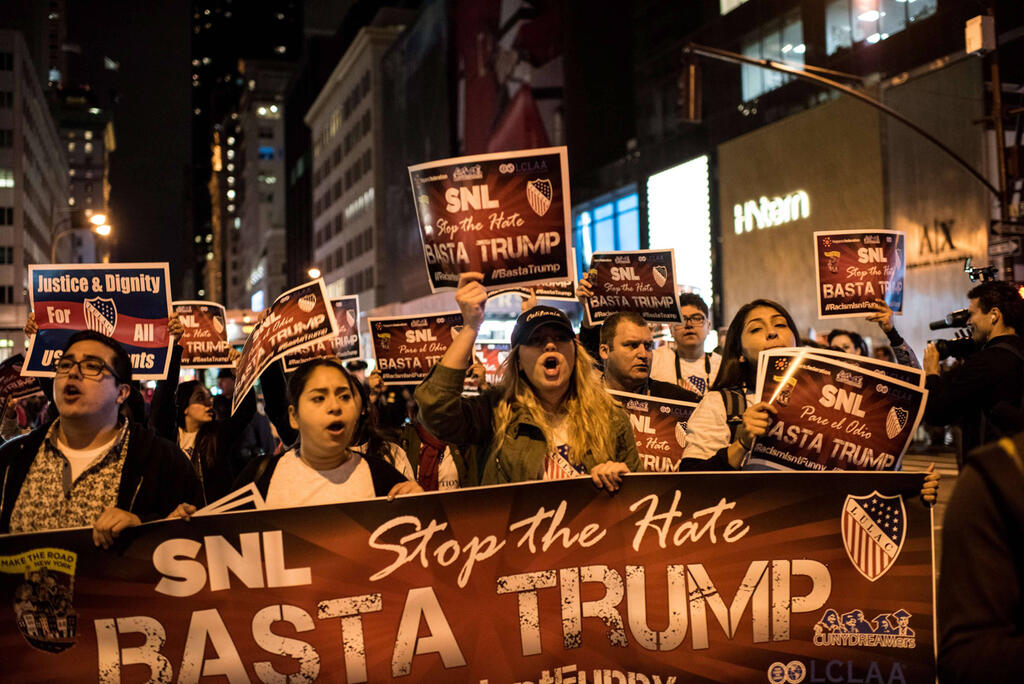
Hispanics protest outside Trump Tower in New York, November 2025
(Photo: AFP)
Inside the party, signs of unease are already visible. Republican Sen. Jim Justice of West Virginia said this week that anyone failing to see how Americans are being hurt by food and fuel prices is “living in a cave,” arguing that Republicans need to pay more attention to economic pressure on voters.
Arizona Republican strategist Barrett Marson put the political danger even more starkly, telling CNN that there is one person who is not sufficiently worried about gas prices, and that “one person controls our fate”: Trump.
Congress has also seen defections over the Iran war. In July, four House Republicans joined Democrats in supporting a resolution calling for an end to U.S. military operations against Iran without congressional authorization.
The measure was largely symbolic, but it highlighted the extent to which the war has become a political problem even within the GOP.
‘Why should we vote if he isn’t doing what he promised?’
Behind the polling are voters who supported Trump in 2024 and are now reconsidering their political choices.
Reuters has been following a group of Trump voters throughout his second term. The group is not statistically representative, but their interviews offer a glimpse into the mood among parts of the coalition that returned him to office.
Juan Rivera, 26, from the San Diego area, said he still intends to vote for Republican candidates. But while canvassing Latino voters, he encountered disappointed Trump supporters who had lost enthusiasm. “Why should I vote when the president isn’t doing what he promised?” he said some voters asked him.
Steve Egan, a 65-year-old Florida business owner who voted for Trump, told Reuters that tariffs had increased his business costs while the war had pushed up fuel and other prices. His opinion of Trump had deteriorated so much, he said, that an endorsement from the president could now make him less likely to support a candidate.
Robert Billups of Washington state said he no longer feels committed to Republican candidates and will vote in November for whoever offers what he considers the best plan, regardless of party. These voters are not necessarily becoming Democrats. That is precisely the problem.
The coalition beyond MAGA
Trump still dominates the Republican Party, and loyalty among MAGA voters remains extraordinarily high. But he did not win in 2024 only because of voters who would support him under almost any circumstances.
He won by expanding the coalition, drawing in Hispanic men, working-class voters, independents and people who had not previously been reliable Republican voters. In November, Republicans need those voters again, but Trump himself will not be on the ballot to draw them out.
Democrats currently lead registered voters 46% to 39% in the Economist/YouGov generic congressional ballot. Among voters who say they are extremely enthusiastic about voting, the gap is much wider: 60% say they plan to vote Democratic, compared with 37% Republican.
Trump’s MAGA base remains intact. The question facing Republicans is whether the broader coalition that returned him to power still exists. For now, the numbers suggest it is beginning to fracture.