

In the November 2022 elections a coalition of right-wing and religious parties won a working majority in the Knesset with 64 seats out of 120. A solid parliamentary majority confers power.
This election was run fairly and efficiently, so there is no calling the results into question. But as is generally known, the governing coalition did not win a majority of the popular vote.

The present coalition owes its parliamentary majority to a peculiarity of the Israeli electoral system, the 3.25 % law. This law, which is known to everyone, states that in order to have any seats at all in the Knesset, a party must win at least 3.25% of the popular vote.
One party, Meretz, came within about 4,000 votes of reaching the 3.25% threshold, and thus qualifying for four MKs. If there were a 3.00% law, rather than a 3.25% law, the present Knesset would be split evenly with 60 seats for each bloc. A difficult situation for governing, but one that would reflect the popular vote.
The importance of the 3.25% law was obvious before the election, and it is to the credit of the current coalition that its members and supporters were better organized, or perhaps just marginally less fragmented, than the opposing bloc.
Still, the present coalition holds power not because it won the popular vote, but because of a quarter of a percentage point in the electoral law. That law has provided the ruling coalition with power. But does it provide the broad legitimacy that a clear majority of the popular vote does?
During the election campaign the parties making up the present coalition made a number of promises, or policy statements, as political parties do during elections.

Benjamin Netanyahu and Bezalel Smotrich
(Photo: Yonatan Zindel)
They promised free education, or care, for the youngest children; they promised to limit inflation; they said they would enhance the Jewish character of the state; they promised to get a firmer grip on the occupied territories; they said they would improve governability; and they said they would reform the legal system.
Economic and financial constraints make many of their social promises impracticable. Changing the legal system does not appear as an item in the state budget, and in the short term, it may not cost much. So they are charging ahead at full speed with this 'reform'.
The main elements of the legal 'reform', or revolution, or counter-revolution, that the present coalition is hurriedly pursuing involve giving the government a preponderant voice in the appointment of judges and other legal officials, and the 'override' clause that would give the Knesset the ability to negate rulings of the High Court with a minimal majority of 61 MKs.
There are also related measures, such as the closing or muzzling the media, intervention in education and giving the government control of the board of governors of the National Library. Measures such as these reflect the overreach of some of the dark regimes that have replaced democracies elsewhere. These measures appeal to certain sectors of Israeli society, but not to most.

Attorney General Gali Baharav-Miara
(Photo: Yoav Dudkevitch)
In Israel, Attorney General Gali Baharav-Miara, former Attorney General Avichai Mandelblit, a former head of police, a former Likud defense minister and a former head of government have all condemned the proposed legislation.
They have been joined by others, not usually politically active, and certainly not radicals. These include the head of the Bank of Israel, members of the financial elite, economists, heads of universities, retired members of the security forces, retired army officers, veterans, and even reservists .
Particularly worrying are the warnings of directors and workers in high-tech, which account for just over half of Israel's GDP. In addition to warning about the effects of the judicial 'reform' these companies have begun voting with their feet. Some have already transferred holdings abroad, others are preparing to do so. In normal times, this would get the attention of the government. Not now.
From abroad, some of Israel's closest allies have cautioned the present coalition about proceeding with its proposed judicial and related legislation.
And together with these business and political elites, ordinary citizens have been demonstrating in numbers and with a frequency that have not been seen in a very long time. The issue, of course, is the threat to democracy that this legislation poses.

Protests in Tel Aviv
(Photo: Tal Shahar)
Western democracies are based on the separation of powers, which is to say, the independence of the various branches of government.
In this model of government the legislative authority gives direction, while the judicial and executive branches retain autonomy. The various branches of government check and balance each other, while periodic elections determine whether the government continues to enjoy popular support.
The English historian, Lord Acton, once observed that power corrupts, and absolute [unrestrained or unlimited] power corrupts absolutely. Getting rid of limitations and checks on government certainly enhances governability.
But without checks and balances and limitations, governors become dictators, and regimes become totalitarianisms, whether of the right, as in Mussolini's Italy or the left, as in Stalin's USSR.
More recently, de facto dictatorships have been established in Hungary, Poland and Turkey. What all these regimes have in common is the elimination of independent judiciaries, domination of the media and educational systems by the ruling parties, and the destruction of the separation of powers.
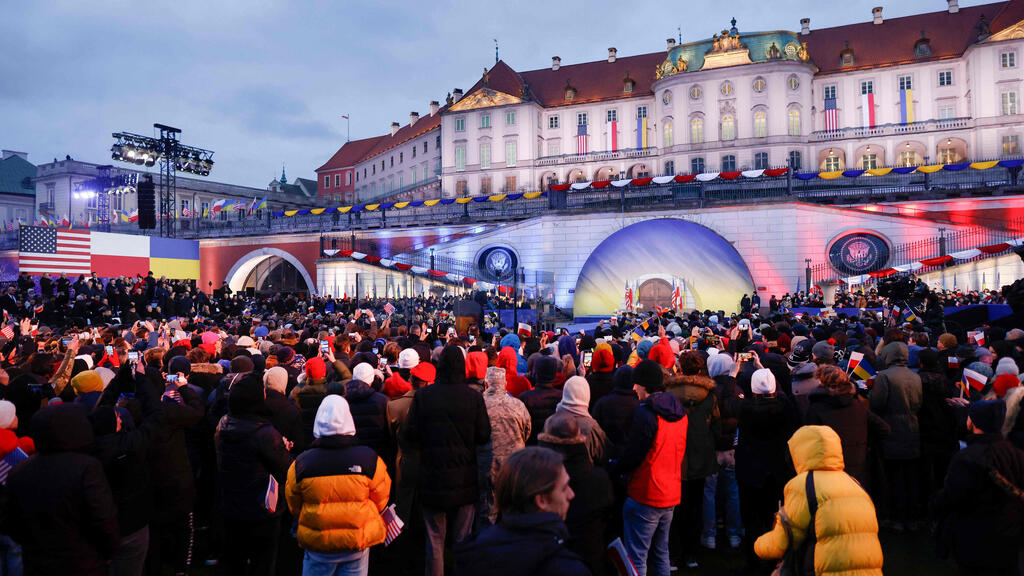
Poland
(Photo: AFP)
The ruling coalition is presenting its legislation on the judicial system, along with related legislation, as a 'reform.' It is not. It is a revolution, or counter-revolution, that amounts to regime change.
Referring to it as a 'reform' is a linguistic trick intended to obscure the extent of the changes that the architects of this legislation have in mind. It is a propagandistic attempt to mislead. It is dishonest.
When the spokesfolk for the present government promote their legislative program, they do so on the basis of the number of seats they hold in the Knesset. The public, they say, has endorsed their program, and they are fully entitled to proceed with it. Posthaste. What they are doing, they say, is entirely legitimate. But is it?
In the first place, the present government is not eager to recognize that it did not win the majority of the popular vote. Secondly, it did not lay its cards on the table honestly during the election campaign.
That polls of Likud voters show that roughly half of them disapprove of the pending 'reform' is a clear indication of this. Polls of the general public are even less heartening for advocates of destruction of the separation of powers, showing only about 25% support.
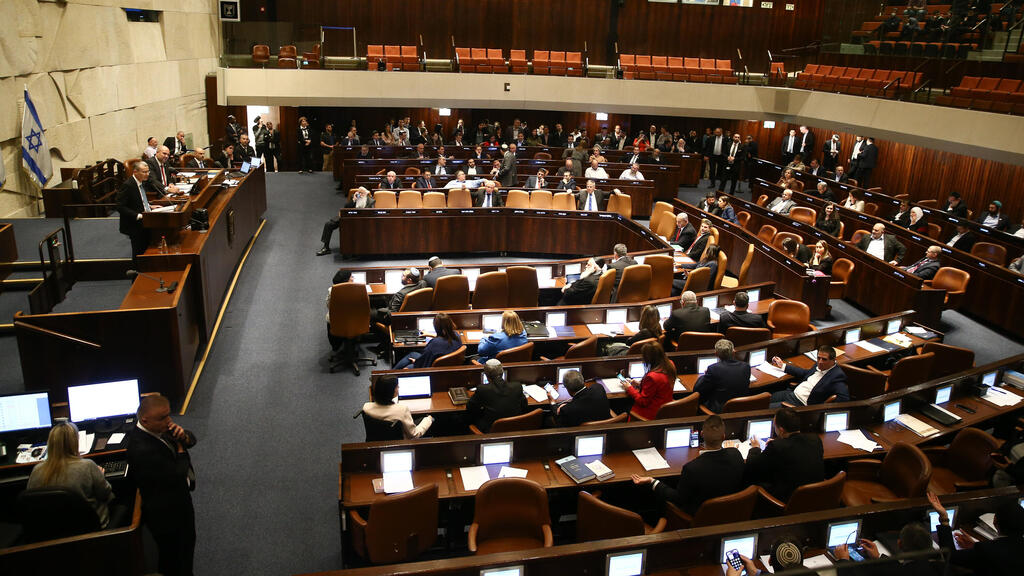
The Knesset Plenum
(Photo: Alex Kolomoisky)
All of this notwithstanding, the current coalition has a solid majority in the Knesset, so it has the power to legislate its program. What it lacks is the support of the electorate, and the legitimacy that such support would provide.
If the government honestly believes that its program enjoys popular support, there is an easy way to prove this: hold a referendum on it, or alternately, call new elections. Ordinarily, governments do not want to hold referendums, and they see no need to hold new elections after they have just won the last one. But this is not an ordinary situation.
What is at issue is a change of regime. Since the issue was not stated clearly and honestly during the last election campaign, it deserves to be put before the public in clear and unequivocal terms now, before the legislation is enacted.
In all probability, the present coalition will not want to hold a referendum on the issues at hand. Formally, it can point out that no referendum has ever been held in Israel. This is so. But it is also true that there is no law against holding referendums.
Regime change is certainly a matter that would justify a direct appeal to the public. And if such an appeal could prevent the country lurching into civil war, or something like it, then it would certainly be worthwhile.

Voting in the November 2022 elections
(Photo: Reuters)
There is also a second, more substantial, reason that the present government wants to avoid a referendum. This is, simply put, that as things now stand, it would lose it overwhelmingly. This creates an awkward situation for those wishing to pursue the 'reform' now under consideration.
If, on the one hand, the government does hold a referendum, it will almost certainly lose. If, on the other, it refuses to do so, it will be a tacit admission that its program of regime change is being rushed through against the will and interests of a substantial majority of the citizenry.
It will be an admission that its parliamentary majority, which was achieved thanks to an arbitrary electoral law, does not represent the will of the majority.
The present government is moving with unholy haste toward legislative changes that move our government away from democracy. It is true, as Winston Churchill said, that democracy is a very bad form of government. It is also true, as the same statesman said, that any alternative is far worse.
If the present coalition is aware that the great majority of the electorate clearly and strongly opposes its judicial and related programs, it should withdraw them.

Protestors in Haifa
(Photo: Nahum Segal)
If it wishes to proceed with them, it should submit them to a referendum, or hold new elections. If it fails to do either of those things it is saying, in effect, that it has the power to do whatever it likes, the needs and values of the majority be damned.
Power and dishonesty can get on very well together. Neither do well with legitimacy. Ignoring, or refusing to verify, the will of the majority on a matter of such far-reaching importance is both dishonest and illegitimate.
And the attempt to rush it through makes it look all the more so. If the coalition presently in power believes it has the support of the majority, it should hold a referendum to prove it. And if it knows that its so-called 'reform' is overwhelmingly unpopular, but still wants to force it through, then neither this government nor its current legislative program can claim legitimacy.