


In recent weeks, a significant shift has been taking place behind the scenes in the Middle East: Gulf states are increasingly coming to the conclusion that Iran and its proxies can no longer be allowed to act with impunity, and that a joint regional effort is needed to confront them. For the first time, Arab states are showing willingness to take part in a form of U.S.-led coalition, and within that framework they are no longer ruling out cooperation with Israel.
One factor that contributed to the shift was Israeli assistance to the United Arab Emirates during the war. In the Gulf, this was seen as proof that Israel knows how to stand by its partners in times of crisis, and other countries have already begun sounding out Jerusalem to see whether they too could receive defensive assistance similar to that provided to the UAE.
Gallery
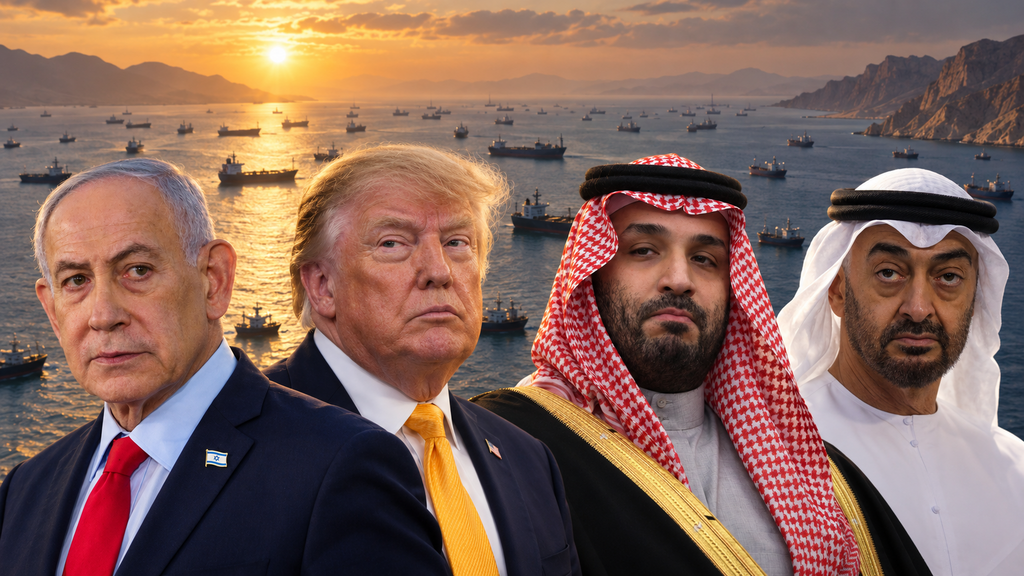
From left: Benjamin Netanyahu, Donald Trump, Mohammed bin Salman, Mohammed bin Zayed with Strait of Hormuz in background
(Photos: Shalev Shalom, Andrew Harnik/Getty Images, Win McNamee/Getty Images, AP, Reuters/Stringer)
The Americans have identified the trend and are working in parallel to shape a new regional security architecture. On one hand, Washington is trying to build a coalition against Iran with the participation of Arab states. From the perspective of countries in the region, one of the key missions is to guarantee freedom of navigation in the Strait of Hormuz and Bab el-Mandeb Strait — two waterways that, in their view, have evolved from a regional problem into a global one. They therefore believe the international community should mobilize and assist the United States in ensuring freedom of navigation through them.
At the same time, the Americans are also examining long-term solutions aimed at reducing dependence on the Strait of Hormuz. These include the possibility of laying an oil pipeline that would bypass the strait, as well as expanding refining capacity on U.S. soil in a way that would increase fuel supplies for the American economy and reduce its vulnerability to disruptions in the region.
The rare meeting in Germany
Against the backdrop of these developments, U.S. Central Command, or CENTCOM, convened a rare meeting in Germany last week — the first of its kind since the outbreak of the war with Iran — attended by senior military commanders from the United States, Israel and a number of Arab countries. According to Axios, the participants discussed the war with Iran and the broader tensions in the region.
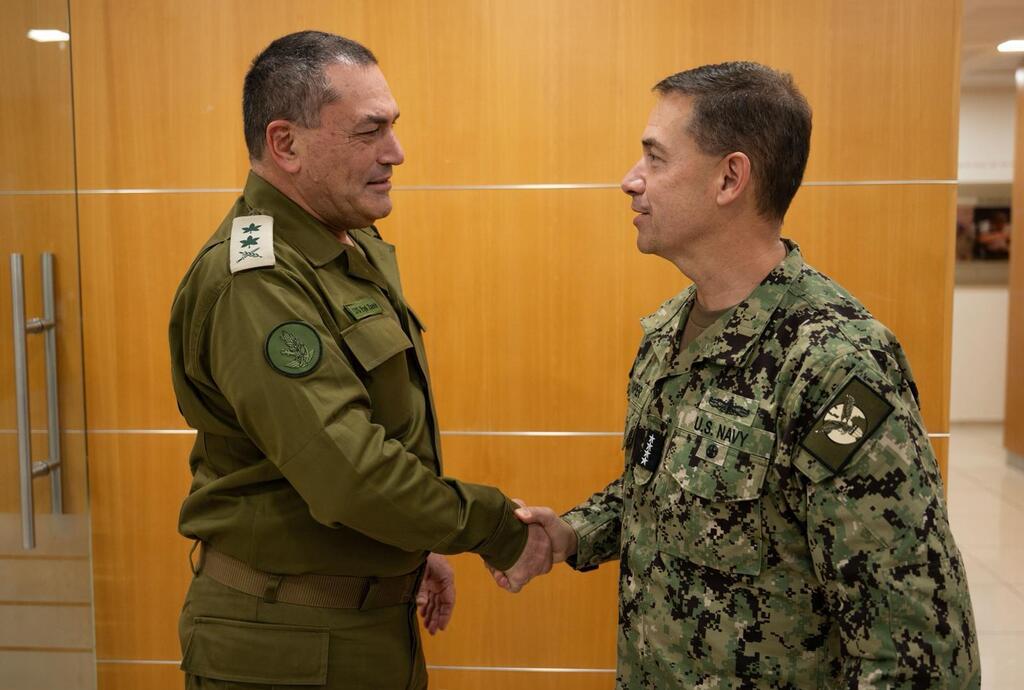
IDF Chief of Staff Eyal Zamir and CENTCOM Commander Brad Cooper. A rare meeting with the military leaders of 7 Arab countries
(Photo: IDF Spokesperson's Unit)
The meeting was organized by CENTCOM commander Adm. Brad Cooper. It offered a rare opportunity for commanders from Israel and Gulf states that do not have diplomatic relations with Israel to meet and exchange views on security developments. Alongside Cooper, the chiefs of staff of Israel, Saudi Arabia, the United Arab Emirates, Bahrain, Kuwait, Qatar, Jordan and Egypt took part.
Cooper sought to reassure the participants, making clear that the U.S. military does not intend to reduce its presence in the region despite Iranian attacks on American bases. He also briefed his counterparts on the U.S. plan to expand ship traffic through the Strait of Hormuz. An Israeli official said IDF Chief of Staff Lt. Gen. Eyal Zamir briefed the participants on IDF operations in the various arenas. CENTCOM confirmed the meeting, saying it had hosted senior military leaders from eight countries in Germany for a scheduled conference that discussed opportunities to strengthen security cooperation in the Middle East.
That cooperation was already evident during the war. Israel deployed the Iron Dome system in the United Arab Emirates, along with personnel who assisted in operating it, and also provided the UAE with real-time intelligence, surveillance and reconnaissance, or ISR, assistance. At the same time, intelligence cooperation between Israel and other Arab states in the region also expanded during the war.
The opportunity with Saudi Arabia
CENTCOM also is working to advance dialogue between Israel and Saudi Arabia, with the aim of having Israel assist Riyadh in confronting the Houthis. Saudi Arabia has suffered a series of blows from the Houthis in recent weeks and has been left largely on its own, after the defense alliance it sought to establish with Pakistan and Turkey proved, from Riyadh’s perspective, to be unreliable.
Despite considerable disappointment in Jerusalem over Saudi Arabia’s conduct in recent months and its distancing from Israel, Israeli officials are not rushing to take pleasure in the kingdom’s difficulties — nor are they telling the Saudis, as one official familiar with the issue put it, “Go ask the Turks and Pakistanis to help you.”
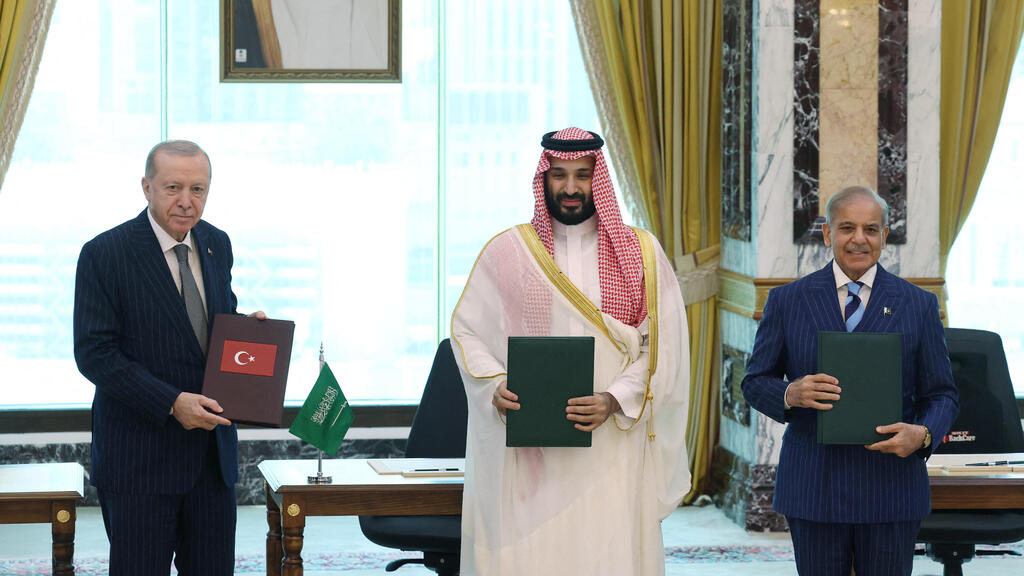
Signing of the defense alliance between Saudi Arabia, Pakistan, and Turkey last month
( Photo: Murat Cetinmuhurdar/Turkish Presidential Press Office/Handout via Reuters)
Israel even sees the crisis as a possible opportunity for a shift in Riyadh’s direction: to move Saudi Arabia away from the axis associated with the Muslim Brotherhood and bring it closer again to the region’s moderate states. At the same time, officials in Jerusalem stress that the Saudis also have work to do in rebuilding relations and that Israel expects them to change course in their policies.
A very senior Israeli official said in this context: “I am optimistic that there will ultimately be an agreement with Saudi Arabia. The Saudis were good friends and the cooperation was excellent. We need to make sure they do not take civilian nuclear power in the wrong direction.”
Clearer voices regarding the Iranian threat are also now being heard in the Arab countries that attended the meeting in Germany. A senior official from one of them said: “I don’t think any of our countries were under the illusion that Iran would not attack us. If the Iranian regime thinks that attacking U.S. bases on our territory will cause us to change our security arrangements with the United States and other members of the coalition, they are mistaken.”
He said the effect has been the opposite: “It only reinforces the belief that we need a military coalition and relations with our American friends and with like-minded countries, because that is our best defense.”