


The Iranian barrage toward the Gulf states overnight totaled 12 ballistic missiles, three cruise missiles and four unmanned aerial vehicles. Iran, however, continues for now to boast of its forces’ control of the Strait of Hormuz even after Roaring Lion — or Epic Fury, as U.S. officials have dubbed the operation — and is banking in particular on revenues expected from controlling the Gulf’s maritime oil route.
Iran cannot afford — and does not want — to allow the United States to demonstrate control in the region and undermine the new rules declared by the Islamic Revolutionary Guard Corps, the regime’s elite military force, after the war. President Donald Trump voiced frustration that the naval blockade had failed to force Iranian concessions and announced in response “Project Freedom” to extract vessels stranded in the strait. In effect, this drew Iran into opening fire on ships, as well as on the United Arab Emirates and Oman.
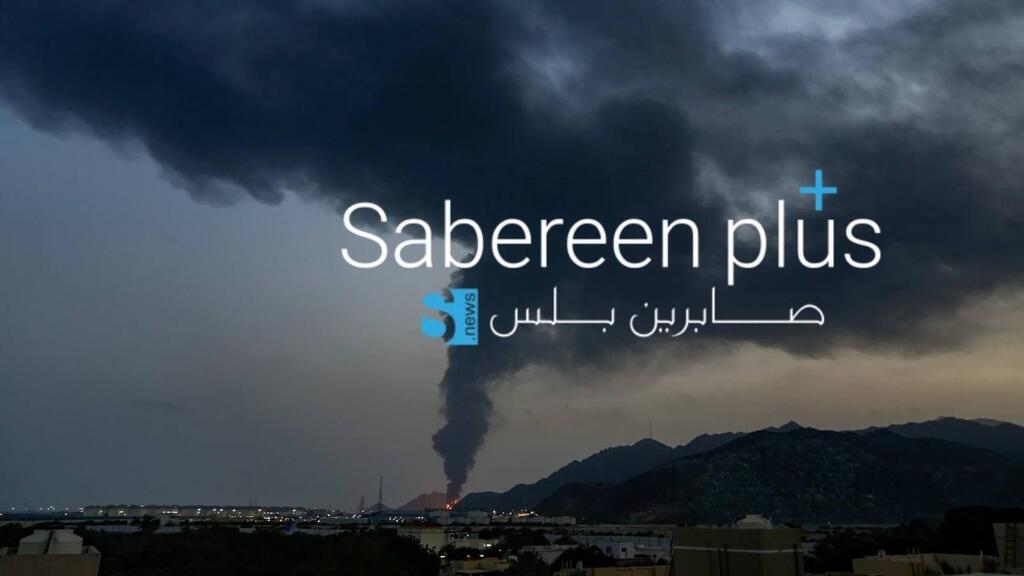
Fujairah Port
(Video: SoarAtlas )


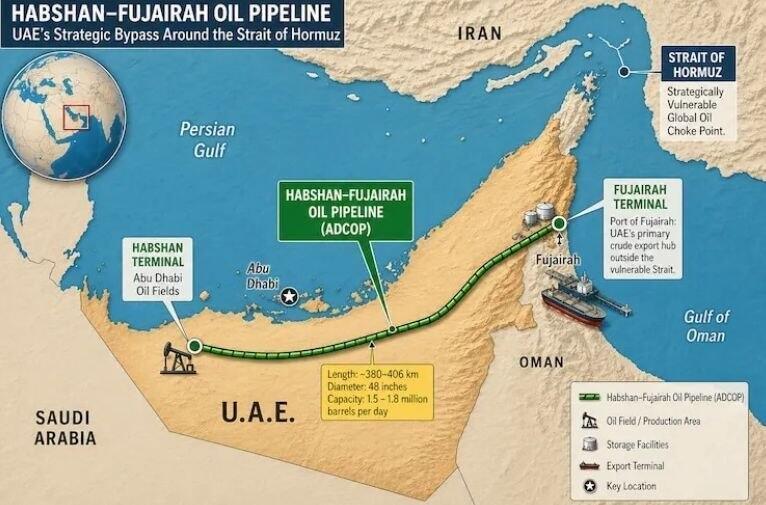
A map showing the oil pipeline in the Emirate of FujairahA map showing the oil pipeline in the Emirate of Fujairah
In the Emirate of Fujairah, officials said three Indian nationals were wounded by Iranian fire targeting an oil industry zone, raising the question of why Iran chose that location. Iran’s Tasnim news agency, which is affiliated with the regime, offered an answer: “Fujairah’s oil terminal is the UAE’s only alternative to the Strait of Hormuz.” The implication is that Iran is attacking alternative routes in the Gulf to preserve maritime dominance and ensure it alone controls regional oil corridors.
“The (Fujairah) pipeline has a capacity of 1.5 million barrels of crude per day, expandable to 1.8 million. It was built specifically to allow the UAE to export its oil without passing through the Strait of Hormuz,” Tasnim reported, alongside an illustration of the bypass Iran appears intent on severing.
Up to 5 million barrels a day
This is not the only route that bypasses Hormuz. Saudi Arabia — which was not attacked overnight — also has such a pipeline, cited in the Tasnim report. “The only other main alternative to the Strait of Hormuz is Saudi Arabia’s East-West pipeline (Petroline) to the port city of Yanbu,” it said.
The Saudi pipeline stretches about 1,200 kilometers (745 miles), carrying oil from the kingdom’s east to Yanbu on the Red Sea. It allows Saudi Arabia to move oil independently of potential blockades by the Revolutionary Guard in Hormuz. Saudi oil infrastructure was targeted during the war, though for now the Iranians have limited themselves to a warning via the news agency report.
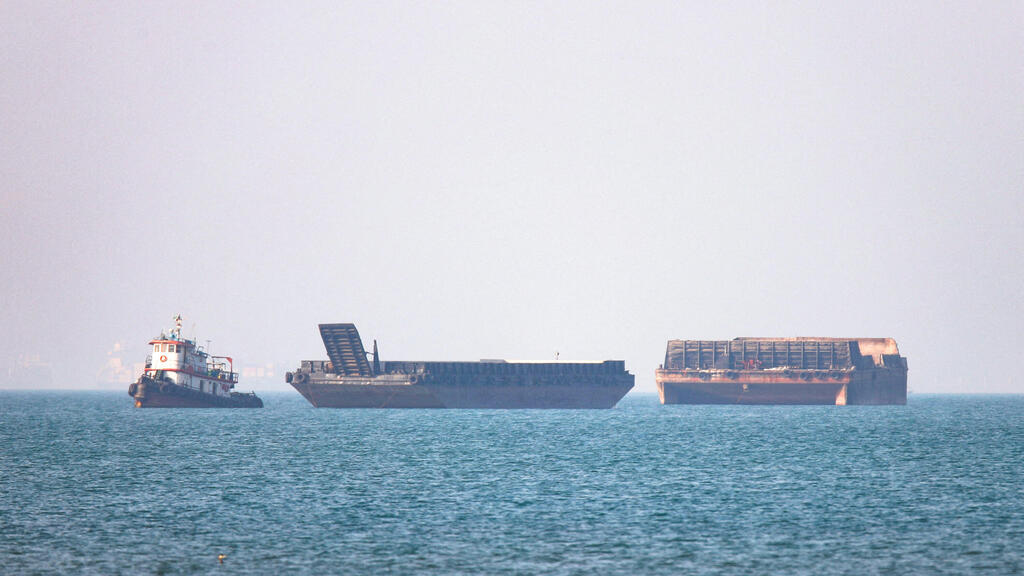
(Photo: Amirhosein Khorgooi/ISNA/WANA (West Asia News Agency) via REUTERS)
Yoel Guzansky, a former Israeli National Security Council official and a senior researcher who heads the Gulf program at the Institute for National Security Studies, an Israeli think tank, said it remains unclear what condition the Saudi pipeline is in. If it is fully operational, he said, it could carry 4 million to 5 million barrels per day.
“Just as Hormuz is a bottleneck, the pipelines have become bottlenecks as well. Iran knows how to hit them, which means there is no real substitute for Hormuz and reopening the strait — likely by force,” he said. “This card has to be taken away from Iran, otherwise it’s a disaster. Iran is not only threatening Hormuz. It is threatening the Gulf states, all energy facilities and the bypass pipelines. Everything is under threat. If the port of Fujairah is damaged, that leaves only Oman’s port in the Gulf. It has a unique location essentially outside the Gulf.”
He said this helps explain why Iran also struck Oman in response to the U.S. operation, possibly as a signal to Muscat not to cooperate with Washington.
The Houthis could join in
After a ceasefire took effect on April 19, Tasnim reported that Iran was “prepared for a scenario of a return to war and sees it as more likely than negotiations.” According to that report, “if war breaks out, Iran will abandon some of the ‘limitations’ it imposed on itself in the first round.” It mentioned, among other targets, Aramco, Saudi Arabia’s national oil company, the port of Yanbu and Fujairah.
Because the western end of the Saudi pipeline lies on the Red Sea, this raises the possibility that Iran could involve the Houthis, the Iran-aligned movement in Yemen, which are closer to that area. Guzansky added that “these threats — including the current one — are meant to tell the international community, the Americans and the Gulf states that Hormuz cannot be bypassed. The Iranians are saying: ‘Hormuz is the key, and Hormuz is under our control.’ The point is to show that all these attempts at bypass pipelines do not work.”
“The UAE was attacked because it is Hormuz. Iran controls the eastern side, but the western side is divided between Oman and the UAE, which serves as Hormuz’s economic backbone, including ports and logistics on its territory. Its close cooperation with Israel also makes it a larger target, especially after recent reports that Israel provided the UAE with significant defensive systems.”
In conclusion, he said: “I don’t think Hormuz was even among the war’s objectives, and now it is the central objective, at least from the American perspective: to reopen Hormuz and deny Iran its main card. For Iran, demonstrating an achievement or victory is much easier. It takes only one ship being hit and insurance rates rising for the world to react. It doesn’t take much to disrupt freedom of navigation in the strait, given its geography and the fact that Iran sits right on it. It has shore-to-sea missiles and small, fast boats. The Revolutionary Guard’s navy in the Gulf has trained for years for this. If U.S. activity continues, Iran may seek to raise the cost and strike additional targets.”