

Israel is “seriously examining” the possibility of building a nuclear power plant, Energy and Infrastructure Minister Eli Cohen says. Speaking in an interview with Mamon, he revealed that he has established a special team of experts to draft principles for a national nuclear-energy strategy.
“There are 63 developed countries today operating nuclear power plants, and there is no reason they should not operate here as well,” Cohen said. “Electricity generation from nuclear energy is becoming cheaper by the day thanks to new technologies, some of them based on original Israeli research and development. When electricity supply is disrupted, even for a few hours, nothing functions and the economic damage is enormous.” Cohen makes no attempt to hide his support for the nuclear initiative and says he intends to bring the expert team’s recommendations to the cabinet for a decision.
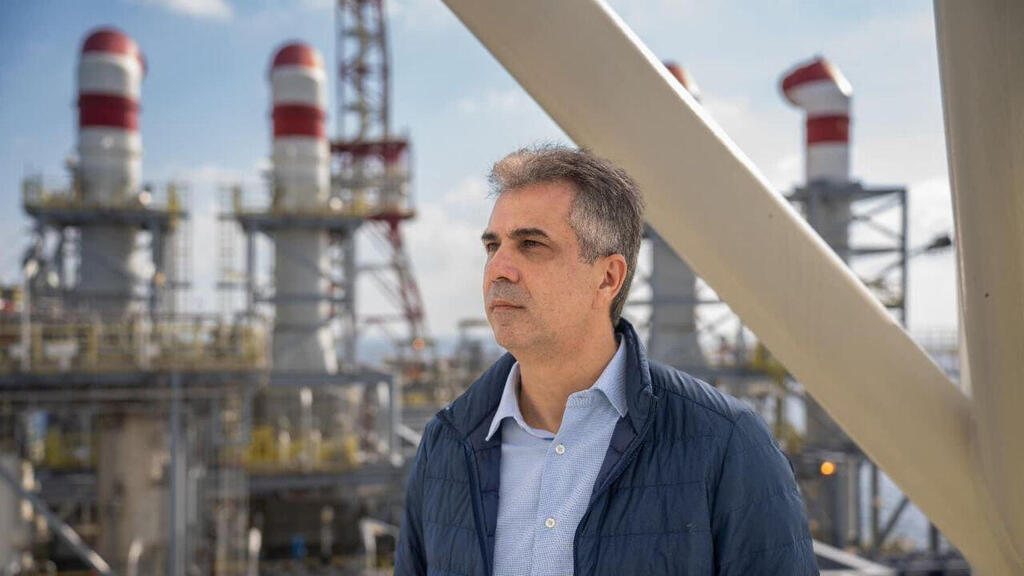
Electricity demand in Israel, Cohen noted, “grows at an annual rate of 3.7 percent, meaning it doubles every 20 years. Add to that the needs of artificial intelligence, quantum computing, electric vehicles and more, and it’s clear we will not be able to avoid nuclear energy.”
Despite our natural gas abundance?
“Natural gas is replacing coal in electricity production, which is slated to drop to zero by the end of the decade,” Cohen said. Ending coal generation will allow the deep-water coal ports in Ashkelon and Hadera to be converted and privatized. At the same time, he added, renewable energy must reach 30 percent of Israel’s electricity generation over the next five years — a target approved by successive governments and achievable mainly through solar power. “Israel once led in this field and can lead again. New technologies have dramatically lowered solar-power costs. Installing solar panels on private rooftops is now the most profitable investment in the market, with real annual returns of around 15 percent.”
Yet rooftop solar remains relatively rare.
“With the ministry’s support and encouragement,” Cohen said, “you will soon see solar installations on another 160,000 single-family rooftops across the country, strengthening national energy security. Office towers are also eager to transition to self-generated solar energy. In eastern Negev, one of the world’s largest solar farms is under construction, alongside a server farm for storing and processing vast amounts of critical digital data that Israel must keep within its borders.”
Will electricity prices drop?
“Yes. By international comparison, Israelis already pay among the lowest electricity prices in the world, and the price decline will only accelerate,” Cohen said. He credits this to the reform that opened electricity transmission and retail to competition. “About 15 percent of households have already left the Israel Electric Corporation for eight private suppliers that offer electricity 6 to 21 percent cheaper. Another 100,000 households join them every month. The ministry is also promoting digital smart meters that allow flexible pricing based on grid load, saving the average household thousands of shekels a year.”
Is there enough natural gas for future generations? The Treasury is pushing to limit exports
“The notion of leaving natural gas in the seabed defies economic logic and Israel’s geopolitical needs,” Cohen said. “We already have enough gas for the next 30 years — for both significant exports and long-term local consumption. Regulation should ease development, not hinder it.”
What is delaying the $35 billion gas-export agreement with Egypt?
“The deal is not stuck,” Cohen insisted. “Talks are under way between the governments and the energy companies. The gaps have narrowed significantly, and certain security clarifications from Egypt were needed, which are close to resolution. I expect the agreement to be signed within weeks. It is a historic deal that will ensure low energy prices for Israeli consumers and bring another 50 billion shekels into the state treasury. It demonstrates how becoming a gas exporter enhances Israel’s international and regional standing. Everyone benefits.”
War lessons: relocating the Haifa refinery
Before Operation Rising Lion against Iran, warnings circulated about a nationwide blackout lasting at least a day. That did not happen, but the Haifa oil refinery did take a direct hit from an Iranian missile.
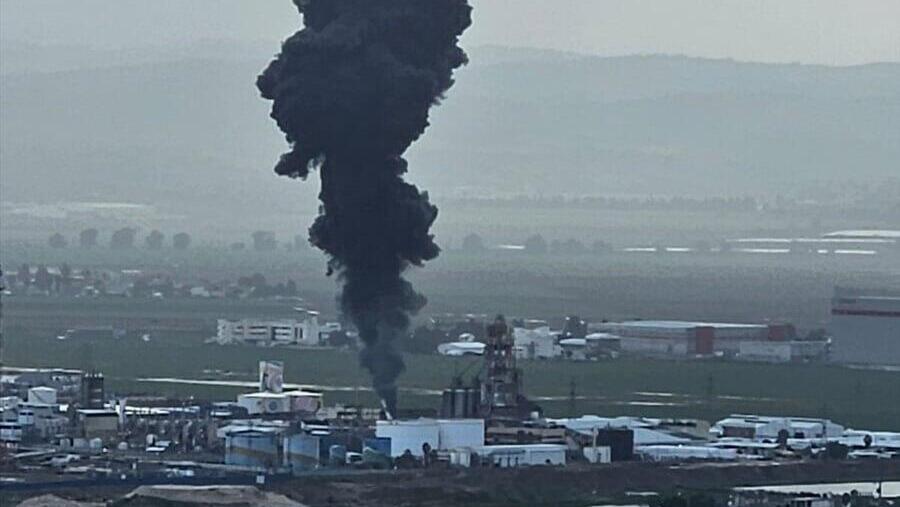
Haifa's oil refinery after a direct hit from an Iranian missile
(Photo: Barak Sabag)
“The refineries have returned to full capacity,” Cohen said, “but as a lesson from the war, I am pressing to change the government plan that required shutting the Haifa refineries entirely. Instead of closure, I propose relocating them to the Negev, to the Mishor Rotem area. It is crucial that Israel retain domestic refining capacity and not rely solely on foreign suppliers. A refinery in the Negev would also create thousands of high-paying jobs. I have reached agreement on the relocation with local mayors.”
A draft of the government’s Arrangements Law included a proposal to strip the Energy Ministry of its powers and transfer them to the Finance Ministry.
“Forget it — the idea is off the table,” Cohen said. What worries him far more, he continued, are “the misguided efforts of the Finance Ministry to make it harder for foreign investors to enter Israel’s offshore oil and gas sector. We are negotiating with another major foreign energy company to join exploration, and we are very concerned about attempts to tinker with regulations under the pretense of ensuring low consumer gas prices. The correct approach is investment in exploration and expanding supply. Without the option to export — which is far more profitable than selling to the domestic market — we will not succeed in attracting major global energy players.”
Cohen also sounded doubtful about next year’s draft state budget. “It does not place enough emphasis on economic growth,” he said. The mission of the Treasury, he argued, “is not just to collect taxes and fund ministries. If I were finance minister, my job would be to activate strong growth engines. We should not be satisfied with a projected GDP growth rate of 4 percent. We should aggressively pursue accelerated growth that could lift Israel’s GDP per capita into the top ten of developed nations.”
Haredi employment and the draft law
Accelerating growth, Cohen said, also depends on integrating Haredi men into the productive workforce. In that regard, he warned, the ultra-contentious draft law currently before the Knesset appears to do the opposite — granting a sweeping exemption from military service specifically to Haredi men who do not work and instead study full-time in yeshivas.
“Based on the data I’ve seen, increasing Haredi enlistment significantly raises their later participation in the labor force,” he said. “Those who enlist become Haredim who work. First they contribute to security, then to the economy. The IDF should operate special vocational-training programs for Haredi soldiers nearing discharge, together with other ministries. It is unthinkable that the draft law become a tool to entrench Haredi avoidance of gainful employment. The law must also address economic needs. That is one of the key criteria for my vote.”
Whether Cohen will support the final bill remains to be seen.
Netanyahu’s trials and the shadow of October 7
Few recall that Benjamin Netanyahu’s criminal cases began with investigations by the Israel Securities Authority. In June 2015, Bezeq announced its purchase of full control of satellite broadcaster Yes, which had been jointly owned by Bezeq and Eurocom. Both companies were effectively controlled by businessman Shaul Elovitch.
The deal raised questions. Yes was losing money, and the price paid appeared artificially high. Bezeq explained that after merging with Yes, it intended to use Yes’s accumulated losses to reduce its own tax liability by hundreds of millions — a standard practice in mergers.
The sticking point was regulatory approval by the Communications Ministry. Professional staff did not oppose the merger — without it, Yes would likely have collapsed — but conditioned their approval on commitments from Bezeq, such as opening the wholesale market to competition and deploying fiber-optic cables.
Securities Authority investigators found the approval suspiciously lenient. A covert investigation turned overt in June 2017 and uncovered an improper give-and-take relationship between senior Bezeq executives and senior ministry officials, with the ministry’s director-general appearing to represent Bezeq’s owner rather than the public interest. Suspects were placed under house arrest and indictments prepared.
Then the figure of the communications minister — Prime Minister Netanyahu himself — entered the picture. The probe expanded from the Securities Authority to the police and state prosecution, emphasizing the suspicion that the lenient regulatory treatment was given under Netanyahu’s direction in exchange for favorable media coverage of his wife and family on Walla, which was owned by Elovitch.
Thus was born what prosecutors labeled Case 4000, after it ceased to be a securities case. Two unrelated suspicions were later added: Case 2000, concerning Israel Hayom, the pro-Netanyahu free daily funded by billionaire Sheldon Adelson; and Case 1000, concerning gifts of cigars and champagne from producer Arnon Milchan. These had nothing to do with Bezeq or Yes but were bundled together.
Netanyahu’s trial opened in May 2020 and has since deteriorated into a hybrid of farce and embarrassment. It no longer serves justice or the public interest. Testimony in Case 4000 has yielded no resolution and has descended into trivialities; Case 1000 has focused on counting champagne bottles and cigar boxes; and Case 2000 was riddled with evidentiary flaws from the start, relying on covertly recorded conversations between Netanyahu and publisher Arnon Mozes, plus partial questioning of Adelson in Las Vegas before his death. Then-Attorney General Avichai Mandelblit had even planned to recommend closing the case.
Today the trial serves mainly Netanyahu and his supporters, enabling him to present himself as persecuted despite his life’s service to the state. This week, Netanyahu asked the president to pardon him in all cases — without admitting wrongdoing or expressing remorse. Many were outraged, pointing to the 1986 pardons in the Shin Bet’s Bus 300 affair, which were issued before a verdict but only after the defendants admitted the acts. The comparison is not relevant: that case involved killing Palestinians and major obstruction of justice; Case 1000 concerns accepting champagne bottles. There is a difference.
And what about 'moral turpitude'?
Netanyahu already bears a far heavier stain: responsibility for the October 7 failure — a moral and historical stain that has no expiration date. No judicial “moral turpitude” ruling in Cases 1000, 2000 or 4000 comes close to the public weight of the October 7 disaster. That burden will accompany Netanyahu for the rest of his life — and beyond.
Israel now stands at a crossroads between a perpetual war posture and diplomatic arrangements with the Arab-Muslim world, including the Palestinians. Between “force alone” and “force combined with compromise.” That is the choice that must govern our thinking. Everything else is secondary — including the legal technicalities of approving a pardon.
From this follows the only condition President Isaac Herzog should set for granting Netanyahu a pardon: immediate resignation as prime minister and a declaration of elections. Netanyahu will not enter that campaign as a statesman cleared by the courts, but as a chastened leader bearing responsibility for October 7 and as a prime minister humbled into requesting a pardon — which is not an acquittal. With those stains, he cannot continue as Israel’s next prime minister, whatever the election results may be.
Unless, of course, his pardon request is rejected on formal legal grounds. In that case, Netanyahu will head to elections as the supposed victim of a conspiracy by the left, the deep state, and the legal elite — as in 2022. That is the choice before Israel.