

Rahm Emanuel woke up this week at the Kempinski Hotel in Tel Aviv. He read a news report that jolted him out of bed: An Associated Press-NORC poll of a broad sample of American Jews asked their opinion of New York City Mayor Zohran Mamdani. Forty-four percent viewed him favorably, while 39% viewed him unfavorably. The poll also asked about Prime Minister Benjamin Netanyahu. Thirty-two percent viewed him favorably, while 59% viewed him unfavorably.
Mamdani hates the State of Israel and openly incites against it, bordering on antisemitism. He does so in New York, the world's largest Jewish city. "There's a new poll out that has Mamdani more popular than the prime minister among American Jews," Emanuel told me when we met that morning. "Think about what that means." He laid the poll numbers on the table like someone producing a winning card from his pocket. If anyone still doubted that his warnings were justified, the poll, he said, removed any doubt.
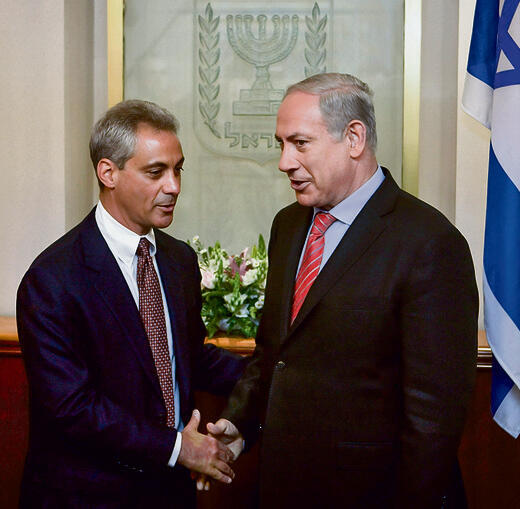
Emanuel, 67, is taking his first steps in what could become a campaign for the Democratic presidential nomination. As part of that effort, he came to Israel accompanied by aides and security personnel. In the past, presidential hopefuls came here to raise money and court the support of American Jews. The routine was to pose for photographs at the Western Wall, Masada and the prime minister's office, lavish praise on incomparable Israel and head home satisfied.
But times have changed. Emanuel came to deliver what he sees as a painful truth to Israel's government. The Washington Post described the speech he delivered this week at Tel Aviv University as "tough love." "Shock therapy" would be a more accurate description. Many people, including writers in these pages, have warned about the deterioration in American public attitudes toward Israel. Emanuel made the warning blunter, more specific and more emphatic. For 60 years, Israel enjoyed bipartisan consensus in the United States. There is still a consensus on Israel, he argued, but it has been turned on its head.
Criticism of Netanyahu and his government is unlikely to hurt Emanuel's political prospects — quite the opposite. It may strengthen his standing among voters who suspect he is too sympathetic to Israel. Yes, he understands the political benefits, but he also believes every word he said.
Eager for a fight
We've known each other for more than 30 years. During the Clinton administration, his office in the White House overlooked the entrance to the West Wing — the building where the real decisions were made. The location was strategic: He could see who went in to see the president, why they were there and what mood they were in when they came out. Power was always his specialty: the pursuit of power, the love of power and the proper use of power. To borrow a line from football, power is not the most important thing — it is the only thing. Rahm Emanuel was, and remains, sharp, witty and eager for a fight. In every position he held, politicians both feared him and were drawn to him.
Detroit builds cars; Washington builds power. There is no better classroom for learning the inner workings of the political machine and how it operates. Rahm Emanuel was an outstanding teacher. I learned from him not only about American politics but also about Israeli politics.
"You're having trouble with Shas," he told me one day. "You need to get them to support Rabin. There's one Knesset member causing problems — Yair Levy."
I remember thinking how extraordinary that was. We were sitting just down the hall from the office where the fate of the world was decided every day, yet spending a long time discussing one of our own politicians, Yair Levy. That, too, taught me a lesson in politics: when the knife is at your throat, every vote counts. The Oslo Accords were hanging by a thread, and President Bill Clinton was looking for ways to help. (I told Rahm this week that Yair Levy later became embroiled in criminal proceedings, was forced to leave politics and recently died. He didn't remember the name.)
There was something else as well: the enormous pleasure Clinton — and Emanuel even more so — took in immersing themselves in Israeli politics. They studied it closely, knew the different players and understood the dynamics. They understood, for example, unlike the CIA, that Shimon Peres was going to lose the 1996 election to Benjamin Netanyahu.
Rahm's father, Benjamin Auerbach — later Emanuel — was born in Jerusalem, belonged to the pre-state Irgun underground militia and served as a medic in Israel's War of Independence before emigrating to the United States. Israeli blood runs through Rahm's veins — and, in many ways, through his temperament as well.
It is tempting to compare him with another son of a right-wing activist who left Israel for America: Benjamin Netanyahu. Sometimes similarities breed mutual contempt. Netanyahu once called Emanuel "a self-loathing Jew." The remark was deeply insulting and, as you will read later, had consequences. But it was also absurd and entirely detached from reality. There is not a trace of self-loathing in Emanuel, nor any rejection of his Jewish or Israeli roots. (His wife, Amy, converted to Judaism. Their children celebrated their bar and bat mitzvahs in Israel. Emanuel has visited Israel 19 times since childhood.)
He served as director of political affairs in Clinton's White House, chair of the House Democratic Caucus, White House chief of staff under President Barack Obama, mayor of Chicago and U.S. ambassador to Japan. He has accumulated a uniquely broad record of dealing with national and international crises.
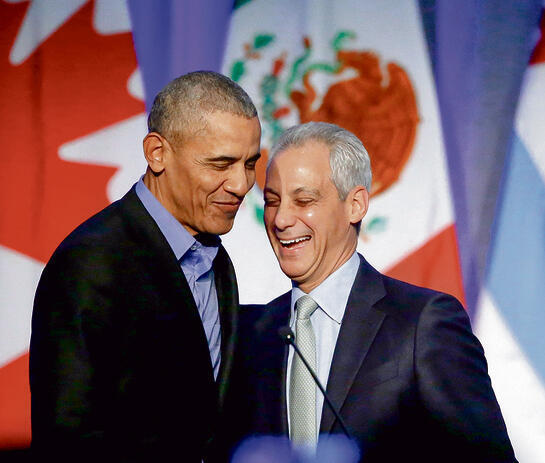
Barack Obama and Emanuel
(Photo: Charles Rex Arbogast/AP)
"The only thing that ends up in the Oval Office or the prime minister's office are bad and worse," he told me. "During the conduct of the three-year war, you have to make decisions between bad and worse. My view is that even elements of your own national security disagree with the conduct of the war because the trade-offs were not worth the price."
In December 2010, I traveled to Chicago to cover his mayoral campaign. The temperature on the elevated train platform was minus 10 degrees Celsius (14 degrees Fahrenheit), and the wind made it feel even colder. Commuters hurried onto their trains to escape the cold, but Emanuel insisted on standing there every morning, handing out campaign flyers and shaking frozen hands. He went on to win the election.
"The mayor of Chicago," he says, "is one of the five most coveted jobs in America. The amount of power concentrated in that office is enormous."
You got Somaliland
We sat on the hotel terrace, 22 floors above the Mediterranean. Emanuel stretched out his arm toward the south, in the direction of Charles Clore Park.
"That's where Manta Ray is, my favorite restaurant," he said.
I told him the restaurant had closed. He was sorry to hear it.
"You argue," I said, "that Netanyahu lost the Democratic Party in 2015, when he came to Washington to address Congress against President Obama and the Iran nuclear deal. Now you're doing something similar — coming to Israel and bluntly attacking its sitting government."
"First of all, I'm not a head of state. I'm a citizen. Big difference," he replied. "When you're a head of state and when you're a private citizen, they come with different responsibilities and different voices, and the volume is not the same.
"Second, the prime minister made a decision to ignore an administration, which no prime minister had ever done—especially to its most important ally. This was behind the back of not only the American president, but his administration, with a total, conscious decision to keep them in the dark. Once you started on this path, you lost America.
"Now, everything I'm saying here, I have said back in the United States. This is not the first time. This is different also. So you're drawing a comparison, which is an insult to the prime minister. Not to me."
I asked whether the Democratic Party had become an enemy of Israel.
"Israel does not have a problem with the Democratic Party," he said. "Israel has a problem with the American public. You've lost Democrats, you've lost independents, you've lost the Republicans, and among people 30 and younger—forget about it. Israel has only 30% support, two-thirds not. And among people under the age of 30, it's in the 20s. That is not sustainable—to have political support for an ally in the 20s."
I asked whether the growing opposition to Israel was simply the result of antisemitism that had long existed beneath the surface and now has surfaced.
"Look, I'm not naive to antisemitism. I've been targeted by it," he said. "When I ran for Congress, that seat was known as the Polish seat because of how big the Polish community is in Chicago. I was running against a Polish vote, and the head of the Polish National Alliance in Chicago made very ugly comments. There were five people in the race. I took over 50%, and only 2% of the district is Jewish."
"When I ran for mayor, I remember that I was thrown off the ballot and I had to go to the Supreme Court to get out of it because I 'wasn't from here'—which I understand and I know what that means, that you were in DC, but it was an attempt. 'He's not one of us.' I know what that meant.
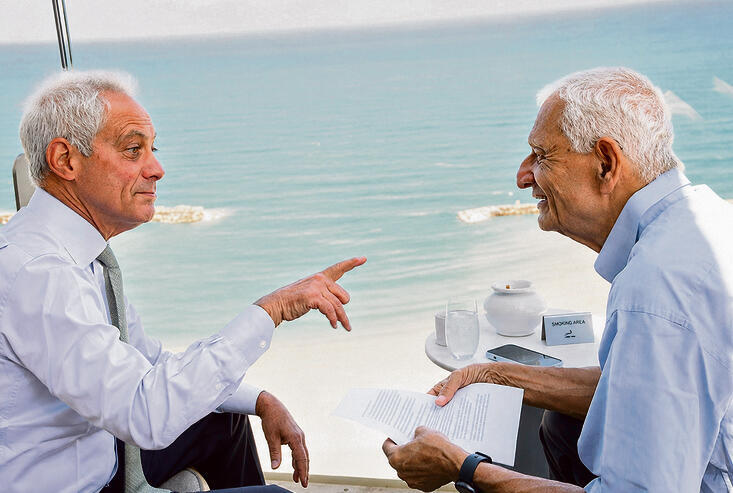
Emanuel and Nahum Barnea
(Photo: Ryan Frois)
"When I ran for congressman, or when I ran for mayor, people voted for my character. I don't hide Rahm Israel Emanuel. So, have I seen ugliness? I've seen ugliness. Have I seen the judgment of people knowing right from wrong, good from bad? Yes, I've seen that. And so, do I know there's antisemitism? I know there's antisemitism, but I also know there are people who can actually see your character for what it is.
"Now, I know, having practiced politics my whole life: if you think Israel is going to stay like this for another 30 years, I've got a bridge over the Tigris River you can buy."
"Thirty years is a long time," I said.
"On July 3rd," he replied. "Amy and I went to the opening of the Teddy Roosevelt Library in North Dakota. It was also commemorating the 250th anniversary of America. If you had taken a bet 250 years ago, 'Does this country survive?' you would have said no. A country built on self-rule where the sovereign is not the king but the people, a country built on laws.
"In 22 years from now that you and I are sitting here, Israel will be 100. It's like a blink of an eye. So in its 100th year, in 2048, will Israel be known as a country that has more Nobel Prize winners than any other country per capita—like it does today? Will it be known as a country that marvels the world with cures to cancer, with new technology, that literally can take a desert and make it bloom? Or will it be known because it knows how to just handle an F-35?
"I'm telling you that over the next 22 years, the world will not stay still. And if Israel thinks that you don't have to make any changes, and that in 22 years you'll continue to burn farmland in the West Bank, you'll continue to have a government that facilitates you kicking people out and terrorizing them in their own homes, you think that's going to stay for the next 22 years? Not happening.
"A country has four tools in its national security toolbox: military power, economic statecraft, political persuasion and cultural attraction. Three of your tools you've thrown out, and you've decided that military power is your only toolbox. And I'm telling you: you don't let the other three atrophy to the point that they have no muscle capacity, and that is exactly what has happened to Israel."
"But Israel has changed," I said. "It's no longer the country you knew and loved — demographically, culturally and ideologically. That change may be dangerous for Israel's future, but it can't simply be ignored. Oct. 7 changed everything. Not everything is politics."
"Yes," he replied, "but those changes, first of all, they're not all inevitable. I've seen a country go from President Obama to Donald Trump in a blink of an eye. But those are all choices, and this is our choice.
"I'm saying you could stay with the status quo. If you want to occupy the West Bank, and you want to stay occupied in Gaza, do you want to send the future of this country to stand in Gaza? Your own reservists can't do it anymore. Your own families can't do it anymore. You have more people leaving your country than ever before.
"The one thing we as Jewish people have spent our entire history trying to get out of is the ghetto, to be accepted as a full member. Yes, we're Jewish, but to be accepted in society, in the world. What are Ben-Gurion's comments? To be 'a nation among nations.' Did you ever imagine in your life, in your mind, that it would be a prime minister who led Israel back in?
"You've lost America, you have lost Europe, and you picked up Somaliland. Your biggest political market is the United States. Your biggest economic market is Europe. Both are lost.
"You are more strategically, diplomatically and politically isolated than in 78 years. If you think that isolation is a sustainable political context, I have warned you that that is not going to sustain itself to 2048, let alone to 2028. No country lives isolated.
"Israeli academics are not welcome at conferences. The Israeli public would like to see their athletic teams compete, but you can't go for security reasons. You are isolated at every level. And it's a consequence. Is there antisemitism? Yes, it existed before; it exists now. But this is a consequence and a reflection of those policy decisions by a government that is leading you into a strategic dead end."
Trump all the way
"I know Israelis," I said, "who would tell you: with all due respect, you're coming here from Trump's America — a deeply polarized society, awash in violence, with a political and judicial system that many believe has stopped functioning and a revered Constitution that is violated daily. Americans love using the Hebrew word chutzpah. Isn't it a bit of chutzpah to lecture us?"
"Do you think I'm quiet about America's politics?" Emanuel asked, "I'm not. I've spent my life working toward progressive politics in America—helping President Obama, President Clinton, helping Speaker Pelosi, helping the people of the city of Chicago. So, we do have problems. If you're waiting for perfection before you can observe, you'll be waiting forever. I'm telling you: I happen to think the prime minister has done a disservice to the State of Israel. I happen to think President Trump has done a disservice to the United States. Not only do I say it, but I also go about winning elections to change it."
"Can America serve as a model for Israel?" I asked.
"That's for you to decide whether that's a model or not," he replied. "Coming back to this 250 years: we have a set of ideals, and you strive toward those ideals, but you never fully get there.
"My mother—her political life in our home was built on civil rights. Do I think that America has achieved the place it needs to be? Not a chance. But you never quit. You don't stop running the race. You're not allowed to quit."
His father died several years ago at age 93. Rahm was at his bedside.
"He said, 'What are you doing?' I said, 'I'm writing an opinion about President Trump.' He looks at me, and he goes, "Such an asshole." And then he goes back home."
Not a hugger
"During President Biden's administration," I said, "the White House pursued what was described as a 'hug Bibi' policy. In your view, was Biden wrong?"
"First of all, I think the speech makes it pretty clear that America has made a mistake around the policy," Emanuel said. "Even when you disagree, you don't say that there can be no daylight between the United States and Israel, because I actually believe that premise has been abused and it hasn't served Israel. It hasn't served the alliance, and it hasn't served America well. All three of them, it hasn't served well."
"So as far as you're concerned," I said, "the hugs are over."
"I'm not a hugger," he replied.
The rupture in their relationship dates back to 2009, when Netanyahu visited the White House.
"I said to him personally, to his face: what you're doing on the West Bank will lead to perpetual conflict and it will lead to the isolation of Israel. If there was a prediction I wanted to be wrong on it, that was the prediction."
"How did he respond?" I asked.
"'You're a self-loathing Jew.' That's what he said. It wasn't a difference of opinion; it was an insult. Not, 'Here's where you're wrong.' It was an insult. I didn't insult him. I just said, 'You're wrong. Here's what I believe.' You may agree and you may disagree."
"Did you ask to meet with Netanyahu during this visit?" I asked.
"The only government official I met in Israel is the president of Israel," he replied. "Last night, I met with President Herzog. I do not want to because of the proximity to the election—I know the prime minister, he will accuse me of playing politics, so I don't want to give him the ability to twist and turn and play games here, so I'll meet with nobody."
"So what is your relationship with him today?" I asked.
"We don't have a relationship, and I don't care," Emanuel said. "I'm not looking to have a relationship. My commitment is to the alliance. My commitment is to America. That's my commitment. You don't have to like me. There are mornings I wake up by 8 a.m., I don't like me either. I don't care. He said what he said."
When all you have is a hammer
"If you had been Israel's prime minister," I asked, "what would you have done in Gaza on Oct. 8?"
"I'm not getting into what ifs on that," Emanuel said. "As I said then, and I'll say now: Israel has a right to defend itself. But how you go about defending yourself—a year later, two years later—what are you achieving? How are you bringing the hostages home, etc.
"I hope this is clear: those who are celebrating October 7 after the murder of 1,200 innocents—the raping, the sexual violence and the taking of civilian hostages—whoever is celebrating them, they're morally bankrupt in my view. I do draw a distinction between a country that uses its missiles to protect its civilians versus—not a country, but an authority—that uses its people to protect its missiles. They're not the same.
"I've said it in the face of people that chant 'from the river to the sea': That will never happen. But if you think a Greater Israel will ever happen... they're both—and I'll say it to you as I said it this week—they're fantasies chanted by fanatics.
"Over the three years, your own national security and members of the government who then walked out said that the conduct of the war was reckless. I didn't just say it; they said it—and members of the national security apparatus: IDF, Mossad, etc. The very people that the prime minister refused to listen to in the preceding months—that the deterrence of Israel was being deteriorated—he wouldn't meet with them, he refused to listen."
"What is at the heart of your criticism?" I asked. "The number of civilians killed in Gaza? The destruction? The images that have emerged from the war?"
"You have decided that the military tool is the only tool you have," he replied. "We have a phrase in America: when all you have is a hammer, everything looks like a nail.
"You have a government in Syria that hates Iran. They're not for Iran. They want a security agreement with Israel. You decided to bomb their defense department. How's that going to help?
"I believe Yitzhak Rabin, the late prime minister, was right. That you fight terrorists if there's no peace process, and you make peace if there's no terror. You have to be capable of doing both simultaneously."
"Rabin did both," I noted, "and he was later assassinated."
A gift to Iran
"New Hampshire," I said, "is a small state in the northeastern United States. But in presidential primaries, it carries enormous weight because it provides the first real test of a candidate's strength. In recent months, you've crossed it from east to west, from the ocean to the river."
"Yes," Emanuel said. "I did a bike trip from the ocean — 113 miles by bicycle. It was the tenth trip I did around Lake Michigan. I did four when I was ambassador to Japan. I think it's the best way to travel actually — better than plane, better than car. You meet people and see things that you can't see otherwise.
"Along the route, I would go to people's backyards, I'd stop at a coffee shop. In the evenings, people gathered neighbors in their living rooms — sometimes dozens, sometimes just a handful — and we talked. We held seven gatherings like that along the way."
"Israel is a long way from everyday life in New Hampshire," I said. "And yet it kept coming up."
"The main questions I got were on education, because I care about education, about the economy. It's about the middle-class life and the fact that the foundation has cracked and it's fallen through. But everywhere I went—it was not the first question, but everywhere I went, in a barn, in a backyard, in a living room—I got a question about Israel and what you're going to do with that government, what you're going to do with that prime minister.
"New Hampshire is far from Israel, far from the Middle East, but it is what it is—you get a question everywhere you go. It's not just because of the Gaza effort, but Iran too."
"The decisions on Iran were made by Trump, not Netanyahu," I said.
"I don't give Trump a pass. Trump has his own agency," Emanuel replied. "He signed off on it, so he owns it. But now America has spent billions of dollars, its political capital, its moral standing—and we have done something that Israel said it would never do, and we said we would never do: lose American lives or spill American blood for Israel's security. That line got crossed. In 78 years, there has always been a principle—I've said this on American TV, so I'm not saying something new here—no American would lose their lives, no American would spill blood on behalf of Israel's security. That got crossed."
"I'm guessing," I said, "that if you'd been sitting in the White House Situation Room in February, you would have argued against striking Iran."
"Let's go through this, as I always say," Emanuel said. "In the past, Russia and China were for isolating Iran and enforcing the JCPOA. Today, they're backing them against the United States. In the past, the uranium was out of Iran; today, it's in Iran. In the past, it was at 3% purity; today, it's at 90%. In the past, you had inspectors on the ground looking; today, there are no eyes, no ears. So I'm going back to my principle in the Oval Office: bad and worse."
"Do you blame Netanyahu for drawing the United States into war?" I asked.
"The prime minister has shopped that military option to President Bush, who said no; to President Obama, who said no; to President Trump, who said no; and to President Biden, who said no. Four presidents have said no. Now, you make other choices. It doesn't mean you just sit on your hands. You do economic sanctions, you do enforcement, you do cyber.
"I was a supporter of the JCPOA. There are elements of Israel's own security that saw the value—may have been critical of, 'You didn't get this, you didn't get that.' When you find perfection, call me, okay? There are trade-offs in life.
"You have now made a decision. Never before did Iran threaten the Strait of Hormuz. Now you've given them the opportunity where they hold the entire world economy hostage.
"Every war game I saw in my tenure, the Strait of Hormuz was always a point of conflict. So it's not like this was a pop quiz; this was known. Never before did the government allow the linkage between Hormuz and southern Lebanon. Now you have that. This is where I also fault President Trump for signing off on something. When you make decisions, there's not right and wrong, it's bad and worse."
"Have we lost the Jews too?" I asked.
"Let me back up," he said. "It's a generational problem.
"I arrived in Israel two days after the 1967 war. I am 8 years old. I spent every summer from June to September here. When I got off the plane, with my two brothers and my mother, we didn't even get to shower. My mother grabbed us to go to Yad Vashem.
"My kids are 29, 28 and 26. For their friends, the Gaza war, and for their generation, the last three years are the most defining moment. It's not just PR. They also saw an Israel that literally went from a desert to a garden, an Israel that has more Nobel Prize winners than any other country on a per capita basis, an Israel that has medical cures, an Israel that offers poor countries a way to grow food and become self-sustaining. So to you I'd say: yes, you have a generational problem because you've decided to become one-dimensional."