

James Bond’s extraordinary missions may have been fiction, but the stories gathered by French weekly L’Express from intelligence agencies across Europe were very real.
In its latest issue, the magazine published a ranking of European intelligence services based on assessments by the people who know them best: spies themselves.
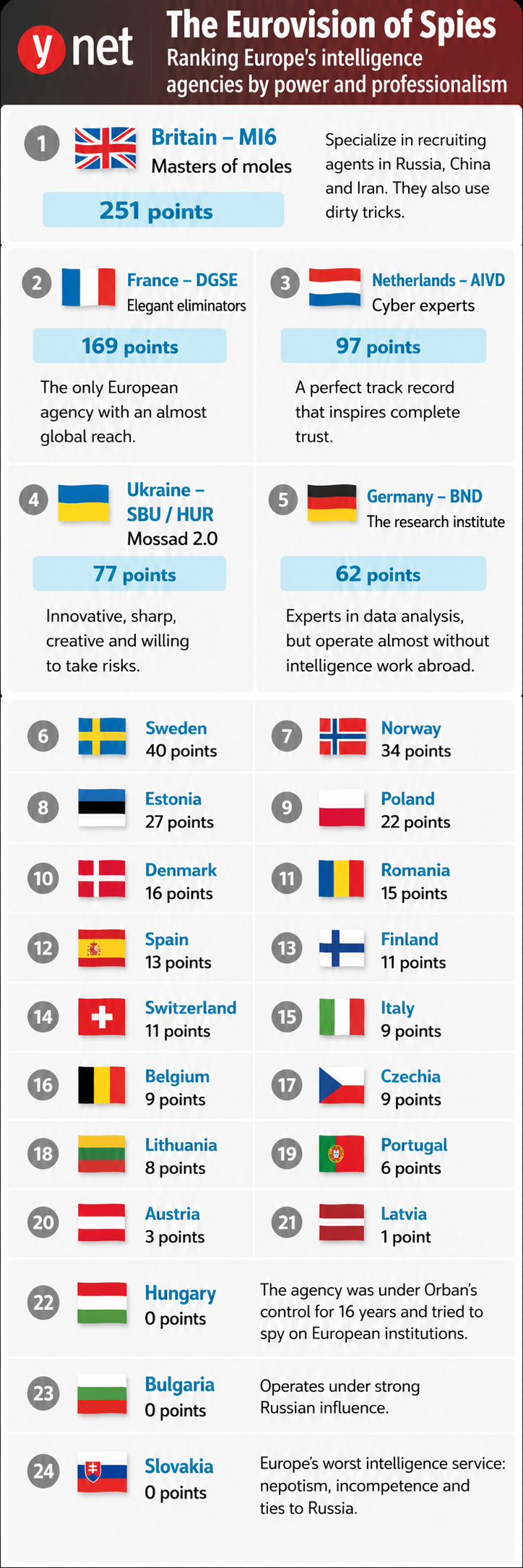
Sixty serving and former intelligence officers from 25 agencies were asked which rival services they respect most and which they would prefer not to work with. Sixteen of the respondents were current or former agency chiefs. Israel was not formally included in the ranking, but former Mossad director Yossi Cohen participated and agreed to be identified by name.
At the top of the European list was Britain’s MI6, followed by France’s DGSE. The British service was judged Europe’s strongest, particularly because of its ability to recruit and cultivate agents inside hostile systems.
MI6 is currently headed by Blaise Metreweli, the first woman to lead the British foreign intelligence service.
In an exclusive interview with ynet and Yedioth Ahronoth, L’Express deputy editor Étienne Girard described what the magazine learned about Europe’s intelligence world and what its insiders think of Israel.
Girard spent three months investigating the subject alongside journalists Alexandra Saviana and Elsa Trujillo.
The agencies were assessed in three main areas: recruiting “moles” and penetrating centers of power; assassination and sabotage operations, including operations such as Israel’s pager attack and Ukraine’s Operation Spiderweb; and intelligence collection, cyber operations and access to encrypted communications.
“I had not imagined that relations between the agencies were much more intense than the official relations between the countries,” a senior Swiss diplomatic figure told the magazine. “An effective intelligence agency gives a country power no less significant than nuclear weapons.”
Girard said specialization often matters more than size.
“It is better to specialize in one intelligence technique or one part of the world where others have no foothold than to be mediocre,” he said.
Portugal, for example, was cited for its intelligence reach in southern Africa, while Switzerland, Luxembourg and Ireland were noted for expertise in economic intelligence.
The surprise third place
At the top of the intelligence hierarchy, Girard said, are countries capable of placing moles deep inside rival governments and institutions.
Britain is particularly respected for its ability to penetrate Russia, China, Iran and Turkey.
“This is the most highly regarded technique, because it allows you both to collect valuable information in real time and to influence decisions,” Girard said.
A senior French intelligence official praised the British approach.
“The British specialize in sources they have built over time. They recruit graduates of elite universities 10 years before they activate them,” he said.
According to the official, Britain was responsible for recruiting former Iranian deputy defense minister Alireza Akbari.
France ranked second, praised for its global reach and its ability to combine human intelligence, covert operations and technical capabilities.
“They are one of the only intelligence services capable of ‘neutralizing’ a target discreetly,” a Polish intelligence officer said.
Five respondents ranked the French first overall.
Gina Bennett, the veteran American intelligence analyst known for her work tracking jihadists, described the French as “the best partners in human intelligence.”
The Netherlands was the surprise third-place finisher.
The Dutch intelligence service is sometimes described as the “little sister of the United States” because its officers were trained by Americans and employ similar technologies.
According to L’Express, there is hardly a major cyber operation in Europe in which the Dutch are not involved. The magazine cited their reported participation in the planting of the Stuxnet malware in Iran in 2007.
Germany, by contrast, was one of the ranking’s disappointments, placing fifth.
“They are more like a research institute with bureaucrats than an intelligence agency,” an American source said.
Still, German media have reported that the BND managed to monitor activity aboard the U.S. president’s Air Force One until 2014 by exploiting a cyber vulnerability.
Ukraine also received high marks.
European intelligence officers praised the rapid transformation of Ukraine’s services under wartime conditions and described what some called their “Mossadization,” referring to increasingly sophisticated and imaginative covert operations.
Behind Ukraine came several Scandinavian and Baltic agencies, whose proximity to Russia has forced them to develop deep expertise in countering Moscow. In some of those countries, Russian agents are still believed to remain embedded.
Poland was also rated highly, although one senior official at a pan-European intelligence body said that “because of political control over the organization,” it lost points.
Hungary fared considerably worse.
“Former prime minister Viktor Orban turned the agency into a political instrument,” one source said.
Mossad still among the elite
Although the investigation focused specifically on Europe, Girard discussed with ynet how intelligence professionals view Israel and the United States.
“If this were a global ranking, the United States would be first. There is no competition with their global deployment and ability to obtain information, although some argue that with capabilities and budgets like theirs, they should be even better,” he said.
But he added that confidence in Washington has changed.
“Since Donald Trump, everyone knows that dependence on the United States has to be reduced.”
Girard stressed that what followed was his personal assessment.
“My personal opinion is that Mossad would rank second or third, after the British. The British and Americans have global deployment, but there is no substitute for Mossad in the Middle East, including in its ability to penetrate on the ground. Mossad fascinates and inspires admiration among other intelligence services, particularly because of its targeted assassination capabilities, such as the pager operation and the neutralization of Iranian scientists. Israel also excels in cyber.”
Asked whether Israel’s political situation had affected intelligence cooperation, Girard said Mossad was still viewed as a partner.
“Mossad is still considered an ally. France’s criticism of Israel sometimes makes operations on the ground more complicated, but I do not think there has been a break.”
Asked whether Mossad’s reputation had suffered after October 7, he drew a distinction between offensive capability and the intelligence failure surrounding the attack.
“Offensively, not at all. The pager operation restored its reputation. On the other hand, it was an instructive lesson for every intelligence service in the world. If there is no good coordination between intelligence and the political echelon, you will still be vulnerable.”