

Israeli intelligence has concluded that even after the aircraft carrier USS Gerald R. Ford and its strike group — which were documented yesterday near Crete, Greece — arrive in the region, the United States has only limited military capability to attack Iran.
That was reported Tuesday by the British newspaper Financial Times, citing an Israeli intelligence official who said the United States could carry out an intensive air campaign lasting “only four to five days,” or a week of “lower-intensity strikes.”
Gallery
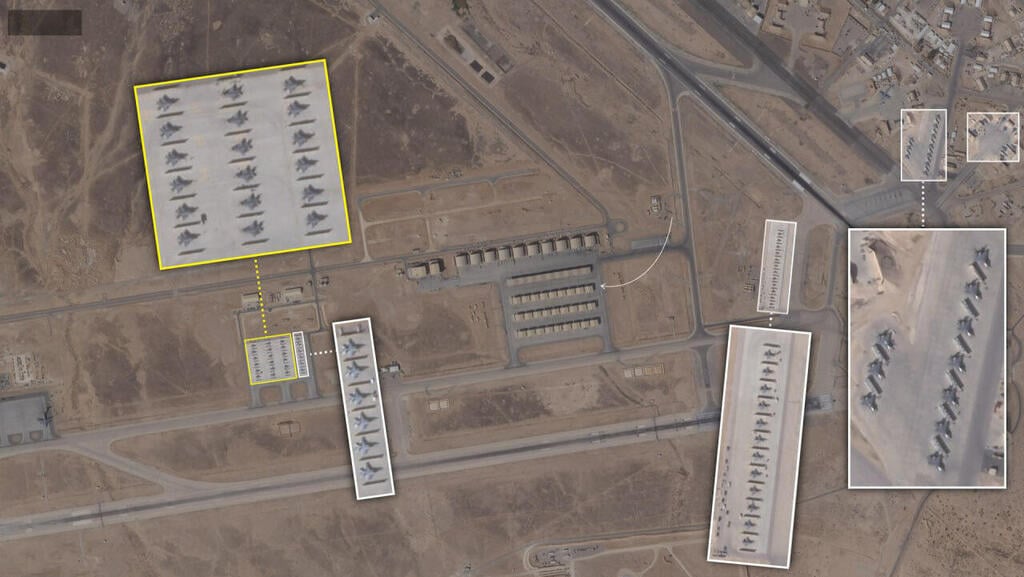
Satellite image of US aircraft buildu p at a base in Jordan, according to The Washington Post report
(Photo: Planet Labs 2026)
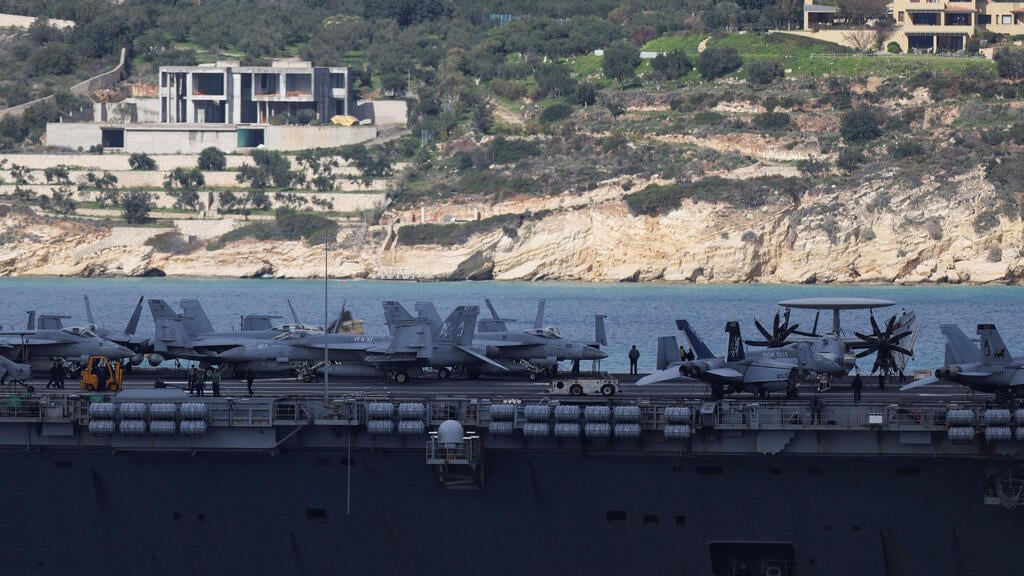
The aircraft carrier USS Gerald R. Ford near Crete, Greece
(Photo: REUTERS/Stelios Misinas)
The report comes amid accounts published Monday in the American media about warnings delivered by the chairman of the Joint Chiefs of Staff to President Donald Trump, and concerns in Washington over a prolonged war with Iran that would incur casualties and cost vast sums.
Against the backdrop of the possibility that Iran’s proxies in the Middle East — chiefly Hezbollah in Lebanon and the Houthi rebels in Yemen — could join the fighting, Reuters reported, citing two senior Lebanese officials, that Israel conveyed a message threatening the government in Beirut: “We will strike civilian infrastructure if Hezbollah intervenes.”
CBS News reported that the president is expressing “growing frustration” with what his advisers describe as the “limitations of military power” against Iran. According to officials involved in the discussions, Trump is pressing his advisers to present military options that would serve as a sufficiently severe “punishment” to shock the leadership in Tehran and force it back to the negotiating table on terms favorable to Washington, without being drawn into a broader regional war.
Trump, CBS reported, is seeking a “dramatic show of force” against Iran, but senior U.S. military commanders have stressed to him that wars “rarely” unfold according to script and that even carefully calibrated strikes could produce unintended consequences.
The president sought to distance himself from reports about limits on U.S. military power and warnings delivered to him by Joint Chiefs Chairman Gen. Dan Caine, in a post Monday on his Truth Social platform. Trump rejected reports suggesting limits on U.S. military power and warnings delivered to him by Joint Caine.
Trump described Caine as a formidable commander representing what he called the world’s strongest military and said Caine had not argued against attacking Iran or advocated only limited strikes. He said Caine’s focus was on winning. Trump added that he still preferred reaching a deal with Iran, but warned that absent an agreement it would be a very bad day for the country.
The president said Caine, like others in the administration, would prefer to avoid war, but believes that if a military strike is ordered, victory would be easy. Trump said Caine was responsible for “Midnight Hammer,” which he described as an attack on Iran’s nuclear development, and claimed the program had been destroyed by U.S. B-2 bombers. He asserted that reports about a possible war with Iran were intentionally inaccurate.
Trump also said that he alone makes the decisions regarding Iran. He warned that if no deal is reached, it would be a very bad day for Iran and, regrettably, for its citizens, whom he described as great people who should not have to face such consequences.
State of the Union
The latest reports on Iran come as final preparations are underway for Trump’s State of the Union address to Congress later Tuesday, in which he is expected to address, among other issues, the question of striking the Islamic Republic.
Trump’s approval ratings are at a low point in polls ahead of the November midterm elections, and the speech is an opportunity for him to persuade voters to preserve Republican control of the House and Senate. It also comes against the backdrop of a U.S. Supreme Court decision overturning Trump’s global tariff program, one of the pillars of his policy since returning to the White House last year.
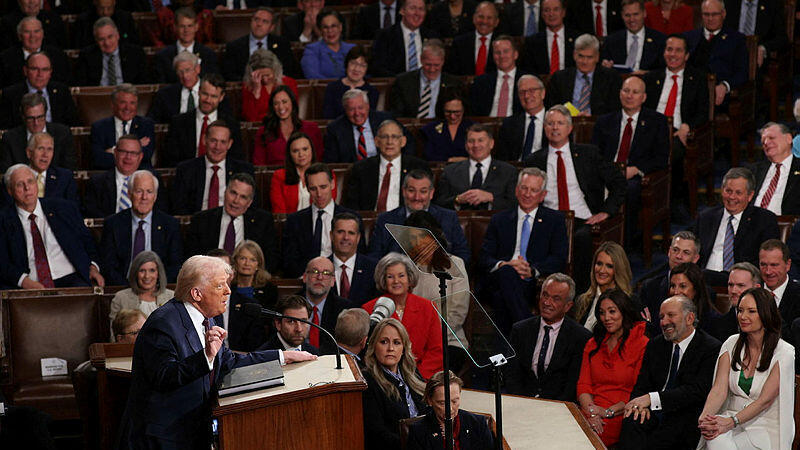
Trump during last year’s State of the Union address
(Photo: AFP)
Trump will deliver the address as most of the Department of Homeland Security is partially shut down due to a dispute between Republicans and Democrats in Congress over the administration’s aggressive immigration policy, a controversy that intensified following a fatal shooting of two American citizens in Minneapolis.
At the same time, the case of convicted sex offender Jeffrey Epstein continues to reverberate in the United States and around the world, and Trump is struggling to move past the controversy surrounding the release of investigative files related to Epstein, who was once his associate.
Despite Trump’s stated desire to win a Nobel Peace Prize, U.S. officials who spoke with Reuters said the president appears to be edging closer to a military confrontation with Iran. Two White House officials, speaking on condition of anonymity, told the news agency that Trump will discuss his plans regarding Iran during the State of the Union address, but provided no further details. They emphasized Trump’s achievements in brokering peace agreements. The speech will be delivered on the fourth anniversary of Russia’s invasion of Ukraine — a war Trump once pledged to end “within 24 hours.”
Protests against the regime at universities in Tehran on Monday



A machine gun mounted on a pickup truck near a university in Tehran
Meanwhile in Iran, the regime is preparing for continued student protests at the University of Tehran. Iran International overnight published a photograph of a machine gun positioned near the site, which it said was part of preparations by local forces to suppress the protest by force.
Iranian government spokeswoman Fatemeh Mohajerani said: “Students have the right to protest, but we must all recognize red lines. Holy sites and flags are red lines that must not be crossed, even at the height of anger. The correct path is effective dialogue and rationality, not anger and aggression.”
First published: 14:04, 02.24.26