


Israel is considering a proposal to hold a trilateral energy summit with Jordan and the United Arab Emirates in Abu Dhabi aimed at advancing regional cooperation on water, energy and diplomatic ties, according to Israeli officials familiar with the discussions.
The proposed meeting, backed by the UAE, would bring together the three countries' energy ministers to discuss a new water agreement under which Israel would supply Jordan with an additional 50 million cubic meters of water annually, on top of the 50 million cubic meters it already provides each year under the 1994 Israel-Jordan peace treaty.
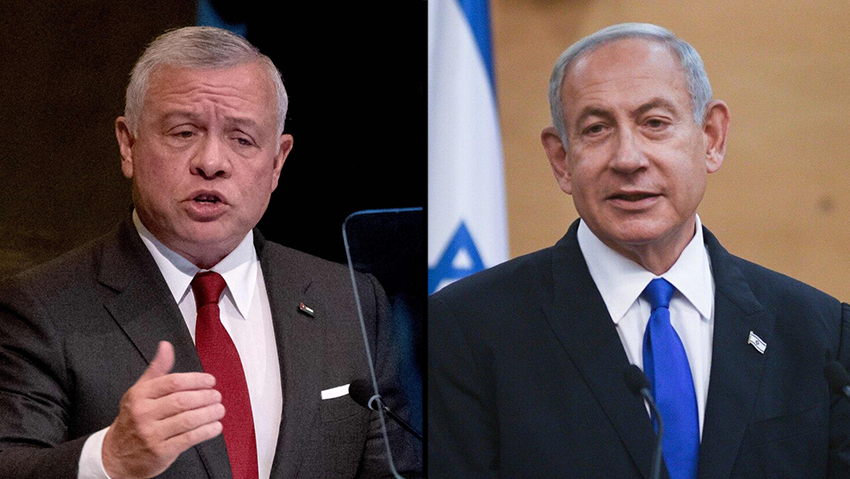
King Abdullah of Jordan, Prime Minister Benjamin Netanyahu
(Photo: AP, Rafi Kotz)
The summit would also seek to revive the so-called "Prosperity" initiative, a regional project under which Israel would build a large desalination plant to provide water to both Israel and Jordan, while Jordan would construct a major solar energy facility to supply electricity to both countries.
Another key issue expected to be discussed is improving relations between Israel and Jordan, whose diplomatic ties have sharply deteriorated since the war in Gaza. Jordan has not had an ambassador in Israel since November 2023, while Israel has not maintained an ambassador in Amman since the Oct. 7, 2023, Hamas attack.
Under the peace treaty, Israel sells Jordan 50 million cubic meters of water annually at a symbolic price.
In 2021, Israel agreed to supply Jordan with an additional 50 million cubic meters each year under a separate three-year agreement. Jordan later sought to extend the arrangement for another five years and increase the additional allocation to 80 million cubic meters annually.
Energy Minister Eli Cohen renewed the agreement every six months after internal debate over whether to continue the extra supply. Israeli officials said the extensions came partly in response to U.S. pressure and Jordan's assistance in intercepting Iranian drones during recent regional hostilities.
Israeli officials also cited repeated criticism of Israel by Jordanian Foreign Minister Ayman Safadi as a factor complicating the decision.
The additional water agreement has not been renewed since November 2025, leaving Jordan without the supplemental supply for the past eight months and further straining relations between the neighboring countries.
"We continue supplying Jordan with the water required under the peace treaty," a senior Israeli official said. "We have no obligation to provide additional quantities. If there is goodwill between the two countries, we can provide the extra water."
The official also noted that 2025 was Israel's driest year in a century, saying the government prioritized replenishing domestic reservoirs to support Israeli agriculture.
According to the official, the UAE is promoting the proposed summit in an effort to provide what was described as "an umbrella of goodwill" that could help restart cooperation.
"If the atmosphere following the war continues to calm, this agreement could return," the official said. "Jordan needs the water, but when you help your neighbors, you expect warmer relations. If there is a meeting, everything will be on the table — normalization, water and strengthening bilateral ties."
Jordan is one of the world's most water-scarce countries, with limited natural water resources, rapid population growth and the added burden of hosting large numbers of Syrian refugees. Repeated droughts and climate change have worsened the crisis, leaving the kingdom with an estimated annual water deficit of about 500 million cubic meters.
Jordanian officials have long identified water security as one of the country's highest national priorities.
A source close to the Jordanian government told Israel's Kan public broadcaster that water "is a very important issue for us and is part of the peace agreement."
Jordanian officials have expressed frustration that water cooperation, long considered a cornerstone of the peace treaty, has increasingly become, in their view, a bargaining chip in Israel-Jordan relations. They warn that continued delays in renewing the additional water agreement risk further deepening tensions between the two countries.