


Hundreds of thousands of ballots cast outside voters' assigned polling stations could still affect the final outcome of Israel's general election, potentially shifting parliamentary seats between parties and altering the political balance. Unlike regular ballots, these votes undergo a separate verification process before being added to the nationwide count, meaning the first results may not fully reflect the final composition of the Knesset.
These votes are known in Israel as double-envelope ballots, a system that allows eligible voters who cannot reach their assigned polling stations to vote elsewhere. They include soldiers, military reservists, diplomats, police officers, prison staff, hospital patients and displaced residents. Each voter places their anonymous ballot inside an envelope, which is then sealed inside a second envelope carrying identifying information. Election officials use the outer envelope to verify that the person has not voted twice before adding the anonymous ballot to the national count.
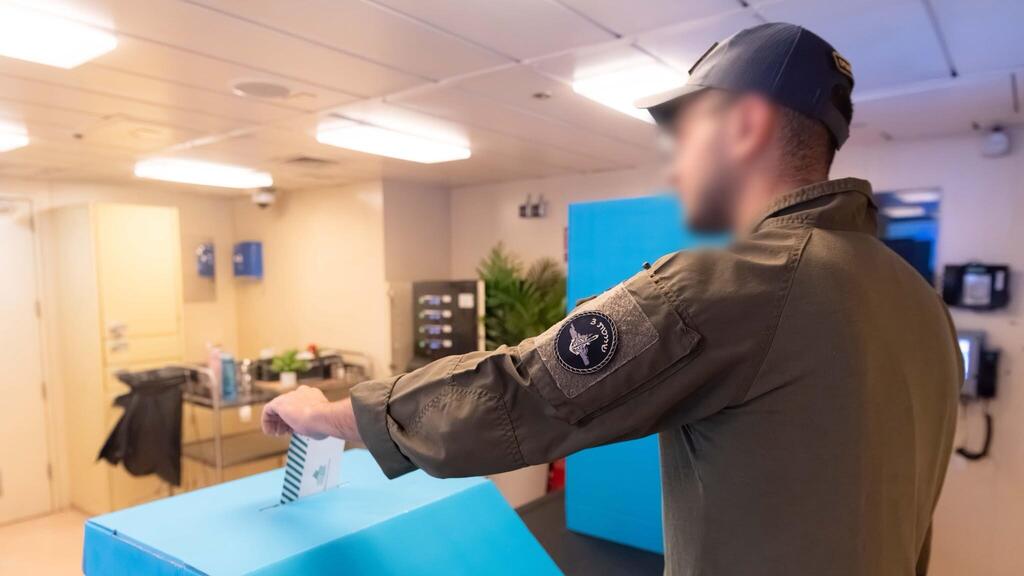
Soldier voting at an IDF polling station
(Photo: IDF)
Because of the war and the large number of mobilized reservists and Israelis displaced from their homes, the Central Elections Committee prepared for an unprecedented number of double-envelope ballots. More than 460,000 were cast in the 2022 election, while advance estimates for this election ranged from 600,000 to 650,000. That volume represents roughly 15 Knesset seats' worth of votes, although those seats are not allocated separately. Instead, the ballots are added to the nationwide totals, potentially changing how seats are distributed among parties.
Historically, these votes have tended to favor Zionist parties across the political spectrum, largely because soldiers make up a significant proportion of voters using the system. Ultra-Orthodox and Arab voters are considerably less represented in this group, meaning their parties' relative share of the overall vote can decline once the ballots are included. The effect is generally limited but can be significant enough to change the allocation of one or two seats.
This means parties such as the ultra-Orthodox Shas and United Torah Judaism, as well as the predominantly Arab Joint List and the Islamist Ra'am party, could see their relative electoral strength change when the double-envelope ballots are incorporated. However, the outcome also depends on the remaining regular votes, the performance of other parties and the distribution of surplus votes.
A similar shift occurred in the 2022 election. Before the double-envelope count, United Torah Judaism was projected to win eight seats and Avigdor Liberman's secular nationalist Yisrael Beytenu party five. Once the additional votes were included, United Torah Judaism fell to seven seats while Yisrael Beytenu rose to six. The shift illustrated how a relatively small change in the overall vote distribution can affect individual parties without necessarily changing the balance between political blocs.
In that election, the number of votes required to secure one parliamentary seat under the allocation formula was approximately 36,227. The double-envelope ballots therefore represented the equivalent of roughly 12 to 13 seats. Likud received enough of those votes to represent approximately three seats, Yesh Atid around two, and Religious Zionism and Otzma Yehudit together nearly two. These figures illustrate the voting strength of different parties within the special count, rather than seats awarded directly from those ballots. The final allocation also depends on the electoral threshold and agreements between parties to combine surplus votes.
The pattern was evident in the March 2021 election as well, when approximately 428,000 double-envelope ballots were counted. Their inclusion reduced Ra'am's representation to four seats and increased the left-wing Meretz party's total to six, without changing the balance between the main political blocs.
The counting of double-envelope ballots requires additional checks and can continue after the regular vote count has been completed. Because the votes are incorporated into the national totals rather than counted as a separate electoral category, their impact may not become clear until the final stages of the process. In a closely contested election, even a small shift in parliamentary representation could have important implications for coalition negotiations. Until all ballots are verified and included, initial seat projections remain provisional, and parties could still gain or lose representation before the final results are announced.