

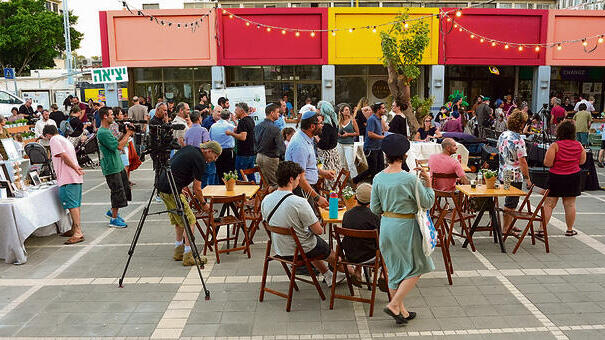
After more than a decade of standing deserted, Hermon Square in Kiryat Shmona came back to life Thursday as a group of families who moved to the city in recent months inaugurated a cafe and cultural center aimed at restoring vibrant commercial activity to the area.
When the host of the opening event asked the city’s new residents to raise their hands, hundreds went up. Jacqueline Elharar, 83, a mother of 18 who immigrated to Kiryat Shmona from Morocco in the late 1950s, was invited onstage as a representative of the city’s longtime residents and received a bouquet from one of the families that had moved to the city only the previous week. “It was very moving to meet them,” she said. “They bring light. There is a feeling that good news is coming here too. That is not something we take for granted.”
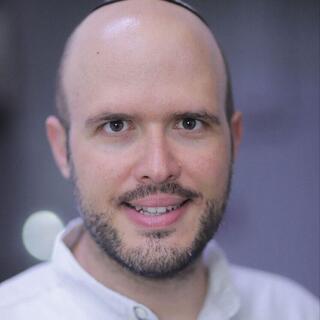
The initiative to establish the cafe and local cultural center is being led by Danny Koten, a social entrepreneur and one of the founders of the Kiryat Shmona Garin, a community group whose members have relocated to the city. Koten himself moved from Tel Aviv and is working to help absorb the new families.
“We want to create a place here that feels different, that feels like Kiryat Shmona,” he said. “A place for beer and performances — not somewhere for a one-time event, but a place that will bring foot traffic back and give other entrepreneurs and business owners a lively space where they can open businesses.”
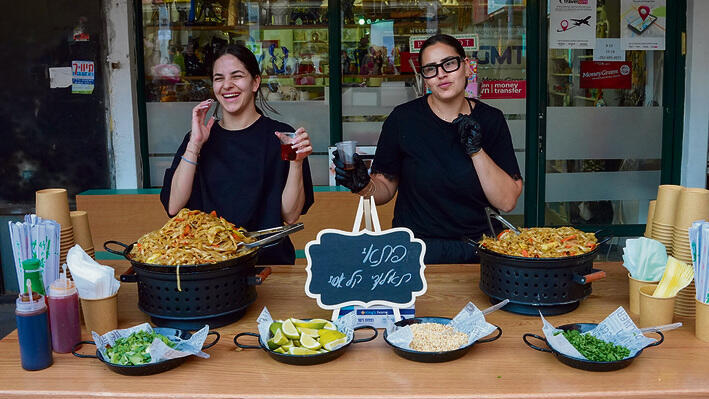
'We want to create a place here that feels different, that feels like Kiryat Shmona'
(Photo: Effi Sharir)
In nearby IDF Square, the Tarbut Movement is also establishing a creative and activity space for artists at the start of their careers.
Koten, who is married and has two children, explained why the group chose to open the cafe in the abandoned square.
“We moved here last summer and saw that anyone who wanted to attack the city would come and film Hermon Square and say, ‘Look how dead this city is, everything here is closed,’” he said. “This is not only the heart of Kiryat Shmona, it is a symbol of the heart of the Galilee.”
Koten sees students at the University of Kiryat Shmona as a strategic target audience. The institution, based on the former Tel Hai Academic College, is set to begin operating with university status in the 2026-27 academic year.
“We wanted to establish a well-designed cafe here with a top-premium feel, an excellent coffee machine, comfortable and attractive furniture and innovative design,” he said.
“Kiryat Shmona is a university city. But while downtown Beersheba, for example, which has a university, is the center of activity where students go for services, social life and community, here the situation is the opposite. They find all of that in the small kibbutzim around the city. We want to create those places here. This will be a great university city.”
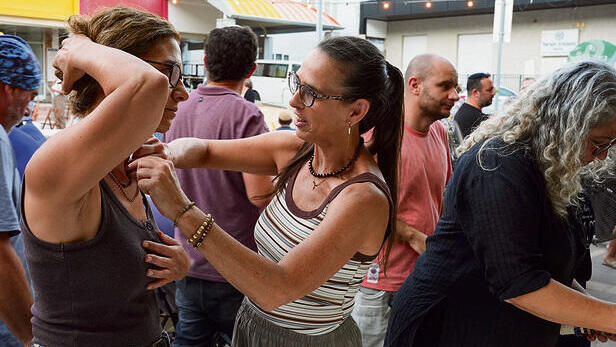
Opening event at Hermon Square
(Photo: Effi Sharir)
To help revive the deserted city center, Bank Hapoalim joined the new initiatives through its Poalim for Revival fund, donating more than half a million shekels.
Alongside the cafe and shared workspace, 12 cultural events will be held throughout the year under the title “Live Thursday in the Square,” featuring live performances and a night market with stalls run by local businesses.
“We are excited to see the vision becoming reality and life returning to the city square,” said Sharona Tarshish, Bank Hapoalim’s community relations director.
Kiryat Shmona Mayor Avichai Stern welcomed the new residents. “You chose to come here at a time when choosing Kiryat Shmona cannot be taken for granted,” he said. “You chose not only a new address, but a community.”
On the eve of the evacuation, Kiryat Shmona was experiencing growth and stood at an unprecedented turning point. Nearly 26,000 residents were evacuated in October 2023 after the outbreak of the war, and fewer than 10,000 have returned so far.
About 40% of the city’s businesses have also not reopened, while those that have are now grappling with lower revenues. Customer traffic remains relatively sparse compared with before the war, slowing the rehabilitation of the urban center and creating a barrier to the opening of new businesses.
Against that backdrop, dozens of new families, totaling more than 300 residents, have chosen to move to the city and take part in its revival alongside longtime residents. They do not see their mission as rehabilitating or saving the town, but as taking part in rebuilding it.
This effort is supported by MAKOM, which works to bring new families to Kiryat Shmona and help them build strong communities and a future in the city. Through its longstanding partnership with MAKOM, Jewish National Fund-USA has helped strengthen this work alongside decades of investment in Kiryat Shmona’s healthcare, housing, employment and quality of life.