

At 5 a.m. on Thursday, September 10, 2026, Ali Al-Ahdal, a fisherman in his sixties from Al-Amoudi neighborhood of Mocha, woke to the sound of successive explosions and gunfire. Within hours, government forces and the National Resistance had withdrawn south toward Dhubab District, while vehicles carrying fighters from Ansar Allah (the Houthis) poured into the city center.
“I woke up to find that the city had fallen within hours, without any warning or prior indication. They gave us no chance to flee. The exits were immediately sealed off, and the sea, which had been the lifeline of our lives, became an open combat zone,” Al-Ahdal said.
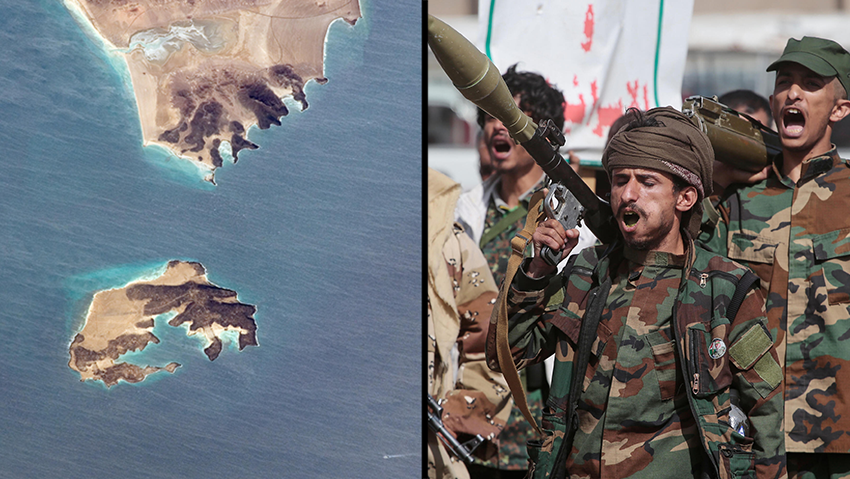
Bab el-Mandab Strait; Houthi gunmen
(Photo: AP Photo, AFP PHOTO / ANSARULLAH MEDIA CENTRE)
What happened in Mocha that morning was not an isolated incident in a protracted war. It marked the starting point of a broader shift: Yemen’s transition from a “civil conflict with regional repercussions” into a direct front in the wider confrontation between Tehran and Washington, which has been raging since February 28, 2026, when the United States and Israel launched strikes on Iranian targets.
The fall of Mocha was not a collapse. It was the latest stage in an escalation that began weeks earlier. On August 9, the Houthis opened a direct front against Mocha itself, shelling the city and its port with more than 25 missiles over several consecutive days, while the government reinforced its positions with units from various brigades.
On September 3, the Houthis launched a broader military operation reaching the war fronts west of Taiz, as well as Hays district in Hodeidah. The Houthis later announced that they had taken control of six districts in the two governorates, covering a total area of 5,400 square kilometers. The advance relied on a combination of ground offensives supported by missile and drone strikes targeting government forces and their equipment before infantry forces advanced, according to two military sources from both sides who spoke to The Media Line.
Events accelerated on Wednesday evening, September 9, when the Houthis made a breakthrough in Al-Wazi'iyah District in central Yemen, followed by their capture of Jabal al-Nar east of Mocha and then Khalid bin Al-Walid Camp, Yemen’s second-largest military base.
By Thursday evening, September 10, the last two districts in Hodeidah governorate still held by government forces had fallen: Hays district, after heavy fighting, and Khokha, which fell without resistance, giving the Houthis full control of the governorate. This was followed by withdrawals of government forces, leading to the capture of Hodeidah city and the islands opposite the Bab el-Mandab Strait. The speed with which Hays, Khokha and Mocha fell—less than 48 hours—raised widespread questions among Yemenis about possible defections of and infiltration within government forces.
As armed fighters entered Mocha, most residents remained inside their homes amid an arrest campaign that affected many people, according to testimonies obtained by The Media Line. Those detained included activists, journalists, doctors, and humanitarian workers. Jamil Mohammed, a resident of Mocha, told The Media Line that many people fled along the coastal road toward Aden Governorate and that the city and its residents were living in a state of intense fear after the Houthis took control of the city.
A Houthi field commander known by his nom de guerre, Abu Rajeh, told The Media Line that this operation was a “carefully devised strategic plan based on the element of surprise and comprehensive coordination between drone operations and ground advance.”
He added: “We wanted to strip the Forces of Aggression of their stronghold and secure Yemen’s sovereignty over its territorial waters in Bab el-Mandab.”
“Now Yemen has full sovereignty over the Bab el-Mandab Strait,” he said, and hailed the city’s return to the “national fold.”
On the other side, a military officer in the internationally recognized government’s forces who spoke to The Media Line on condition of anonymity explained the reasons for the massive setback. “Our positions were subjected to unprecedented firepower and missile strikes. The decision to redeploy and withdraw toward Dhubab, and later to safe areas, was a tactical step to protect our forces and civilians from certain annihilation after the loss of air cover,” he said.
He stressed that the fighting was ongoing, adding: “Mocha, Bab el-Mandab and the neighboring districts remain the center of a military operation. The battle is not over yet.”
The West Coast did not fall because of insufficient military presence. From late August through the first week of September 2026, fighting spread horizontally from the West Coast northward and from Taiz in central Yemen eastward toward Marib, Al Jawf and Al Bayda, in one of the most intense waves of ground escalation since the 2022 truce.
The clashes resulted in a new map of territorial control across districts along the front lines. According to a medical source in the capital, Sanaa, the fighting had resulted in the deaths of more than 450 Houthi fighters.
According to a Majed Al-Nuzaili, a spokesperson in the IRG’s armed forces: “the [IRG’s] stated objective of this simultaneous escalation was to restore state institutions and end the Houthi coup.”
Military analysts, however, believe that opening fronts in Al-Jawf and Al-Bayda was intended to disperse Houthi forces and ease pressure on the western coast by forcing them to fight in multiple directions simultaneously.
The UN envoy to Yemen warned that the expansion of the fighting in this manner “threatens to widen the scope of the conflict” and “will have serious consequences” for prospects of reaching a political settlement, calling on regional and international actors to contain the escalation.
As of Sunday, September 13, fighting along the West Coast had not subsided. The Yemeni army announced that it had carried out airstrikes targeting Houthi gatherings near Mocha port and the Dhubab area, while government forces launched a counteroffensive in western rural Taiz to retake some districts.
What distinguishes this round from previous ones, however, is its regional context. Since the outbreak of the war between Iran and the United States and Israel in late February, Bab el-Mandab has become a direct Iranian pressure point on the global economy. Meanwhile, disruptions in the Strait of Hormuz had already increased oil flows through Bab el-Mandab from around 5.4 million barrels per day in the fourth quarter of 2025 to approximately 8.1 million barrels per day in the second quarter of 2026, as Saudi Arabia redirected part of its exports away from Hormuz.
With the Houthis announcing a naval blockade of Saudi Arabia and carrying out attacks on vessels near the strait, as well as strikes against Saudi energy infrastructure, two major routes for global oil supplies were simultaneously placed at risk. This prompted Riyadh to request U.S. military intervention to strike Houthi positions, but the administration of President Donald Trump has so far rejected the request.
As an expected consequence of the escalation, the International Organization for Migration has recorded the displacement of around 76,000 people from Taiz and Hodeidah since September 3. The figure is likely to increase in the coming few days.
Meanwhile, Yemen’s Executive Unit for the Management of IDP Camps recorded the displacement of approximately 9,746 families from Taiz, Hodeidah and Lahj as of September 10, a measure expressed in households rather than individuals.
In Mocha and around Bab el-Mandab, none of these broader calculations appears to mean much to Ali Al-Ahdal. Sitting in his home, he watches columns of smoke rising above the port through gaps in his windows, summing up the plight of thousands of people along the coast in a single sentence:
“We have become fuel for a war that leaves nothing untouched. We do not want the armies’ conflicts or the international shipping routes. All we need is to live safely in our homes and return to fishing and the simple lives that were taken from us overnight.”
Between Iran and the United States, Riyadh and Sanaa, and the West Coast, Al Jawf, Marib and Al Bayda, Yemen’s geography remains an open arena for a multi-front conflict whose course is increasingly beyond the control of its inhabitants.