

This is likely the greatest dilemma Hamas has faced since its founding. The delay in issuing an official response to U.S. President Donald Trump’s peace plan reflects the depth of the organization’s internal struggle.
There is no doubt that the plan is far from favorable for Hamas. At its core, it requires the movement to give up the very thing that defines it: its weapons. Hamas has always presented itself as the vanguard of “resistance,” an identity rooted in armed struggle. Agreeing to surrender its arsenal, even to a foreign force, would erase its political and organizational identity. The situation resembles the pressure Hezbollah faces in Lebanon, though there it stems largely from domestic politics. For Hamas, the real pressure comes from abroad: Arab states urging it to accept the deal. Leaders in Gaza and Qatar know that if even Qatar and Turkey, its closest ideological allies within the Muslim Brotherhood sphere, along with other Arab states back Trump’s plan, Hamas risks standing isolated against Israel without any Arab support.
For that, much credit goes to Trump and to Prime Minister Benjamin Netanyahu, who managed to corner Hamas. If Hamas accepts, it ceases to be Hamas. If it refuses, it becomes the ultimate spoiler of peace in Gaza. On the surface, it appears a win-win for Israel.
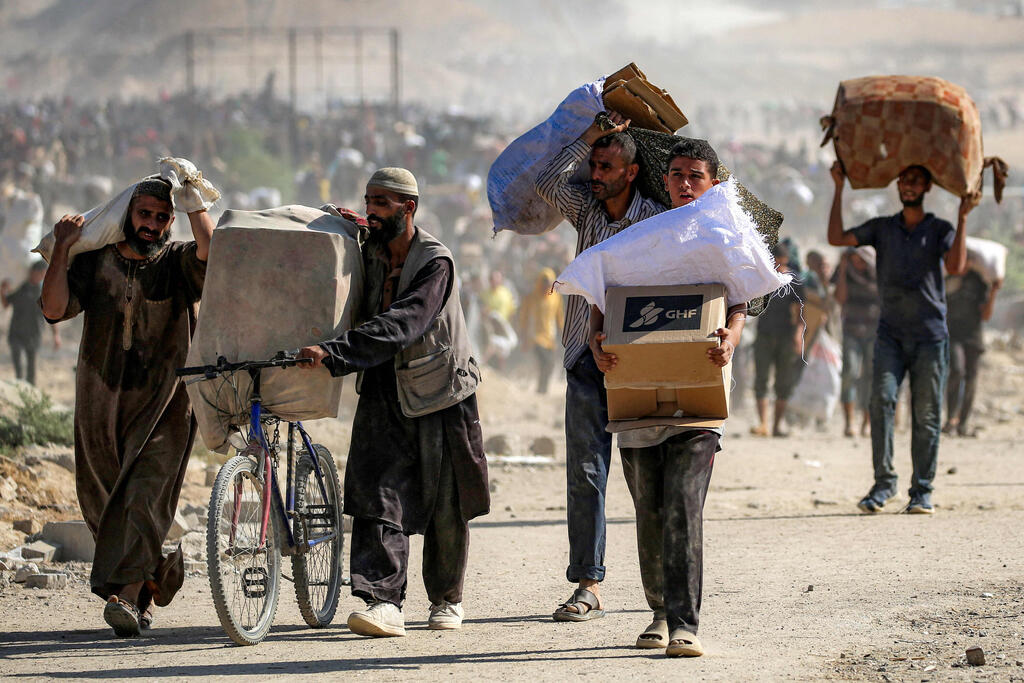
Gazans in Nuseirat
(Photo: Eyad BABA / AFP)
The pressure on Hamas leaders in Doha is enormous, but the question is how their counterparts inside Gaza, such as Izz al-Din al-Haddad and Raed Saad, who reportedly oppose the plan, will respond. Hiding in tunnels, they know Gaza faces devastation and mass displacement. Yet for them, agreeing to the plan equals surrender: freeing hostages and handing over weapons.
Still, if Hamas refuses, Israel will receive a green light for yet another round of devastating strikes in Gaza, flattened neighborhoods, mounting civilian casualties, Israeli soldiers killed, and likely more hostages taken. But Hamas will not be erased. Judging by the intensity of recent fighting in Gaza City, much of its fighting force has already shifted south along with hundreds of thousands of civilians. Even if Israel retakes Gaza City, as it did in late 2023, that would not spell the group’s end nor secure the release of hostages.
The failed assassination attempt against Hamas leaders in Doha proved to be a tactical failure but a strategic turning point. Instead of eliminating the organization’s top brass, it brought the Muslim Brotherhood, and Qatar in particular, back to center stage in mediation. Now, Doha enjoys not only its own protective shield but also the implicit backing of Trump’s America.
Qatari officials, long accused of funneling millions in cash to Hamas and of fueling incitement through Al Jazeera, have reemerged as indispensable players. One of them, Ali al-Juwadi, known for close but controversial ties with Israel, was seen at White House meetings between Trump and Netanyahu, alongside businessman Steve Witkoff.
In the end, what was meant to be Hamas’s elimination attempt instead restored Qatar and the Muslim Brotherhood to full prominence as mediators, while Hamas continues to fight, bolstered by its backers. For all the destruction, the war remains business as usual.