

A magnitude 4.2 earthquake struck southern Israel on Thursday morning, triggering alerts in the Dead Sea region and sending tremors felt as far north as central Israel, according to authorities and residents.
The quake occurred at about 9 a.m. local time. Home Front Command said its automatic alert system was activated due to the earthquake, with warnings sounding in parts of the Dead Sea area. Residents in central Israel reported feeling the shaking at roughly the same time.
Earthquake felt across southern and central Israel
(Video: from social media)


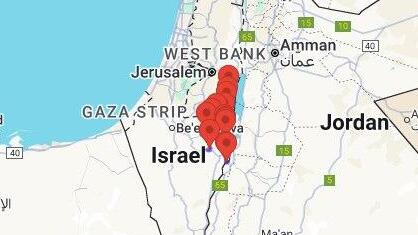
According to the Euro-Mediterranean Seismological Centre (EMSC), the epicenter was located about 19 kilometers (12 miles) from the southern city of Dimona, in the seismically active Dead Sea Rift Valley.
Earlier reports indicated the tremor was felt across wide areas of southern Israel, including Mitzpeh Shalem near the Dead Sea, the Ein Bokek hotel district, Arad, Neot HaKikar, Ein Tamar, the Rotem Industrial Zone, Neveh Zohar, Ein Gedi, Massada and the Ein Gedi Baths, as well as El For’eh and Kfar HaNokdim in the South Negev.
The Magen David Adom emergency medical service said it had received no reports of injuries or damage.
“My entire office shook, and our municipal emergency center collapsed,” Dimona Mayor Benny Biton described the moment of the quake. “I saw my chair shaking. We really felt the earthquake. There have been earthquakes here before, but this is the first time I truly understood what that means.”
Police said officers were deployed to areas where the tremor was felt to inspect buildings and public spaces for possible hazards.
Earthquake felt across southern and central Israel
(Photo: Cumta)
In the city of Beit Shemesh, where a nationwide emergency preparedness drill for schools was underway at the time, residents also reported feeling the earthquake. “By coincidence, a major earthquake drill was scheduled for this morning in Ramat Beit Shemesh D as part of national emergency preparedness week,” the municipality said in a statement. “Just minutes before the exercise began, a real earthquake, magnitude 3.9, originating from the Dead Sea, was felt across many cities, including Beit Shemesh.”
“I felt it for maybe two seconds, but it was unmistakable," Shlomo Kandiyati, a Beit Shemesh resident, told ynet. "I was sitting on the couch and the whole house shook. I got no alert, nothing. It happened at 9:01 a.m. Friends of mine in the city told me they experienced exactly the same.”
However, not all areas reported feeling the quake. The Ein Gedi company, located near the Dead Sea, said no tremors were felt at Kibbutz Ein Gedi, despite receiving an earthquake alert. “It’s the first time we’ve had an alert like this for an earthquake, but no one felt anything,” a spokesperson said.
Dr. Ron Avni, a seismologist at Ben-Gurion University, explained that the alerts likely came from the “Teruah” early warning system, which uses sensors along the Dead Sea Fault. “When an earthquake occurs, two types of waves are generated,” he told ynet. “The first are fast-moving P-waves, traveling at about five kilometers per second, and the second are the slower but destructive S-waves, at about 2.5 kilometers per second.”
“The early warning system detects the initial P-waves, which are not damaging, and sends alerts before the destructive waves arrive,” he added. “In a place like Arad, there may be less than 10 seconds of warning. In Tel Aviv or Haifa, you might have 20 seconds or more.”
The Dead Sea region is part of the geologically active Syrian-African Rift, which has a long history of mild to moderate seismic activity. A powerful 7.8-magnitude earthquake on the northern edge of the fault in southern Turkey in 2023 killed more than 56,000 people in Turkey and Syria.