

Nearly a week after Israel's October 27 election, the political deadlock appears no closer to resolution. Gadi Eisenkot, chairman of the Yashar! party and the leading candidate to receive the first mandate to form a government, faces five possible paths forward. At least four of them are far from what the former IDF chief of staff had envisioned before the election.
Yet while Eisenkot faces difficult decisions, Prime Minister Benjamin Netanyahu appears to have even fewer viable options for assembling a government, unless he can persuade elements of the rival bloc to join him. The paradox is that Eisenkot's attempts to break the deadlock could ultimately work in Netanyahu's favor.
Gallery
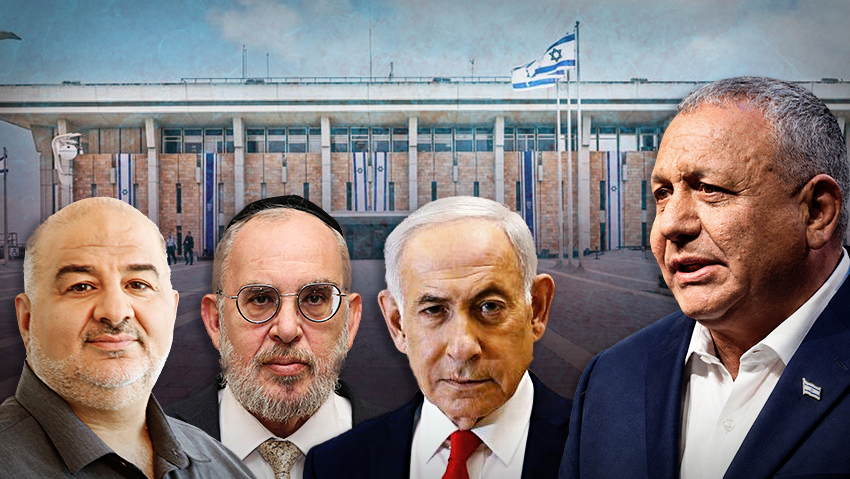
Eisenkot's impossible coalition equation: Haredim, Arabs or Netanyahu
(Photo: Ryan Preuss, Alex Donin / Shutterstock, Jack Guez/ AFP)
It is no coincidence that Eisenkot opened a lengthy statement Saturday night with the words "At a historic crossroads." Whichever path he chooses, forming a government may require him to break at least one campaign promise, whether by establishing a minority coalition or entering an alliance with ultra-Orthodox lawmakers and possibly members of the Arab Ra'am party. Even if he succeeds, the compromises could carry a considerable political cost in a future election.
Option 1: A government with United Torah Judaism, and possibly Ra'am
This is perhaps the scenario Likud fears most, and the one favored by Eisenkot's associates. But it would require him and his allies to abandon a central campaign pledge: the vision of an "alliance of those who serve," built around parties committed to expanding military and national service.
If Eisenkot pursues this route, he would have to negotiate directly with United Torah Judaism (UTJ), the ultra-Orthodox party whose lawmakers oppose compulsory military service for the population they represent. Some of its members describe their political worldview as anti-Zionist. At the center of any negotiations would be one of Israel's most divisive issues since the October 7 massacre: military conscription.
Throughout the election campaign, Eisenkot and his political partners made the issue a central priority. The Yashar! leader established a clear principle that only parties willing to advance military and national service for all Israeli citizens would be eligible to join his government. It is highly doubtful that UTJ would accept that condition.
Such negotiations could become a political trap. Any concessions Eisenkot makes could find their way into the media and later be used against him by Netanyahu and Likud, particularly if Netanyahu temporarily distances himself from his traditional ultra-Orthodox partners. UTJ, meanwhile, has refused to commit to recommending any candidate during the consultations with President Isaac Herzog later this week.
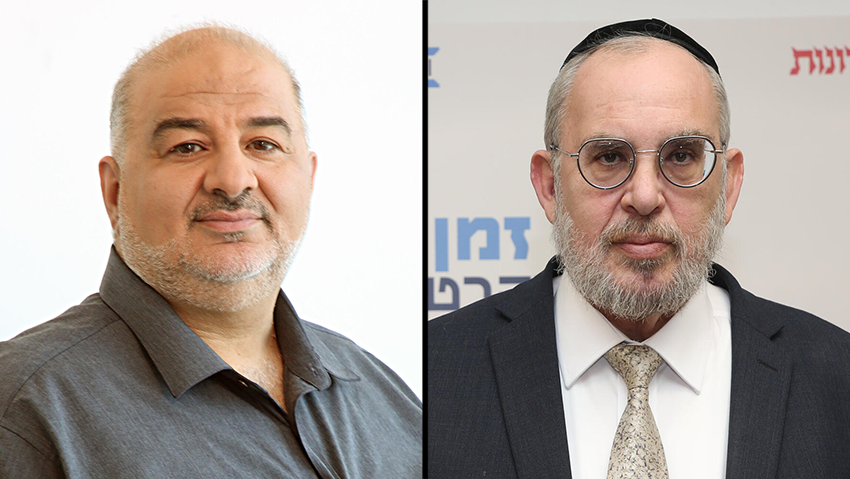
United Torah Judaism lawmaker Yaakov Asher and Ra'am chairman Mansour Abbas. Could an alliance with ultra-Orthodox and Arab parties undermine Eisenkot's campaign commitments?
(Photo: Ryan Preuss)
Even an agreement with UTJ may not be sufficient. Eisenkot could also need Arab parties to abstain from a crucial parliamentary vote, or potentially require Ra'am's active support to assemble a viable majority.
Likud officials are concerned about precisely such an arrangement. "Our fear is that a government with Arabs and Haredim, even with Shas's six seats, could last an entire term," a senior Likud official told ynet in the past 24 hours.
Another obstacle would be Yisrael Beiteinu chairman Avigdor Lieberman, a senior member of Eisenkot's political bloc. Lieberman promised during the campaign that he would not sit in a government with ultra-Orthodox or Arab parties, and reiterated that position after the election.
Eisenkot could therefore force Lieberman into an uncomfortable choice: break his own campaign pledge to remove Netanyahu from power, or risk sending Israel back to the polls.
Option 2: A minority government relying on Arab parties
This scenario would require Eisenkot to negotiate with Arab parties despite having promised not to establish a government with them.
In the political climate following October 7, it is doubtful that large sections of the Israeli public, particularly voters who supported Naftali Bennett's Beyachad party or Lieberman's Yisrael Beiteinu, would readily accept a government dependent on Arab parliamentary support.
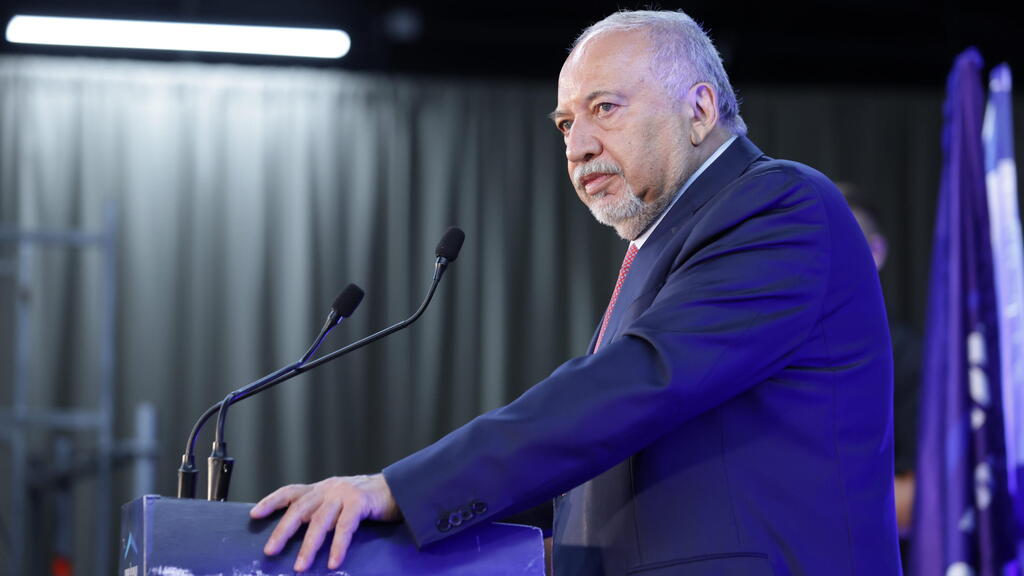
Yisrael Beiteinu chairman Avigdor Lieberman, whose opposition to both ultra-Orthodox and Arab parties could complicate coalition negotiations
(Photo: Oz Mualem)
Even if Eisenkot pursued the arrangement, something his associates currently deny is under consideration, and persuaded his political partners to support it, the resulting government could be highly unstable and potentially short-lived.
Netanyahu could emerge as the political beneficiary. Voters who opposed him in the election but rejected an Eisenkot government relying on Arab parties might reconsider their allegiance in a subsequent vote.
The prime minister began campaigning against the possibility of a government backed by Arab parties on election night, following their unprecedented electoral success. His messages on X have largely been short and direct. "You must not form a government with them," he wrote Sunday.
For now, this is Eisenkot's least preferred scenario, and figures within his bloc give it little chance of succeeding.
One of its leading advocates is Democrats chairman Yair Golan, who argues that the broader anti-Netanyahu bloc commands 67 Knesset seats when the Arab parties are included. Golan says the opposition must rethink its approach and cooperate with them.
His preferred formula would bring Ra'am into the coalition while relying on outside parliamentary support from the Joint List.
Option 3: A unity government under Netanyahu, or a rotating premiership
Only days before the election, Eisenkot declared in a recorded interview that he would not serve under Netanyahu in any political arrangement. "If that happens, I will resign an hour later," he said.
Joining a Netanyahu-led government would carry enormous political risks, particularly among voters who backed Eisenkot and his partners specifically to bring the prime minister's tenure to an end.
The cautionary example is Benny Gantz, Eisenkot's former political partner, whose electoral standing suffered dramatically on two occasions after joining Netanyahu.
The first came during the COVID-19 pandemic, when Gantz entered a unity government in 2020. His Blue and White party subsequently fell from more than 30 Knesset seats to a single-digit result in the 2021 election.
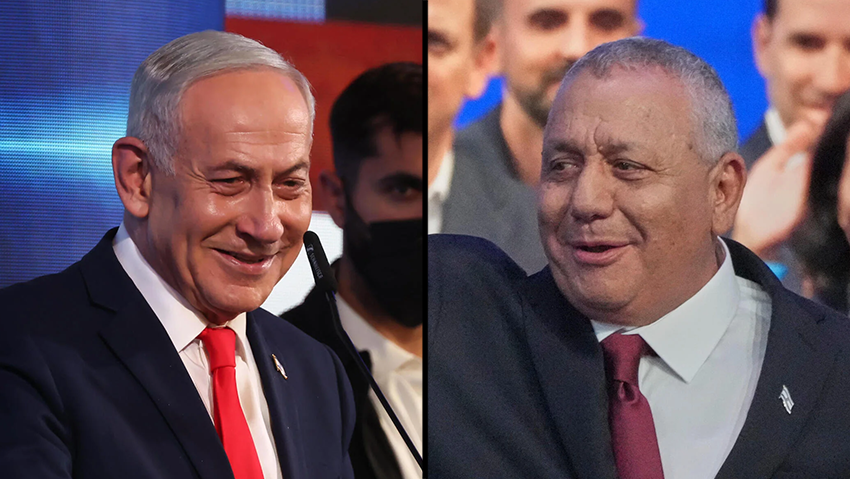
(Photo: AP/ Ariel Schalit, Chris McGrath/Getty Images)
The second came after the October 7 massacre, when Gantz joined Netanyahu's emergency government while enjoying strong public support. His polling numbers later collapsed from nearly 40 projected seats to below the electoral threshold, ultimately prompting him to withdraw shortly before the 2026 election.
"Be Rabin, not Gantz," veteran Arab lawmaker Ahmad Tibi urged Eisenkot after the election, an apparent warning about the political fate of those who enter unity arrangements with Netanyahu.
Eisenkot would not be the only leader facing a broken promise. All his political partners have pledged not to serve with Netanyahu, making it unclear who would follow Eisenkot into such an arrangement.
Lieberman has already rejected a unity government, just as he has ruled out both a minority government relying on Arab parties and a partnership with the ultra-Orthodox. Golan also categorically opposes unity with Netanyahu.
Yair Lapid and members of his faction would be expected to end their partnership with Bennett if such a government were formed, given Lapid's consistent opposition to serving alongside or under Netanyahu.
A unity deal could therefore fracture the anti-Netanyahu bloc or dismantle it entirely. Furthermore, Netanyahu could potentially bring down the government at a politically advantageous moment, leaving Eisenkot to bear much of the electoral damage, just as Gantz did.
Another unresolved question is whether Netanyahu wants such a government at all. A senior Likud official told ynet Saturday night that the chances were already slim because "the concessions are too great."
Nevertheless, ynet has learned that Netanyahu was asked in private conversations about the possibility of a rotating premiership in a unity government. "We are examining everything. I am not completely ruling out any option," he replied.
There may still be a limited political benefit for Eisenkot in attempting this route. If he offers unity and Netanyahu rejects it, Eisenkot could present himself to the public as the responsible leader who sought a compromise while his rival refused.
Option 4: Another election
If none of the first three scenarios materializes, Israel could once again face an election, despite President Isaac Herzog's repeated appeals to political leaders to avoid another vote.
The possibility of US President Donald Trump intervening to encourage a unity government has also been raised, particularly one that excludes National Security Minister Itamar Ben-Gvir's Otzma Yehudit party.
Eisenkot himself has declared that "another election would be a mistake." Behind that statement lies a widely shared political assessment that Netanyahu's bloc could benefit from a second round.
The reasoning is straightforward. Over the coming weeks, Eisenkot may become embroiled in countless negotiations, political maneuvers and public disputes. To move closer to forming a government, he could be forced to compromise on his promises not to cooperate with the ultra-Orthodox, Arab parties or Netanyahu himself.
Even unsuccessful negotiations could provide material for a future Likud campaign, allowing Netanyahu to portray Eisenkot and his allies as politicians who abandoned their commitments when the opportunity to govern arose.
There is also uncertainty about whether the unusually high turnout recorded in the October election would be repeated. Israelis living abroad who traveled to vote might be less willing or able to make the journey again, while overall participation could also decline.
But Netanyahu's most immediate advantage would be simpler: he would remain prime minister while the political system struggled to form an alternative government.
For an incumbent facing the possibility of losing office, additional time can itself be a valuable political asset.
Option 5: Using the ‘clear parliamentary majority’ against Netanyahu
Even if Eisenkot cannot form a government, he may still have an opportunity to use the new Knesset's composition to advance key legislation before another election.
In a statement Saturday, Eisenkot pledged to make use of what he called the "clear parliamentary majority" opposed to Netanyahu.
That could mean establishing a state commission of inquiry into the October 7 massacre, repealing legislation associated with the government's judicial overhaul and potentially advancing a new military service framework, provided there is sufficient time and parliamentary support.
Eisenkot is currently working to secure recommendations from other parties ahead of Herzog's consultations, scheduled to begin Wednesday, November 4. Senior figures in the anti-Netanyahu bloc say it is particularly important that the Yashar! chairman receive the first opportunity to form a government.
One senior figure outside Eisenkot's party warned Sunday: "If the entire bloc does not recommend Eisenkot, all the judicial overhaul laws passed by the current coalition will take effect on January 1, 2027, as stipulated by law."
The warning refers to legislation concerning the attorney general's office, the Police Internal Investigations Department and changes to the composition of the Judicial Selection Committee.
Under the opposition bloc's plan, receiving the first mandate could help Eisenkot and his allies secure control of the Knesset's Arrangements Committee, which oversees parliamentary procedures during the formation of a new government.
The bloc hopes to use that position to advance two particularly consequential moves: replacing the Knesset speaker and overturning the judicial overhaul legislation before its scheduled implementation. Both would require sufficient parliamentary cooperation and votes.
Bennett's Beyachad party announced Sunday that it would recommend Eisenkot to Herzog as its candidate to form the next government. Figures in the anti-Netanyahu bloc also expect the Democrats to back him.
The remaining uncertainty concerns Lieberman, who has yet to publicly commit to a candidate and has not clarified his intentions even in private discussions among the opposition leaders.
That leaves Eisenkot approaching the presidential consultations with a considerable advantage in potential recommendations but no clear route to a governing coalition.
For Netanyahu, the situation is hardly ideal. His own parliamentary bloc lacks the numbers to form a government without new partners. Yet as long as Eisenkot cannot reconcile the conflicting demands of his allies, the prime minister could continue to benefit from the deadlock.
The immediate question is whether Eisenkot can turn the opposition's parliamentary strength into a workable government. If he cannot, the next battle may be over what the new Knesset can accomplish before Israel is drawn into another election.