


Israel's final television election polls have delivered a clear but politically complicated verdict: former military chief Gadi Eisenkot's Yashar party is ahead of Prime Minister Benjamin Netanyahu's Likud, yet neither the opposition nor Netanyahu's allies are projected to secure the 61 seats needed to form a government.
The three surveys, published Friday by Kan 11, Channel 12 and Channel 13 ahead of Tuesday's October 27 election, give the bloc seeking to replace Netanyahu a lead of between two and six seats. With about 7.3 million Israelis eligible to vote, the results point to another potentially difficult round of coalition negotiations, and possibly even another election if no governing majority emerges.
Gallery
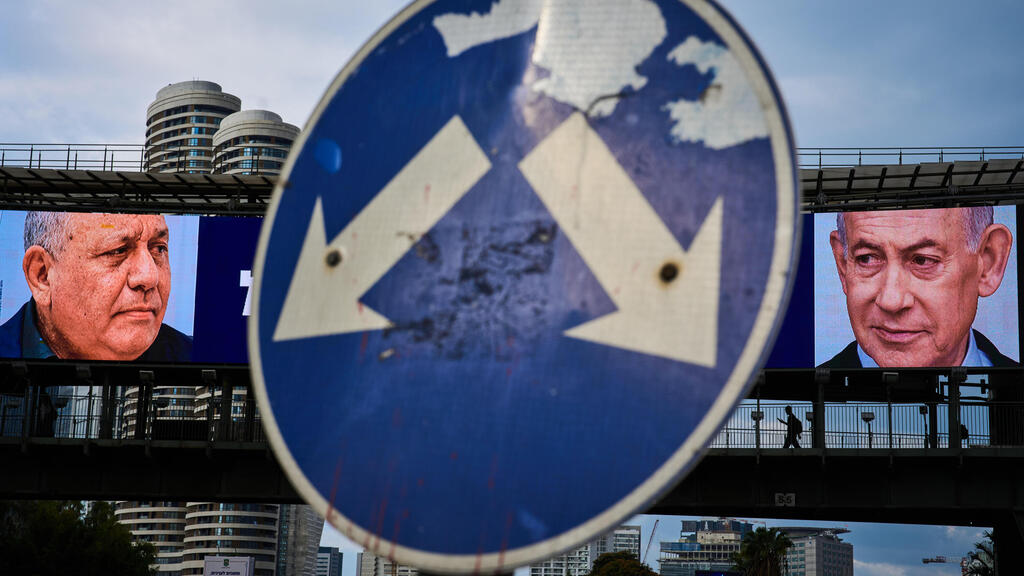
The anti-Netanyahu bloc leads in the final election polls but falls short of a 61-seat majority without support from Arab parties
(Photo: AP Photo/Oded Balilty)
All three networks project Netanyahu's right-wing and religious bloc winning exactly 50 seats in the 120-member Knesset, while the opposition's so-called change bloc receives between 52 and 56 seats. The Arab parties, which are not counted as part of either bloc, are projected to win between 14 and 16 seats.
How the political blocs are divided
Kan 11 projects 52 seats for the opposition bloc and 50 for Netanyahu's allies. The Arab parties receive another 14 seats, while the Reservists-Economic Party, led by Yoaz Hendel and Yaron Zelekha, wins four seats that are not assigned to either major bloc.
Channel 12 gives the opposition its strongest showing, with 56 seats compared with 50 for Netanyahu's bloc. The Arab parties receive 14 seats.
Channel 13 predicts a narrower opposition advantage of 54 seats to 50, with the Arab parties winning 16 seats.
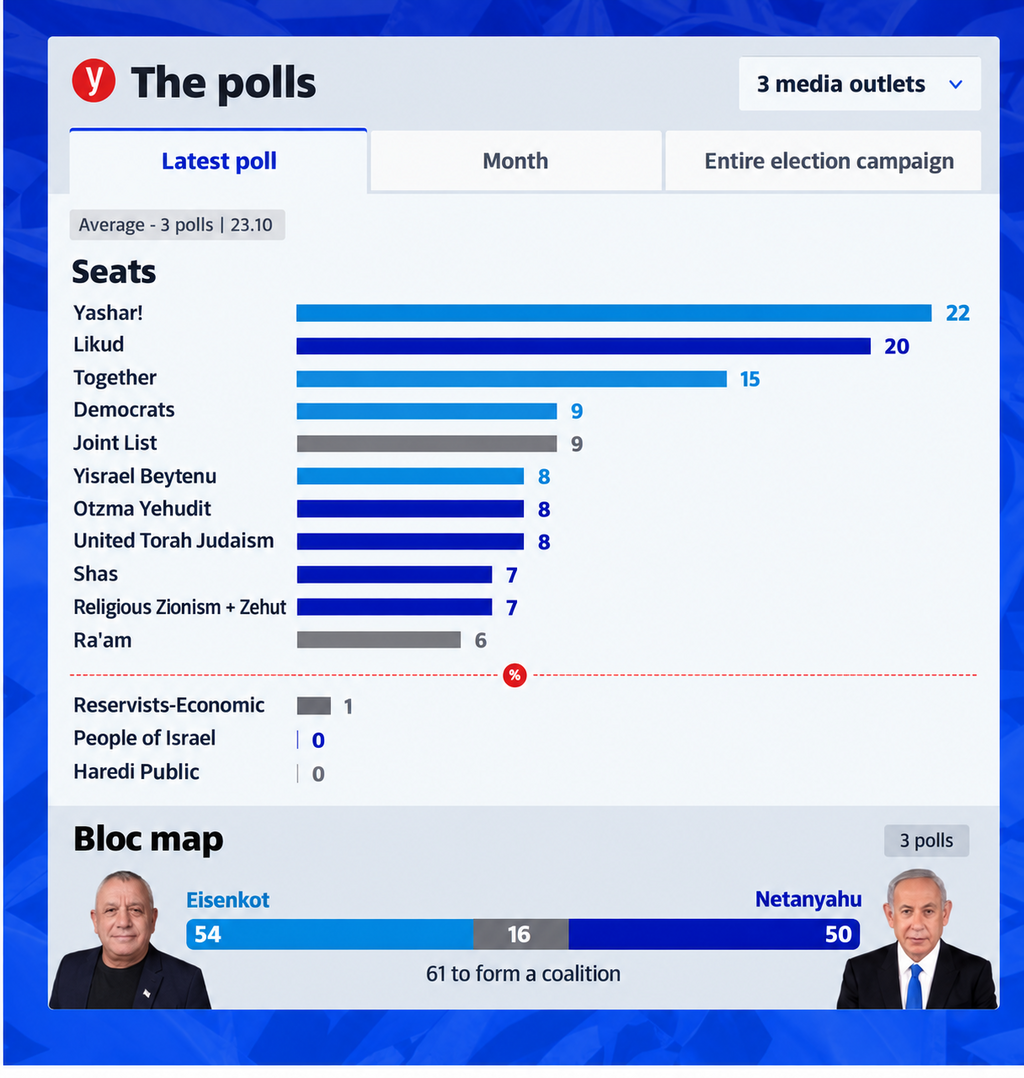
The figures highlight the central challenge facing both camps. While the opposition leads in all three surveys, it remains short of a majority without additional parliamentary support. The Arab parties could therefore become pivotal, although their projected strength does not automatically translate into support for an opposition-led government.
Eisenkot, a former IDF chief of staff, emerges as the leader of the largest party in all three polls. Yashar wins 22 seats in the Kan 11 survey, 23 in Channel 12 and 22 in Channel 13.
Likud follows with 20, 21 and 19 seats, respectively, while former prime minister Naftali Bennett's B'Yachad, or Together, comes third with 14, 15 and 14 seats.
The electoral threshold could decide the outcome
Beyond the rivalry between Eisenkot and Netanyahu, one of the biggest uncertainties concerns smaller parties struggling to cross Israel's 3.25% electoral threshold, the minimum share of valid votes required to enter the Knesset.
Former IDF general Ofer Winter's People of Israel party, known in Hebrew as Amcha Yisrael, falls below the threshold in all three surveys. It receives 2.9% in Kan 11's poll, 2.5% in Channel 12's and 3.1% in Channel 13's, coming closest to entering parliament in the latter survey.
The joint Reservists-Economic Party, headed by former minister Yoaz Hendel and economist Yaron Zelekha, faces a similarly uncertain future. While Kan 11 projects it winning four seats, Channel 12 puts its support at just 2.4% and Channel 13 at 3.0%, both below the threshold.
The Haredi Public party, led by Moti Leitner and seeking support among ultra-Orthodox voters, also remains well below the cutoff, receiving between 0.5% and 1.3% across the three polls.
The consequences could be substantial. Votes cast for parties that fail to cross the threshold do not translate into parliamentary representation. Depending on which parties fall short, the resulting redistribution of seats among those that qualify could alter the balance between the rival political camps.
The poll of polls: Eisenkot leads with 22 seats
A combined picture based on the three television polls places Eisenkot's Yashar first with 22 seats, followed by Netanyahu's Likud with 20 and Bennett's B'Yachad with 15.
The Democrats, led by Yair Golan, and the Arab-majority Joint List, headed by Yousef Jabareen, each receive nine seats in the published composite.
Three parties receive eight seats apiece: Avigdor Liberman's Yisrael Beytenu, Itamar Ben Gvir's Otzma Yehudit and United Torah Judaism, led by Yaakov Asher.
Aryeh Deri's Shas and Bezalel Smotrich's Religious Zionism-Zehut alliance each receive seven seats, while Ra'am, the Arab party led by Mansour Abbas, receives six.
Winter's People of Israel and Hendel and Zelekha's Reservists-Economic Party both fall below the threshold in the overall assessment, although the latter retains a residual average of approximately one seat because it crosses the threshold in one of the three surveys. That statistical remainder does not mean the party is projected to enter parliament.
The complete results from the three television polls
Kan 11 poll
Yashar: 22 seats; Likud: 20; B'Yachad: 14; Joint List: 9; Democrats: 8; Otzma Yehudit: 8; Yisrael Beytenu: 8; United Torah Judaism: 8; Shas: 7; Religious Zionism-Zehut: 7; Ra'am: 5; Reservists-Economic Party: 4.
Below the electoral threshold: People of Israel, 2.9%; Black Color, 0.8%; Haredi Public, 0.7%.
The survey was conducted by Kantar, headed by Dudi Hasid, among 1,006 respondents, with a reported sampling margin of error of 3 percentage points.
Channel 12 poll
Yashar: 23 seats; Likud: 21; B'Yachad: 15; Democrats: 10; Joint List: 9; Shas: 8; Yisrael Beytenu: 8; Otzma Yehudit: 8; United Torah Judaism: 7; Religious Zionism-Zehut: 6; Ra'am: 5.
Below the electoral threshold: People of Israel, 2.5%; Reservists-Economic Party, 2.4%; Haredi Public, 0.5%.
The survey was conducted by the Midgam polling institute, headed by Mano Geva, in cooperation with iPanel. It included 1,018 respondents and had a reported sampling margin of error of 4.4 percentage points.
Channel 13 poll
Yashar: 22 seats; Likud: 19; B'Yachad: 14; Democrats: 10; Joint List: 9; United Torah Judaism: 8; Yisrael Beytenu: 8; Religious Zionism-Zehut: 8; Otzma Yehudit: 8; Shas: 7; Ra'am: 7.
Below the electoral threshold: People of Israel, 3.1%; Reservists-Economic Party, 3.0%; Haredi Public, 1.3%.
The survey was conducted by HaMadad, headed by Shmuel Rosner and Noah Slepkov, together with Stat-Net, the Midgam Project and Asakria, with additional data from Hive and statistical advice from Professor David Steinberg. It included 1,875 respondents and had a reported sampling margin of error of 2.3 percentage points.
Could Israel face another election?
The final surveys leave considerable uncertainty over Israel's next government, with both political camps facing obstacles to building a workable parliamentary majority.
The outcome could change significantly depending on voter turnout, particularly among supporters of smaller parties, and on how many votes ultimately go to lists that fail to enter parliament.
Last-minute shifts in voter preferences could also reshape the final distribution of seats, while party leaders may find themselves under pressure to reconsider commitments made during the campaign if coalition negotiations reach a deadlock.
For now, the three television polls show Eisenkot's party leading the race, but winning the largest number of seats is not the same as securing the premiership. The decisive question on October 27 will be not only which party finishes first, but which political leader can assemble the 61 lawmakers needed to govern.