

U.S. President Donald Trump reignited a deeply sensitive debate in Britain over the weekend when, during a turbulent visit to Ireland, he openly backed the reunification of the Republic of Ireland with Northern Ireland, which remains part of the United Kingdom.
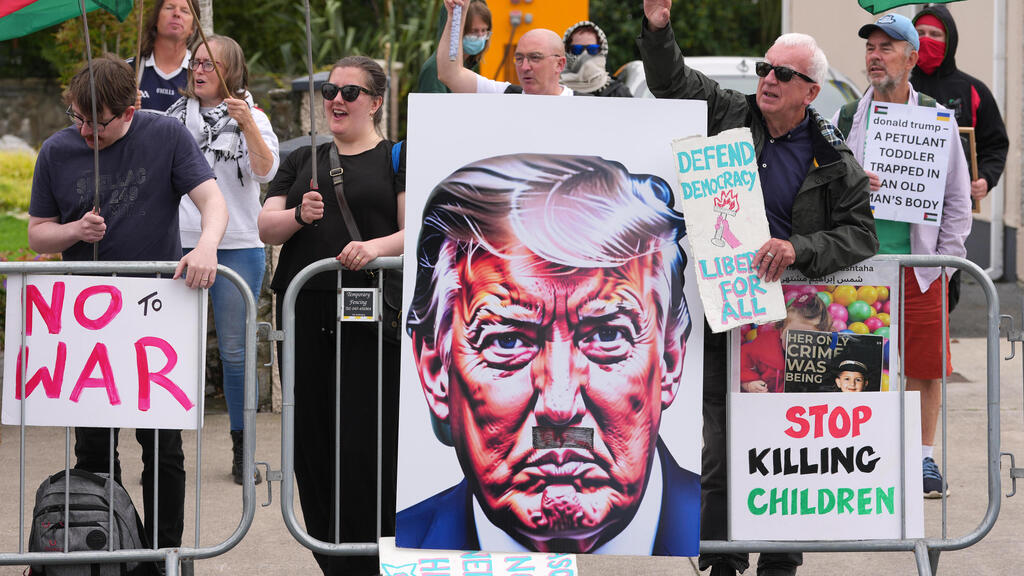
The visit was also marked by large anti-Trump and pro-Palestinian demonstrations, including crude displays depicting Prime Minister Benjamin Netanyahu and Russian President Vladimir Putin performing sexual acts with an inflatable figure of Trump, apparently intended to portray the two leaders as controlling him.
The obscene sexual puppet display targeting Trump and Netanyahu in Ireland


Thousands of protesters carrying Palestinian flags gathered in Dublin, where signs declared that Trump was not welcome and accused him of enabling what demonstrators described as genocide in Gaza.
Trump, meanwhile, used the two-day visit to depart from Washington’s longstanding neutrality on one of the most politically charged questions in British and Irish politics.
During a meeting with Irish Prime Minister Micheál Martin on Saturday, Trump said he would “love to see a united Ireland.”
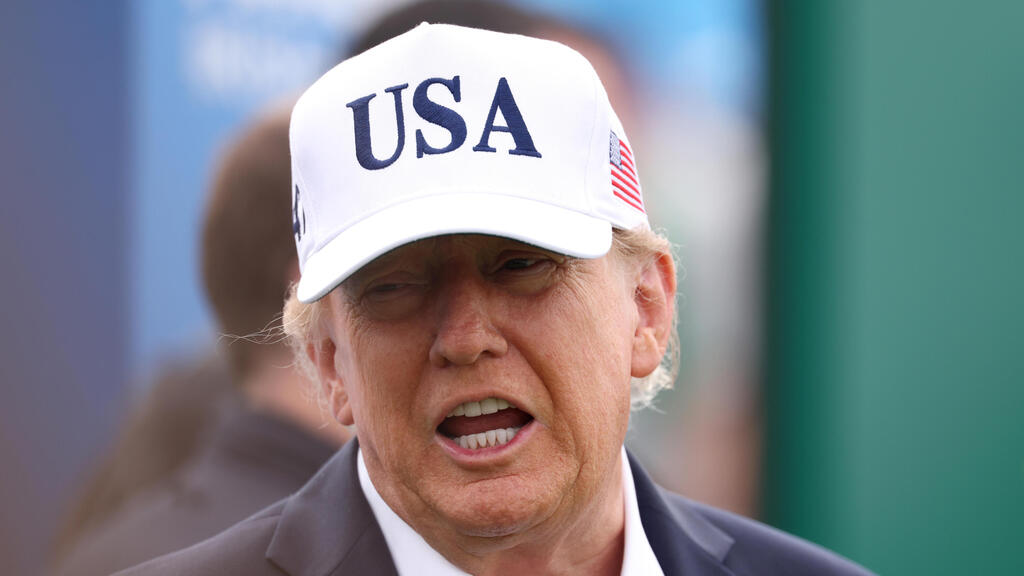
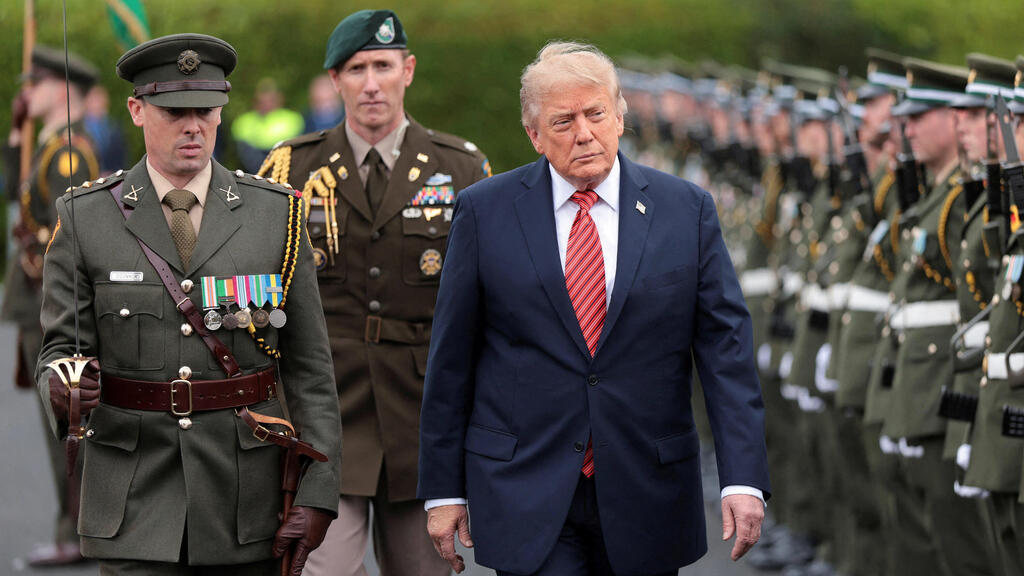
(Photo: REUTERS/Kylie Cooper)
A day later, speaking at his Doonbeg golf resort, Trump doubled down on that position.
“I've always loved the people of Ireland. It just seems to me you have Northern Ireland and Ireland,” he told reporters.
“It seems that one of the naturals of all time is to put them together.”
“That's only my opinion, and by the way many people agree,” Trump added, describing his earlier comments as “a fairly routine comment.”
Asked about Scottish independence, Trump declined to take a position, saying: “I won't talk about Scotland yet. I will save that.”
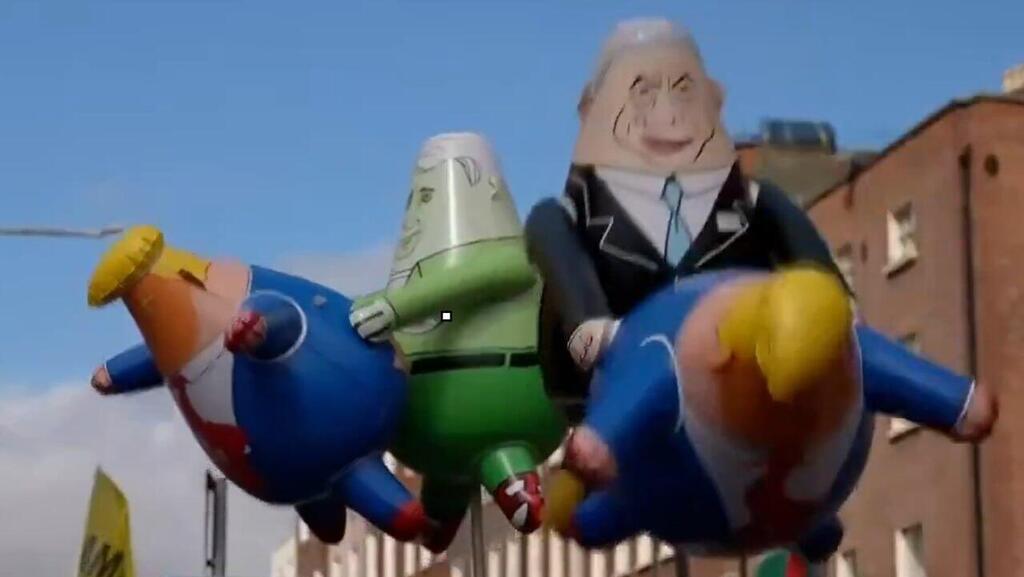
U.S. President Donald Trump during his visit to Ireland; protest display depicting a sexual act with Netanyahu
A sensitive break with US tradition
Ireland has been divided since 1921 between the independent Republic of Ireland and Northern Ireland, which forms part of the United Kingdom alongside England, Scotland and Wales.
For decades, Northern Ireland was engulfed in sectarian conflict between mainly Protestant unionists who wanted to remain within Britain and largely Catholic nationalists seeking reunification with Ireland.
About 3,500 people were killed during the period known as the Troubles before the 1998 Good Friday Agreement largely ended the violence.
Under that agreement, a referendum on reunification can be held if the British government determines that a majority in Northern Ireland appears likely to support it.
Successive U.S. administrations have generally avoided taking sides on whether such a referendum should ultimately lead to reunification.
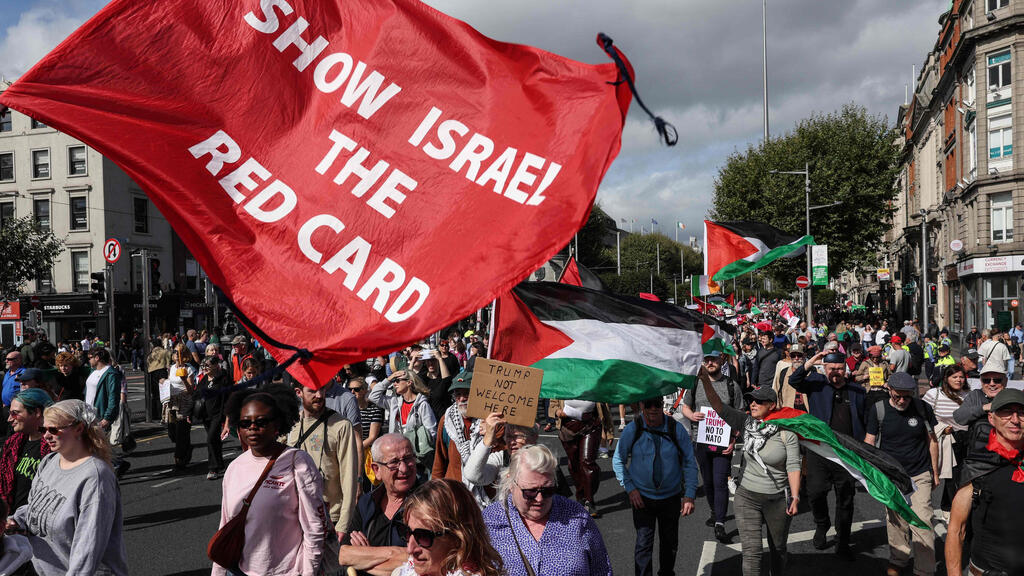
(Photo: Adrian Dennis / AFP)
(Photo: AP Photo/Kin Cheung)
Trump’s comments therefore immediately attracted attention in Britain, particularly because British Prime Minister Andy Burnham said only last month that a referendum was not currently on the agenda.
Asked about Burnham’s position that there would be no vote until a majority in Northern Ireland appeared likely to back reunification, Trump replied: “Everybody says that and then things happen.”
Burnham’s spokesman pointed reporters to the prime minister’s statement in parliament last week that Britain remained “100% committed” to the Good Friday Agreement.
Democratic Unionist Party leader Gavin Robinson rejected Trump’s position, writing on X: “As unionists, we have no interest in the destruction of our country by joining the Irish Republic.”
It remains unclear whether Trump’s remarks represent a formal shift in U.S. policy or were simply an expression of his personal view.
Martin played down the controversy, saying Trump’s stance had not surprised him.
“He believes unity is the logical way for the island to be configured and organised,” the Irish prime minister said, adding that some of the reaction had been an “overreaction.”
Supporters of Irish reunification are nevertheless likely to seize on Trump’s remarks as evidence that international attitudes may be shifting.
The comments also come ahead of the U.S. midterm elections in November. Roughly one in 10 Americans identifies as having Irish ancestry, and while Irish Americans are not a unified voting bloc, support for reunification could resonate with some voters.
Anti-Israel protests greet Trump
Trump’s visit unfolded amid a massive security operation involving thousands of police officers and other security personnel, including snipers, with its cost estimated at about 20 million euros.
More than 10,000 people marched through Dublin on Saturday in opposition to the U.S. president, according to the BBC, with many carrying Palestinian flags and signs condemning Trump.
Some displays were considerably more provocative.
Protesters carried giant inflatable figures depicting Trump in sexual acts with Netanyahu and Putin, apparently intended as a commentary on their influence over the U.S. president.
Other demonstrators portrayed Trump as Adolf Hitler, accused him of being a warmonger and linked him to the Jeffrey Epstein affair. One display mocked his ambitions over Greenland using penguins.
A small group of black-clad masked protesters also burned an American flag.
“Trump is a warmonger,” said 19-year-old student Killian Whelan. “He has no right to be in my country. He should be put on trial.”
Ireland has emerged as one of Europe’s most outspoken critics of Israel during the Gaza war and one of its strongest supporters of the Palestinian cause.
Trump also met Irish President Catherine Connolly, a left-wing politician and fierce critic of the U.S. president.
Afterward, she said she had expressed what she described as the Irish public’s firm opposition to the normalization of war and genocide, referring to Israel’s actions in Gaza.
Britain’s separatist debate gathers momentum
Trump’s comments came at an especially sensitive moment for the United Kingdom.
The leaders of nationalist parties in Scotland, Wales and Northern Ireland were due to meet Monday in Cardiff for what has been described as a “separatist summit.”
Scottish National Party leader John Swinney, Plaid Cymru leader Rhun ap Iorwerth and Sinn Féin Vice President Michelle O’Neill are expected to sign a memorandum calling for referendums on the constitutional futures of Scotland, Wales and Northern Ireland.
The gathering underscores the broader political pressures facing the union at the same moment the U.S. president has publicly endorsed Irish reunification.
Trump received a much warmer reception away from the protests, particularly at his golf resort in Doonbeg, where local residents and business owners praised the jobs and economic activity generated by the property.
But his visit ultimately left behind two political controversies extending well beyond Ireland: renewed debate over the future of the United Kingdom and another highly visible demonstration of anger over his close alignment with Israel during the Gaza war.