


A former Wisconsin gynecologist and fertility specialist is facing a civil lawsuit accusing him of secretly using his own sperm to inseminate a patient more than four decades ago, without her knowledge or consent.
“I feel like I was raped,” Mary Ellen Lukaszewicz said after learning what she alleges happened during fertility treatment in the early 1980s.
Gallery
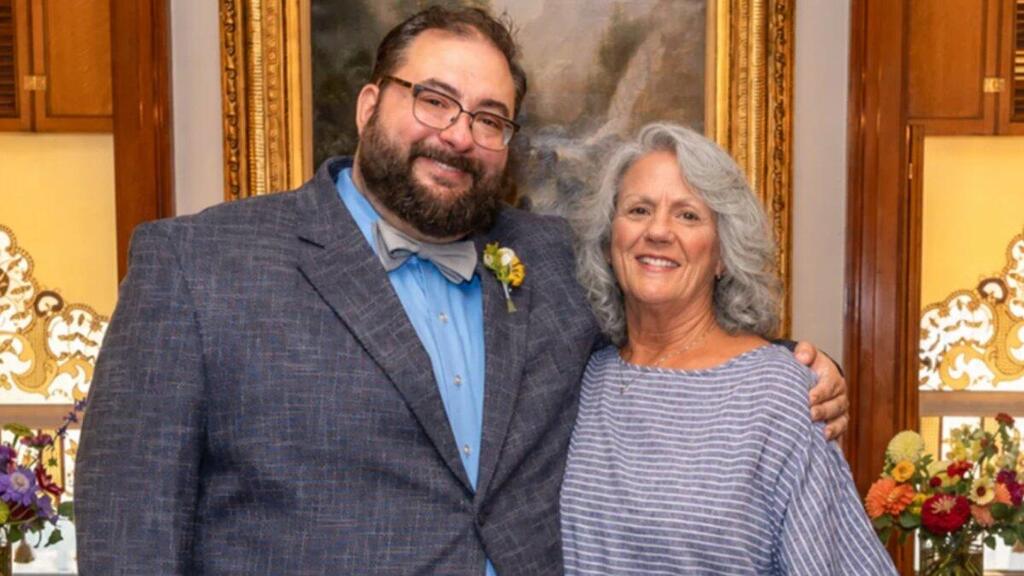
Mary Ellen Lukaszewicz and her son, Joseph Laedtke Hyder, who was allegedly conceived using the doctor’s sperm
(Photo: Laedtke family)
The lawsuit was filed August 6 in Milwaukee County Circuit Court by Lukaszewicz and her son, Joseph Laedtke Hyder, against Dr. Frederick Dettmann, who practiced for decades in Whitefish Bay, near Milwaukee.
According to the complaint, Lukaszewicz and her husband, Thomas Laedtke, who died in 2005, struggled to conceive. In 1980, when she was 25, she turned to Dettmann, her gynecologist, for fertility treatment.
She says Dettmann proposed artificial insemination using sperm from an anonymous donor described as a young, healthy medical student. Lukaszewicz agreed, became pregnant in 1982 and gave birth to Joseph on February 13, 1983.
For more than 40 years, neither mother nor son had reason to question that account.
That changed in late 2024, when Joseph submitted a DNA sample to a genealogy service. The results, received in December, showed nine previously unknown half-siblings. After examining the matches, he says he traced the connection to Dettmann’s family and ultimately identified the doctor as his biological father.
“The anonymous donor, the medical student my mother was promised would be my biological father, never existed,” Joseph said at a family news conference in June.
“There are no words to describe what it is like to learn that your entire identity is built on a lie,” he said, adding that the alleged deception came from “a doctor who took an oath to do no harm.”
Joseph said the discovery was particularly painful because of what it meant for his mother.
“As difficult as this has been for me, more than anything I think about my mom,” he said. “She was a young woman who wanted nothing more than to become a mother.”
The lawsuit alleges Lukaszewicz would never have consented had she known Dettmann intended to use his own sperm. She and her son are seeking damages to be determined in court.
Lukaszewicz said she hopes speaking publicly will encourage other women with similar experiences to come forward.
“It’s not right,” she said. “And I want other women to feel comfortable coming forward and talking about it.”
Nine half-siblings raise broader questions
The discovery of nine half-siblings has raised the possibility that other former patients may have had similar experiences.
Attorney Al Foeckler, who represents the family, said several people contacted him after the allegations became public in June and described what they characterized as uncomfortable interactions with Dettmann dating back to the 1970s.
He did not say how many people had contacted him and did not claim they had all undergone insemination using the doctor’s sperm.
“I have absolutely no doubt that this man was a serial predator of women,” Foeckler said.
The family has urged former Dettmann patients who underwent fertility treatment and later discovered unexpected relatives through genetic testing to contact them.
The case has also brought renewed attention to a separate allegation from the 1980s.
On August 19, 1985, a man contacted Whitefish Bay police and alleged that his wife had been sexually assaulted during a gynecological examination by Dettmann. The doctor denied the allegation.
According to police records cited by local media, an assistant district attorney decided the following day not to file charges, concluding that meeting the burden of proof would be difficult. The state medical board reviewed the matter in April 1986 and closed it without further action.
Whitefish Bay police said additional records from that period no longer exist because they were destroyed under the record-retention rules in effect at the time. Police said in June there was no active criminal investigation against Dettmann.
Wisconsin business records cited in local reports show that his practice was registered in 1976 and dissolved in 1997. His attorneys said he stopped actively practicing medicine in the early 1990s.
Dettmann, now in his 90s, lives in Scottsdale, Arizona. Local media reported that he has held an Arizona medical license since 1997, though they found no indication that he practiced medicine there. A reporter who went to his home seeking comment said he did not answer the door.

(Photo: Shutterstock)
Through attorney Sean Gaynor, Dettmann disputes the allegations.
Gaynor said the alleged events took place nearly 50 years ago and that Dettmann has “no independent recollection” of the people making the claims and is unaware of evidence supporting them.
He also said that before the current lawsuit, Dettmann had never been sued, disciplined, investigated, had his license challenged or been the subject of an ethics complaint.
The ‘Wild West’ of fertility treatment
The case is part of a broader wave of alleged fertility fraud cases uncovered in the United States through home DNA testing.
One of the best-known involved Indiana fertility doctor Donald Cline, whose case was featured in the Netflix documentary Our Father. Genetic testing revealed decades later that Cline had used his own sperm to inseminate multiple patients without their knowledge.
Prof. Arthur Caplan, a medical ethics expert at New York University’s Grossman School of Medicine, said it is difficult to determine how widespread such practices were because, before consumer genetic testing, patients and their children had little practical way to identify the true source of donor sperm.
He described fertility medicine in the 1980s as a regulatory “Wild West,” with far less oversight than exists today.
“This isn’t just unethical,” Caplan said. “It’s lying to someone and using your sperm when you said you were going to use somebody else’s sperm.”
“You’re also not meeting what we call the standard of care. It’s absolute medical malpractice.”
If the allegations are proven, he said, the conduct would also represent a fundamental breach of patient autonomy and informed consent.